Frequently, data warehouse problems start with data being distributed across multiple systems. Current businesses collect tons of information not just from sales and financial operations, but also from their customers’ interactions with them. Data Warehouse provides companies with a single repository for data to be used for reporting and analysis.
Companies don’t need to switch between the spreadsheets and individual databases, and instead have one trusted source of truth. However, analysis of that data can be slow and inconsistent when they’re not combined.
This causes bad decisions to be made and their decisions to take longer. A modern data warehouse addresses these challenges by integrating data, providing AI capabilities to derive insights and features, and providing business-wide visibility. Beyond that, The Business Research Company had released a market report that revealed that the data warehousing market has grown at a fast pace.
This is expected to rise from $37.42 billion in 2025 to $43.48 billion in 2026 at a compound annual growth rate or CAGR percentage of 16.2%. It is quite an uptrend and reflects the importance structured data management has become for modern organizations.
This requires businesses to invest in efficient data warehouse solutions that can provide meaningful, reliable data all in one place and in an organized format to facilitate faster decision-making. The article delves into the latest data warehouse architectures and deployment strategies, focusing on the process of these innovations provide scalable analytics, data quality, and AI preparedness.
Key Takeaways
A Data Warehouse is the system that enables consolidating and organizing business data from several systems, to provide business functions with reliable information to report, analyze the history, and build faster strategies for the company.
An efficient data warehousing systemis designed and implemented using defined data architectures and designs, which gather data, transform data, store that data, and present it to the end users for scalable data analysis, and BI.analytics, AI readiness, and stronger support for informed business decisions.
The advantages of data warehouses are vast, such as scalability, better quality data, real-time analytics, AI readiness, and robust support for making informed business decisions.
ScaleOcean ERP integrated 360-degree system automates data consolidation, assists with AI forecasting, ensures secure & scalable growth, and improves data warehouse management.
A data warehouse is a single repository that holds structured data from many data sources across the business that is used for reporting, analytics, and business decision-making. It is optimized for performance, to handle quick queries and the last few years’ historical analysis, and not daily transaction handling.
A data warehouse tends to be in a table format and contains both current and historical data that is highly optimized for queries. They consume transactions and logs from source records and process them, clean, join, and display a processed and coherent data set for analysis and interpretation. They are deliberately designed to be able to handle complex queries on large sets of data, whereas transactional databases can’t.
A data warehouse represents a single point of data for data from ERP, CRM, and other enterprise systems. One example of common data warehouse use is data from the point of sale system that can be joined with accounting transaction data and customer data into a single analytics platform.
Data onboarding tools are used to load the data into the Data warehouse and make sure that it contains accurate and structured data that can be analysed well for getting the insight. This makes it possible to view trends through time, compare departments, and utilize AI design for predicting trends.
History of the Data Warehouse
The idea of a data warehouse originated in the 1980s as an early “business data warehouse” described by IBM researchers Barry Devlin and Paul Murphy, for enterprise reporting needs. This concept has been embraced since the 1990s through the influence of some pioneers, including data warehousing “father” Bill Inmon.
Inmon was the one who stated that the data warehouse is a “subject-oriented, integrated, nonvolatile, time-variant” collection of data to support management decisions, and he formalized that definition at that time.
These four characteristics continue to be elemental. As time passed, data warehouse technology developed from on-premise technologies to encompass cloud and hybrid solutions. Today’s warehouses combine big data and artificial intelligence skills and features, but the need to organize the enterprise information for analysis has become no less important.
How Does Data Warehousing Work?
The structure of data warehousing consists of three levels: collection level, process level, and presentation level, which can be stored by the system with better efficiency. One architecture – from the bottom to the top:
These layers combine to gather raw data from different sources, convert and structure it into useful data, and finally provide meaningful information to end users. Knowing these layers can help paint a picture of the different ways that data centers can help organizations with comprehensive and timely data decision-making.
Bottom Tier
This layer captures raw data from operational systems (ERP, CRM, flat files, web logs, and so on) in a staging area. The data extracted from the sources is cleaned, deduplicated, applied to business rules, etc., and loaded into the data storage in ETL/ELT processes.
The lowest layer filters and guarantees the quality and consistency of the data that goes into the warehouse. Common examples of retail data warehouses involve consolidating information from different sales channels into a unified data repository that can be structured.
Middle Tier
In this case, the cleaned data is stored in the central warehouse database, prepared for data analysis. Typically aggregated together is an OLAP (Online Analytical Processing) engine or SQL analytics engine, which pre-aggregates data and enables fast multi-dimensional queries.
To accelerate the solutions that are modern ones, make use of what is referred to as distributed computing or massively parallel processing (MPP). This design allows for querying the warehouse fast and without affecting the source systems.
Top Tier
The top tier is reporting and analytics tools (dashboards, BI platforms, data science notebooks) used by end users to access the warehouse. The layer that is finally rendered contains user interfaces for data interrogation and visualization.
Analysts and business users leverage these tools for reports, charts, and dashboards from the warehouse. At this stage, popular BI tools, such as Power BI, Tableau, and Looker, can plug in and transform raw warehouse data into actionable data.
The three-tier design decouples concerns for improved scalability and performance. Processing and delivery of data happens at the top, efficient collection and preparation at the bottom, and storage at the middle, providing enterprise-wide analytics.
An example of top-tier data warehousing isPT Bukaka Inti Aircon, made up of several businesses that deal in HVAC systems and sell, install, and offer after-sales services. Their premise covers Singapore and Indonesia, and they are taking care of their operations by using the ScaleOcean ERP software across various departments, from Sales, Service Order, Inventory, Finance, to Field Service Tracking.
PT Bukaka Inti Aircon’s data warehouse combines data from these different sources:
Field Service: Job costing, Technician performance, Service timelines.
Management can take these datasets together and see patterns that would not be seen in separate systems. The ScaleOcean ERP modules capture and store all transactional data and sales orders, service jobs, invoice records, inventory movements, and customer information, all in one system.
Data Warehouse Deployment Models
There are several ways businesses can deploy data warehouses, catering to various requirements and conditions. Depending on your infrastructure, budget, and analytical requirements, these deployments offer various possibilities for storage location, control, and access to your data.
These deployments tend to correspond to various sorts of data warehouse strategies, as per infrastructure and compliance requirements.
On-Premises/Traditional
Traditionally, the Warehouse runs on the company’s servers and data centres. The business owns the hardware, database, and updates. While this allows maximum control over the data, it also incurs greater initial investment in hardware/software, maintenance, and limited scalability.
Cloud Data Warehouses
The warehouse is now cloud-based, including Google BigQuery, Snowflake, and Amazon Redshift capabilities. These types of Cloud Tech-based Data Warehouses are serverless and offer amazing benefits. They can be very large (up to a petabyte in size), can be expanded to virtually any size without needing significant arrangements or causing outages, and free up IT staff from routine tasks.
By shifting the storage for The Home Depot’s warehouse to Google Cloud BigQuery, in some cases, the company has been able to expand its capacity from 450 terabytes to over 15 petabytes, increasing both cost effectiveness and performance. Warehouses based on cloud data tend to be extremely flexible and scalable, and are automatically enriched with updates from sources at low administrative effort.
Hybrid Approaches
Hybrid is a mix of on-prem and cloud computing. New or large-scale analytics workloads can be deployed in the cloud, and sensitive/sheltered data can be kept on-site. By doing this, businesses can utilize the benefits of cloud scalability while transitioning to another cloud location in the event of a failure. This is a great way to leverage the scalability of the cloud environment without relocating.
For instance, financial records can be kept on site due to the compliance they provide, while market data about customers can be gathered and stored in a cloud warehouse. When implementing cloud services or responding to regulatory requirements, flexibility in a hybrid design becomes essential. Effective Master Data Management (MDM) also helps ensure data remains accurate, consistent, and accessible across both on-premise and cloud environments.
What Are the Three Schemas in a Data Warehouse?
There are three types of schema: Star, Snowflake, and Galaxy. These fact and dimension tables can be designed in several different ways, and they all have some compromises in terms of simplicity, usability, and performance for queries with complex relationships.
Efficient organisation of data is crucial to enable faster and more accurate analysis of the data in the data warehouse. To accomplish this, the data warehouses employ this kind of schema design for storing data and also how it is related.
Access to these schemas helps to design an organization’s analytical schemas for use in the organization’s unique needs in the context of its data warehouse. This is a summary of the different types of schemas and their functions:
Star Schema
The star schema consists of one fact table (with metrics such as total sales) with multiple dimension tables (such as Product, Time, and Customer) that are denormalized. This is the way that the layout is created in a “star” shape.
Each one of these individual dimension tables is then connected to the fact table, and the star schema does not have to be rigid and does not need to be a complex one, but is very efficient in effectively performing queries. For instance, a Sales DW would be required to have a Fact Sales table and dimensional tables related to Product and Date.
Snowflake Schema
A snowflake schema is a schema that creates several tables that are related to the dimension tables. For example, a Customer dimension could reference a different City dimension, and a City dimension to Country.
The advantage of this hierarchical “snowflake” structure is that there is no duplication (writes, where the drawback is that there are more joins). There is great flexibility in handling complex hierarchies on Snowflake schemas. For instance, more than one level of location, product category, etc. They can save space, but are more complex to query.
Galaxy Schema
Another variant of a galaxy schema, a fact constellation, is more than one fact table sharing dimension tables. Take into account two (or more) star schemas linked together via a common dimension. For instance, there might be two Course Attendance / Exam Scores fact tables, which share the dimension tables for Student and Course.
This design enables the pursuit of a multi-process analysis. In general, galaxy schemas consist of a collection of multiple fact tables, all related to different areas of business activity (e.g., Sales, Inventory), and all of which use the same dimensions as tools to analyse the data from different processes.
Characteristics of a Data Warehouse
A data warehouse is designed to support business intelligence and decision-making by providing a reliable, consistent, and comprehensive repository of organizational data. To fulfill this role effectively, data warehouses possess key defining characteristics that distinguish them from other data storage systems.
These core properties ensure that the warehouse organizes, integrates, and preserves data in ways that facilitate meaningful analysis and reporting.
Subject-Oriented
Data is organized around subjects (like customers, products, sales) rather than specific applications. This makes it easier to analyze particular business areas. For example, all customer-related data (orders, inquiries, support) would be integrated for holistic customer analysis.
Integrated
Data from multiple source systems is cleaned and unified. This includes consistent naming conventions, formats, and units. For instance, product codes from different departments would be reconciled into one master code. Integrated data ensures that reports across divisions use the same definitions.
Time-Variant
Historical data is kept (often for many years). Every record is tagged with time (day, month, year). This allows trend analysis, such as year-over-year sales or seasonal patterns. A warehouse retains snapshots of data, for example, monthly snapshots of inventory. so that users can analyze how metrics change over time.
Nonvolatile
Once data is entered into the warehouse, it is not frequently changed. Data loading happens in batches, and the warehouse is read-only for analysis queries. This stability ensures that reports are reliable and that a “snapshot” of data is preserved for audit and BI purposes.
Together, these characteristics make the data warehouse a trusted single source of truth for enterprise-wide analytics. By structuring data in this way, businesses can confidently base strategic decisions on comprehensive, consistent, and time-aware information.
Components and Architecture of a Data Warehouse
A well-designed data warehouse relies on a combination of essential components and architectural frameworks to efficiently collect, store, process, and deliver data for business intelligence and analytics.
These elements work together to ensure that data from diverse sources is integrated, cleansed, and made accessible in a way that supports timely and accurate decision-making.
Understanding the key building blocks and common architectural approaches helps businesses design a data warehouse that meets their specific needs in terms of scalability, performance, and usability.
ETL/ELT Tools
The Extract-Transform-Load process (or Extract-Load-Transform) is core to warehousing. These tools connect to sources, clean and merge data, and populate the warehouse. Popular ETL/ELT platforms, like Informatica, Talend, Azure Data Factory, etc., automate this. They ensure data quality by handling tasks like deduplication and conforming data.
API Layer
An API or data integration layer can enable real-time feeds and microservices. For example, webhooks or data APIs might push new transactions into the warehouse on demand. An API layer allows applications to query or update the warehouse programmatically.
Data Layer/Central Database
This is the warehouse database itself (on-premise SQL server, Oracle, or cloud MPP database like BigQuery, Redshift). It stores the cleansed, integrated data. This layer often uses a columnar or optimized storage format for fast analytics.
Sandbox
A sandbox or data mart layer provides a staging space for data scientists. Users can experiment with raw data subsets without affecting the main warehouse. This sandbox might be a separate schema or workspace where teams can query large data in different ways.
Access/BI Tools
Front-end tools connect to the warehouse for reporting. These include dashboards, OLAP clients, SQL query tools, and data science notebooks. They provide the user interface for generating insights.
Simple
A simple data warehouse architecture involves loading data directly from source systems into the warehouse. This approach is easy to set up and works well for small-scale projects. However, it offers limited control over data cleaning and transformation, which can affect data quality and consistency.
Simple with Staging Area
A more common design includes a dedicated staging layer. Data is first loaded into staging tables (often on the central server), where transformations and loading logic run. The final data is then moved from staging to the main warehouse tables.
Hub-and-Spoke
In this hybrid model, an enterprise data warehouse (hub) feeds multiple downstream data marts (spokes). Each spoke might serve a department (finance, sales, etc.) with a subset of data optimized for that group. The hub-and-spoke architecture balances centralized integration with flexible departmental access.
Together, these components and architectural strategies create a cohesive system that ensures data flows seamlessly from the sources to the end users. By leveraging these designs, businesses can maximize the value of their data assets, enabling deeper insights, faster analytics, and more informed decisions across the enterprise.
Types of Data Warehouses
There are several types of data warehouse solutions, each tailored to meet specific organizational needs and analytical goals. Choosing the right type depends on factors such as the scope of data, the intended users, and the nature of the analysis required.
Understanding the common types of data warehouses helps businesses select the best approach to consolidate, manage, and analyze their data effectively. The main types include Enterprise Data Warehouses, Operational Data Stores, and Data Marts, each serving distinct purposes within the overall data architecture.
Enterprise Data Warehouse (EDW)
This is a centralized, organization-wide warehouse that holds all of an enterprise’s data. An EDW provides a unified platform for analytics across departments. It’s usually subject-oriented and designed for strategic decision support.
For example, a company might use an EDW to gather all sales, finance, HR, and operational data for top-level reporting.
Operational Data Store (ODS)
An ODS is a lighter-weight data store that holds current, near-real-time data for operational reporting. It is updated frequently and used for routine queries, such as current inventory levels.
The ODS is usually a complement to the EDW, as it provides up-to-date data for managers, whereas the EDW focuses on historical analysis. For instance, an ODS might track today’s transactions and feed relevant data into the EDW later.
Data Mart
A data mart is a subset of the data warehouse, usually oriented to a specific business line or department. It contains a focused view of data for quick analysis, for example, a finance data mart or marketing data mart.
Data marts improve performance and usability for end users by providing only the relevant data. In design, a data mart can be fed from the central EDW or built independently using key data extracts.
Data Warehouses vs. Other Data Storage Types
Choosing the right data storage architecture is critical for business performance and scalability. While many organizations use databases, data lakes, or data marts, each system serves a different purpose. A data warehouse stands out because it is specifically designed for structured analytics and enterprise reporting.
However, confusion often arises when businesses compare these technologies. Some assume a database can handle advanced analytics at scale, while others believe a data lake can replace a warehouse entirely.
In reality, each solution supports different workloads and data structures. Understanding these differences helps companies build a more efficient and future-ready data strategy.
Comparison: Data Warehouse, Data Mart, Data Lake, Data Lakehouse
Understanding the differences between data warehouses, data marts, data lakes, and data lakehouses is essential for choosing the right data storage and analytics solution. Each of these platforms has unique characteristics, advantages, and use cases that suit different business needs.
This comparison will help clarify how they differ in structure, purpose, and functionality, enabling organizations to make informed decisions about their data strategy.
Types
Advantages
Primary Use
Data Type
Schema
Data Warehouse
Centralized, consistent, high-performance for queries
Enterprise reporting and BI
Structured (cleansed, integrated)
Predefined schema (star/snowflake)
Data Mart
Centralized, consistent, high-performance for queries
Departmental analytics (finance, sales)
Structured (departmental)
Predefined (often star schema)
Data Lake
Handles massive raw data (structured/unstructured); flexible, cost-effective
Data science, ML, streaming analytics
Raw, unstructured & structured
Schema-on-read (no fixed schema)
Data Lakehouse
Combines lake and warehouse features (SQL + ML); supports ACID & open formats
Unified analytics platform (both BI and ML)
Both structured and raw
Flexible schema (supports SQL/Parquet)
Each data storage solution serves a different purpose depending on business goals, data complexity, and analytics needs. While they may seem similar at first glance, their architecture, data handling approach, and primary use cases differ significantly.
To understand which one best fits your business, let’s take a closer look at each type and how it functions in practice.
Data Warehouse vs. Data Mart
An enterprise data warehouse covers the whole business, whereas a data mart serves a single department. A data mart is essentially a smaller version of a warehouse that contains only the specific data needed by one team (for example, finance). Data marts are faster and cheaper to build, but lack the broad view of an enterprise warehouse.
In practice, data marts may draw data from the main warehouse or from source systems. They allow a business unit to analyze data quickly without sifting through all enterprise data.
Data Warehouse vs. Database
A traditional database is optimized for transactional processing (OLTP), whereas a data warehouse is optimized for analytical queries (OLAP). Databases handle day-to-day operations, focusing on insert/update performance. In contrast, data warehouses handle large-scale read queries, often performing complex joins and aggregations.
For example, an operational database might record each sale, while the warehouse stores consolidated sales history for trend analysis. Because of this, data warehouses often use denormalized schemas and columnar storage to speed up analytics.
Data Warehouse vs. Data Lake
Data warehouses store processed, structured data ready for analysis, while data lakes hold raw data (structured, semi-structured, and unstructured). Warehouses enforce schemas on write, ensuring data quality and consistency.
Lakes, by contrast, use schema-on-read, allowing any data to be stored flexibly. Lakes excel at big data tasks like machine learning and log analytics, whereas warehouses excel at standard BI reporting.
For example, a data lake can ingest raw IoT sensor feeds and text documents, while the warehouse contains cleaned sales and customer records. Many businesses use both, and they may store streaming or unstructured data in a lake, then ETL a curated subset into the warehouse for reporting.
A data lakehouse bridges the gap by adding warehouse-like features (SQL support, ACID transactions) to a data lake, enabling unified analytics on diverse data.
Data Warehouse vs. Data Lakehouse
A data lakehouse is essentially a hybrid of a lake and a warehouse. It keeps data in a lake storage layer but adds metadata, schemas, and analytics capabilities similar to a warehouse. A data warehouse is more rigid but highly optimized for BI.
A lakehouse offers flexibility to handle raw data and advanced analytics (including ML) while still providing structured query support. In practice, a lakehouse lets companies run both traditional reporting and machine learning on the same platform.
As one source notes, lakehouses increasingly blur the lines, allowing SQL analytics directly on lake data without pre-aggregation.
Data Warehouse Benefits and Advantages
Implementing a data warehouse offers numerous advantages that can significantly enhance an organization’s data management and decision-making capabilities. By consolidating data from multiple sources into a single, reliable repository, data warehouses enable faster, more accurate analysis and reporting.
This centralized access to integrated and historical data supports better insights, improved operational efficiency, and more informed strategic planning. The benefits extend across various business functions, helping companies gain a competitive edge in today’s data-driven environment.
The application of data warehouse systems extends beyond reporting into AI, forecasting, and real-time monitoring. Below are the data warehouse’s benefits and advantages:
Built to Scale
They are built to handle very large datasets. Modern warehouses (especially cloud-based) can scale from gigabytes to petabytes easily. For example, Google’s BigQuery allows adding processing capacity without downtime, so companies can grow usage quickly. This built-for-scale design means queries and storage grow gracefully as data increases.
Better Uptime
Cloud warehouses eliminate maintenance windows. In a modern system, adding capacity does not interrupt service. For instance, after moving to BigQuery, Home Depot reported “no service interruptions when capacity is added,” meaning analysts never wait for infrastructure upgrades. This ensures 24/7 access to data for business users.
Operating Savings
By consolidating data into one platform, businesses can reduce redundant systems. Cloud warehouses use commodity storage and charge based on usage, often lowering the total cost of ownership.
In fact, using a cloud warehouse can cut up-front hardware investment and management labor. Companies also benefit from predictable pricing models. Home Depot, for example, adopted a flat-rate billing for BigQuery, which allowed cost predictability and ensured unused capacity could serve any team.
Improved Data Quality
A warehouse’s ETL process cleans and standardizes data, improving consistency and accuracy. This means analysis is built on trusted information. Data is reconciled into a “single source of truth,” making cross-departmental reports reliable.
For example, combining finance and sales data in one warehouse eliminates mismatched formats or duplicate records, yielding higher data integrity.
AI and Machine Learning Initiatives
Modern data warehouses natively support AI/ML workloads. They allow data scientists to run machine learning directly on production data without complex data movement. For example, Google’s BigQuery offers in-database ML and AutoML so analysts can build models against the warehouse tables.
This shift reflects broader ERP trends where AI-driven analytics is becoming a core business capability. This integration of AI means companies can rapidly develop predictive insights. By contrast, legacy warehouses often force exports to specialized systems for ML, introducing delays. A modern data warehouse overall streamlines these initiatives.
Real-Time Analytics
With powerful engines and real-time loading, warehouses can deliver up-to-the-moment insights. Businesses can feed streaming data into the warehouse and get instant access.
For example, after moving to BigQuery, Home Depot began analyzing application performance data across its stores in real time, something that was impractical on the old system. This ability to monitor and respond quickly drives agility.
Cost Predictability
As noted, many cloud warehouses use fixed or pay-as-you-go pricing. This predictability helps budgeting. Teams can allocate a fixed compute budget and not worry about unpredictable spikes. BigQuery’s flat-rate pricing, for example, ensured Home Depot could forecast costs and share capacity across projects.
Overall, warehouses are designed to deliver fast, reliable analytics at scale, while cutting operational overhead. They make data-driven initiatives (BI, AI, real-time monitoring, etc.) more efficient and consistent.
A data warehouse delivers the most value when it is supported by an integrated operational system. ScaleOcean complements this foundation through a 360-degree ERP platform that captures structured data from across the business in real time. As a result, reporting stays consistent and reliable as the company grows.
If you want to strengthen your data strategy, it is worth considering how an integrated ERP can enhance warehouse performance. Discover how ScaleOcean can help you build a more connected and scalable data environment and request a free demo today.
What Is a Data Warehouse Used For?
The application of data warehouse technology plays a vital role in modern businesses by supporting analytics, reporting, and strategic planning.
Its ability to integrate, store, and organize large volumes of data from multiple sources makes it an essential tool for driving informed decision-making, improving operational efficiency, and enabling advanced analytics.
From real-time decision support to machine learning, data warehouses transform raw data into actionable insights that help companies stay competitive and responsive in dynamic markets. Below are some of the key business uses for data warehouses.
Making Real-Time Decisions
By providing up-to-date data, warehouses support timely decision-making. For instance, executives can view live sales and inventory dashboards during peak hours to adjust promotions on the fly. With a real-time data warehouse, fraud detection systems can flag suspicious transactions immediately.
Consolidating Siloed Data
One of the main uses is to bring together data from across the enterprise. Sales, marketing, finance, operations, all their data can be combined in the warehouse. This unified view removes data silos and enables holistic analysis.
For example, a retail chain centralizes its sales and customer data in a warehouse to understand how inventory levels affect revenue, something that would be hard if those systems were separate.
Enabling Business Reporting and Ad Hoc Analysis
Data warehouse powers dashboards and reports. Finance teams generate quarterly reports, marketing teams analyze campaign ROI, and operations teams study supply chain metrics using warehouse data.
Because the data is already cleaned and integrated, reports are faster to create. Data analysts can run ad hoc queries across years of data. For example, “compare this year’s sales trend by region”, without waiting for disparate teams. As one source notes, data warehouses make it easier to pull large datasets from multiple sources to support analytics.
Enabling Machine Learning and AI
Warehouses are the backbone of predictive analytics. They provide the historical data needed to train models (for forecasting, customer churn prediction, etc.). Companies often build ML models on warehouse data directly.
For example, Google BigQuery ML enables running SQL queries that train machine learning models in-place. As noted earlier, this eliminates data moves and accelerates AI initiatives.
In each case, the data warehouse turns raw business data into a strategic resource. It underpins data-driven strategies like advanced customer personalization, demand forecasting, and real-time operations monitoring.
What Are the Challenges of a Data Warehouse?
While data warehouses provide strong analytical capabilities, companies must address several operational and technical challenges during implementation and maintenance. Without proper planning, these issues can affect performance, scalability, and data reliability.
Complex implementation that requires careful data integration and system alignment.
High initial investment in infrastructure, tools, and skilled personnel.
Data quality issues occur if cleansing and governance processes are weak.
Performance bottlenecks may happen when handling very large datasets without proper optimization.
Ongoing maintenance and system upgrades that require continuous oversight.
Industry-Specific Data Warehouse Use Cases
Data warehouses play a crucial role in a wide range of industries by enabling tailored solutions that address unique business challenges and objectives. Different sectors leverage data warehousing to improve decision-making, optimize operations, and gain competitive advantages through data-driven insights.
Each industry demonstrates a practical application of data warehouse systems to solve sector-specific challenges. Understanding an industry-specific data warehouse example can highlight how organizations apply data warehouse capabilities to meet their particular needs and drive growth. Common examples include:
Banking
Banking is a strong data warehouse example, where institutions analyze millions of transactions to detect fraud and manage risk. For instance, they analyze transaction data across millions of accounts to spot unusual patterns and comply with reporting requirements.
Historical data in a warehouse helps with credit scoring, financial forecasting, and customer analytics. In addition, according to 360 Research Reports, about 18–20% of global data warehouse deployments are in the banking and financial services sector, reflecting a strong demand for analytics in risk management and compliance
Manufacturing
Manufacturers rely on warehouses to optimize supply chains and production. By integrating data from production lines, inventory systems, and sales forecasts, warehouses help identify bottlenecks and forecast demand. For example, analyzing years of production and failure data can enable predictive maintenance of machinery and prevent costly downtime.
Health care
Healthcare organizations use data warehouses to improve patient care and operational efficiency. They combine data from electronic medical records, lab results, and financial systems for analytics.
They can also support population health studies (identifying trends in patient outcomes) or financial analysis (reducing billing errors). A healthcare warehouse may also accelerate compliance reporting, for example, by reporting infection rates or vaccine coverage.
Public Center
Government agencies and public institutions use data warehouses to analyze citizen data and improve services. Examples include a city aggregating traffic, weather, and event data to optimize emergency response, or a school district analyzing student performance and attendance across years to guide curriculum decisions.
Warehouses in the public sector facilitate policy planning and transparent public reporting by consolidating cross-agency data.
These examples show that wherever organizations need to analyze large, complex datasets to drive decisions, a data warehouse can provide the necessary backbone.
Optimize Data Warehouse Management with ScaleOcean’s Solution
ScaleOcean’s ERP software integrates, automates, and provides real-time data visibility across your business. Managing a data warehouse is far more effective because ScaleOcean is directly connected to a 360-degree ERP solution.
As a result, operational data flows directly into a centralized data warehouse without manual consolidation or fragmented systems.
ScaleOcean also offers unlimited users with no hidden fees. Every staff member can input and access relevant data without restrictions. This ensures complete and accurate data capture across departments, strengthening reporting and analytics.
In addition, this all-in-one solution includes more than 200 modules and specialized features. Every aspect of the business is recorded in detail within the company’s data warehouse system.
The platform is suitable for industry-specific businesses with complex data structures and can be customized to match operational needs. Furthermore, it aligns with CTC grant requirements, supporting digital transformation initiatives in Singapore.
Key Features include:
Smart Integration: ScaleOcean connects data from production, finance, sales, and manufacturing into a single centralized data warehouse. Data stored across departments is combined in a structured location, enabling more complete and accurate analysis.
Customization and Scalability: Supports modular integration, allowing businesses to adjust features based on operational needs without using separate systems. Flexible server options, including cloud and hybrid, ensure scalability as data volume and complexity increase.
Data Security: Provides physical server security at the business location, combined with role-based access control. Includes fallback and cloud backup mechanisms to maintain data integrity during internet disruptions.
Predictive Forecasting: ScaleOcean delivers AI-based ERP capabilities that analyze historical data in the data warehouse. This enables accurate market demand forecasting, helping businesses plan production, inventory, and procurement proactively.
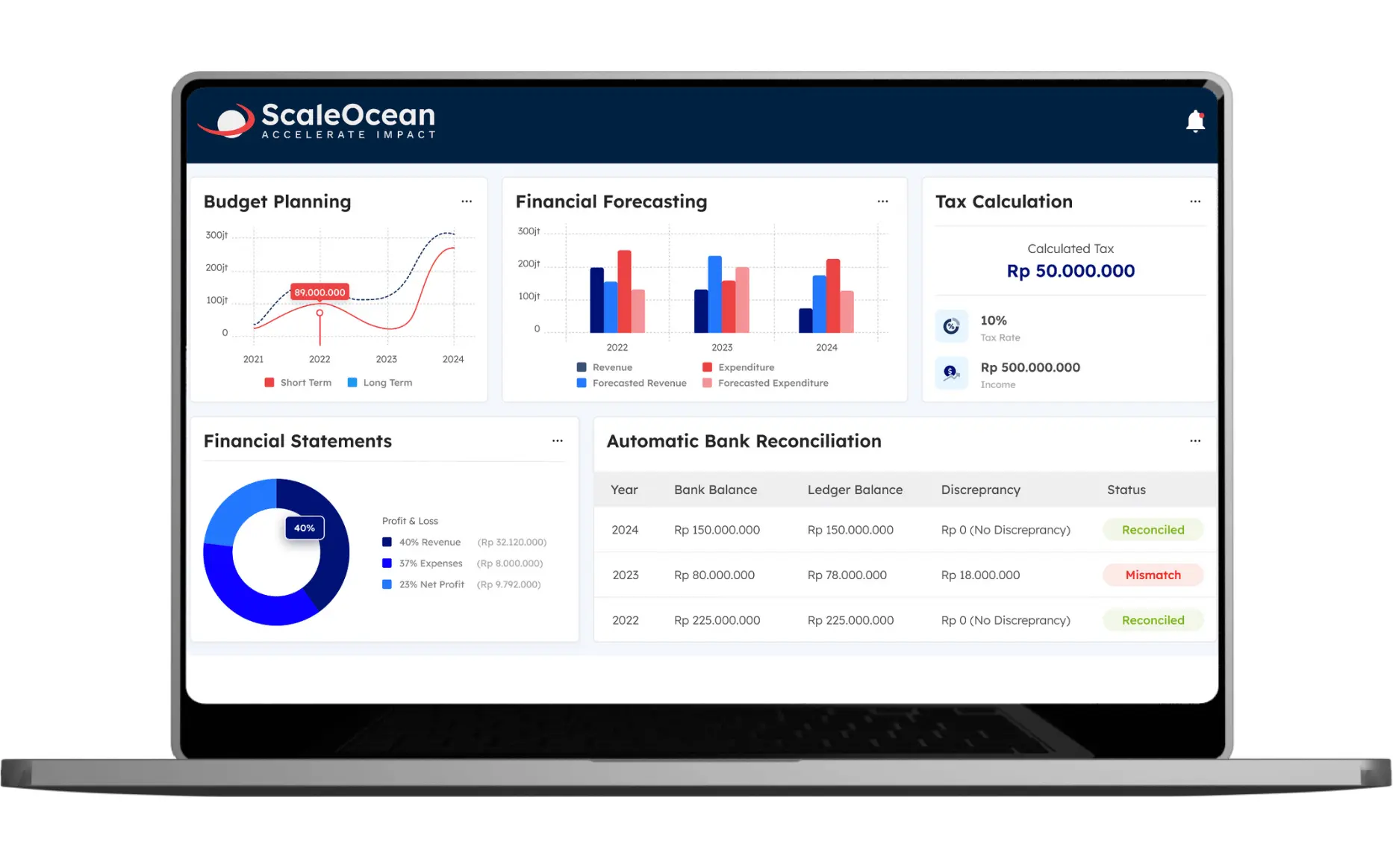
ScaleOcean’s user-friendly dashboards provide clear accounting and analytics views. By combining ERP and data warehouse capabilities, ScaleOcean enables companies to focus on growth instead of wrestling with data fragmentation.
Conclusion
A well-designed data warehouse is essential for business agility. It breaks down silos, ensuring all teams work from trusted data and can leverage AI/ML effectively. However, building and running a warehouse requires robust infrastructure and integration.
ScaleOcean’s integrated ERP and data solution lays a strong foundation by consolidating enterprise data from multiple sources into a single platform. It supports real-time analytics and is built for AI readiness, helping businesses streamline operations and adapt quickly to market changes.
With ScaleOcean, you gain a warehouse architecture that is scalable, reliable, and directly connected to your daily operations. Embracing these technologies allows your business to transform raw data into strategic insights, driving smarter decisions and sustainable growth.
To see how ScaleOcean can elevate your data management and analytics capabilities, request a free demo today and explore the benefits firsthand.
FAQ:
1. Is SQL a data warehouse?
No. SQL is a query language used to access and manage data. A data warehouse is a system that stores integrated data for analytics. Analysts use SQL to query the warehouse, but SQL itself is not a warehouse.
2. Is a data warehouse OLAP or OLTP?
A data warehouse is an OLAP system. It is built for analytical queries and large-scale reporting. OLTP systems handle daily transactions, while warehouses support analysis and business intelligence.
3. Can you give a data warehouse example?
Many companies use data warehouses for analytics. Netflix analyzes user viewing data to improve recommendations. Home Depot uses BigQuery to manage petabytes of customer data. Uber also relies on warehousing to analyze ride transactions and optimize operations.













 Key Takeaways