

International Financial Reporting Standards (IFRS) are globally recognized principles developed by the International Accounting Standards Board (IASB) to ensure financial reporting consistency and openness. Singapore accepted IFRS Standards with minor changes, resulting in the Singapore Financial Reporting Standards (SFRS).
According to PWC, as the deadline for IFRS-based climate reporting approaches, the SBF conducted a survey and roundtable with 40 small- and mid-cap companies to gauge their readiness. This aligns with Singapore’s adoption of IFRS, ensuring consistent and transparent financial reporting under SFRS.
This alignment enables Singapore enterprises to publish credible financial reports, which boosts investor confidence and facilitates cross-border operations. In Singapore, the Accounting and Corporate Regulatory Authority (ACRA) requires all publicly traded firms to follow SFRS, guaranteeing consistency with worldwide financial norms and improving the city-state’s status as Asia’s premier financial hub.
 Key Takeaways
- IFRS (International Financial Reporting Standards) is a comprehensive global set of accounting rules that govern global financial reporting.
- The Purpose and Benefits of IFRS include simplifying reporting with automated processes, standardized templates, and consistent, transparent financial statements, and more.
- Key Features of IFRS ensure global consistency, flexibility through principles-based standards, and are required for many entities to promote transparency and reliable reporting.
- ScaleOcean’s accounting system offers an innovative accounting system created exclusively for Singapore firms to ensure seamless compliance with IFRS.

1. What Are IFRS?
IFRS (International Financial Reporting Standards) is a comprehensive global set of accounting rules that govern global financial reporting. IFRS, which covers issues such as revenue recognition, leasing, and financial instruments, ensures consistency, transparency, and comparability in accounting methods across businesses and nations.
With over 140 nations adopting IFRS, including Singapore, it is the most widely accepted framework for international financial reporting standards. Within Singapore, companies would turn to ACRA (Accounting and Corporate Regulatory Authority) for help in ensuring compliance with regulations within the company
IFRS is the accounting standard that corporations in the European Union and other countries must adopt, showing its global relevance. In Singapore, IFRS adoption promotes transparency and comparability, which are critical for attracting foreign investment and sustaining the country’s competitiveness as a global financial hub.
2. IFRS Compliance in Singapore
In Singapore, the Accounting Standards Council (ASC) is in charge of overseeing the adoption and implementation of SFRS to ensure compliance with IFRS. The Accounting and Corporate Regulatory Authority (ACRA) monitors compliance and requires correct financial reporting, including the accurate management of accounts receivable.
Adherence to IFRS improves company credibility, facilitates access to foreign markets, and simplifies reporting for multinational firms based in Singapore.
According to Allen and Gledhill, beginning in FY 2025, the Singapore Exchange Regulation (SGX RegCo) will require climate-related disclosures that are consistent with the IFRS Sustainability Disclosure Standards, reinforcing Singapore’s commitment to global reporting rules.
3. Key IFRS Standards Relevant to Singaporean Companies

Singaporean enterprises must focus on numerous essential IFRS standards to ensure compliance with both local and international obligations. These Singapore financial accounting standards handle complicated financial reporting difficulties by establishing a systematic approach that improves accountability and investor confidence.
Proper adoption of these standards also makes audits easier and promotes financial transparency for stakeholders.
a. IFRS 16 – Leases
Recognition of lease assets and liabilities that provides a more comprehensive view of the company’s overall position.
This standard removed the classification of operating and finance leases for lessees, whereby all leases are brought onto the balance sheet. The ERP finance module can help automate and support this process to ensure latest accounting standards.
IFRS 16 increases the transparency of financial information for Singaporean firms with extensive leasing contracts, for example in the retail and logistics sectors. It also supports financial planning by providing a more realistic picture of a company’s long-term commitments.
b. IFRS 17 – Insurance Contracts
It provides a uniform reporting requirement for insurance contracts and improves compatibility. This standard introduces a standardized way to recognize revenues and measure liabilities for insurance companies by abolishing old ways.
For Singapore’s robust insurance industry (both foreign and local), IFRS 17 contributes to greater transparency in measuring risk and returns. It enhances investor confidence by assuring stakeholders that reported financial statements reflect the economic reality of the insurance contracts.
c. IFRS 9 – Financial Instruments
It governs the classification and measurement of financial assets and liabilities.
This standard establishes an expected credit loss model whereby the accounting for potential future credit losses of financial instruments is mandatory and also provides figures that may be used in calculating the leverage formula to gauge capital structure.
For Singaporean banks and financial institutions, IFRS 9 results in improved risk management due to more forward-looking credit loss provisions and increased financial statement transparency, as investors gain more insight into an institution’s credit and market risk when reviewing metrics such as the AP turnover ratio.
4. Purpose and Benefits of IFRS
The purpose of International Financial Reporting Standards (IFRS) is to provide a global framework of reporting standards, promoting transparency, consistency, and comparability of financial information across companies internationally.
By applying IFRS, businesses ensure they comply with international accounting standards, fostering investor confidence and better decision-making.
Below are some key benefits of IFRS that help in improving the reporting of companies concerning international standards:
a. Automated Reporting
The automated aspect of IFRS financial reporting saves time and resources. This system streamlines financial reporting processes, allowing firms to produce reports efficiently, thereby maintaining compliance with reporting standards promptly.
Companies benefit from reduced human error and increased efficiency, and can swiftly adapt to changes in IFRS without delay.
b. Standardized Templates
IFRS enables companies to prepare financial statements using standardized formats, allowing for uniformity and comparability in financial reporting. Stakeholders are then able to easily compare financial performance data across companies, providing greater ease in comparative analysis.
The standardization of reporting templates is a time-saving feature. Companies can spend their resources inputting correct information into the report rather than spending excessive amounts of time on formatting.
c. Transparency & Consistency Across Reports
The clarity of the IFRS standards ensures financial information is presented reliably and without ambiguity. This leads to stakeholders gaining the assurance that the company’s financial statements are accurate and dependable, for a higher degree of trust and confidence.
The consistency across reports that IFRS mandates ensures investors and regulators have a greater ability to compare data across company performance and industries due to the uniform presentation methodology.
d. Instant Access to Data
IFRS allows companies to have real-time access to financial data, and important stakeholders will always be aware of the business status. Having real-time access to precise and up-to-date financial data will mean that companies can react promptly to market changes and new trends as they develop.
With real-time access to financial data, it is also easier to maintain up-to-date records of a business’s performance. Having proactive access to a business’s financial status will mean that firms can identify problems with finance and correct these errors, rather than issues escalating into problems.
e. Global Consistency in Financial Language
One of the greatest advantages of IFRS is the common language of financial reporting that they are able to provide. Companies worldwide can report their financial performance in a language that is understood by global investors, and these allow global investors to compare financial data easily.
Using this common language of reporting can assist in overcoming language barriers in international business.
With this common method of reporting, cross-border business will be better able to communicate and thus contribute to a higher volume of cross-border trade and attraction of global investment.
5. Key Features of IFRS
The International Financial Reporting Standards (IFRS) are standards developed to improve worldwide financial reporting. These standards assist companies in communicating financial information to stakeholders clearly.
They are crucial as investors will rely on the company’s reported financials when making an investment decision. The main features that make up the IFRS are:
a. Worldwide Standard
IFRS is utilized by companies throughout the world, making it a globally recognized financial reporting standard.
Its widespread adoption allows multinational companies to prepare financial statements consistently across different countries, while also supporting compliance with local regulatory requirements, including IRAS compliance in Singapore.
Furthermore, it makes reporting globally simpler, as investors worldwide can compare companies easily using financial statements from companies globally.
By allowing a global standard to be implemented, countries can improve the clarity of their financial reporting. The worldwide standards will enable investors and regulatory bodies to have easy comparisons between financial statements and hence facilitate stability worldwide.
b. Based on Principles
IFRS differ from most accounting standards in that they are principle-based rather than rule-based. It gives more flexibility for companies to interpret the standards for their own circumstance, rather than being required to follow set rules.
However, the focus still remains on the essence of transactions and not mere compliance with specific rules.
This will give accurate information in situations where stringent rules do not adequately reflect actual circumstances. IFRS will present financial statements that truly reflect a business’s financial health.
c. Required for Numerous Entities
The International Financial Reporting Standards (IFRS) apply to many public companies, along with a host of other organizations worldwide, especially firms listed on the stock exchanges. The application to so many varied entities ensures that consistency is applied globally.
The application of the standards on entities all over the world makes financial reporting easier for firms with international operations, making it easier to have compliance across numerous regions with one unified accounting language.
d. Overseen by IASB
The IASB develops and updates standards such as the IFRS. It works closely with companies in various nations to try to maintain uniformity and consistency of these standards across global markets. It also keeps these standards up-to-date, to be relevant to global business at any point in time.
By acting with National standard setters, the IASB can keep IFRS current and relevant throughout the global economy and prevent the use of different, albeit still valid, ways of accounting for items internationally.
e. Addresses Extensive Areas
The IFRS covers a large number of aspects within financial reporting.
These can range from recognition of revenues to leases and will explain the methods and rules that each of these needs to follow so that every country understands a company’s financial report the same way, irrespective of their location and local laws.
The wide variety of topics covered within IFRS is very important for global business, as nearly every transaction a business can make has a guide which helps in its reporting so that it conforms with IFRS.
This allows all types of businesses, ranging from financial services to manufacturers, to report their earnings the same way, making comparison between firms from varying industries relatively easy.
6. Important Requirements for IFRS Reporting
Within the framework of IFRS, companies have a series of key financial statements that will need to be provided to investors; these statements must clearly explain where the company is positioned with regard to finance. Some essential requirements include:
- Balance Sheet: With IFRS, the balance sheet should present the financial status of the business. It is important to display all the relevant information to the investor to explain exactly where the company is in relation to its finances.
- Income Statement: The Income statement will present the net earnings of the company throughout its reporting period, using the relevant data. This statement is essential in showing exactly where the company is financially, as it reflects all income and expenses.
- Statement of Equity Changes: The Equity statement gives investors a view of the money flow within the equity of the business over the period of reporting.
- Cash Flow Statement: An essential component of IFRS reporting; it shows where cash is coming from and going to within a business. This statement is key in monitoring and examining a firm’s liquidity position and also ensures IFRS compliance.
7. Challenges in IFRS Implementation
Applying IFRS can be very challenging for businesses because of its complicated rules, the volume of information and resources required, and the inability of SMEs to cope with global requirements.
To overcome these problems, ERP modules support IFRS accounting by making reporting faster and less intensive.
a. Complexity
IFRS can be quite confusing for businesses lacking strong accounting resources. Each of the individual standards comprises a complex set of rules and calculations that need a proficient skill level to fully understand and implement.
An example is the usage of IFRS 16 lease accounting, where substantial data collection is required along with the need for thorough analysis of all lease contracts.
Technical challenges can easily arise in smaller firms around Singapore, where external consultants would have to be used in order to bridge the gap in knowledge.
b. Cost of Transition
The transition of firms to IFRS would require expenses such as training, upgrades in technology, monitoring, and many other forms of resource inputs.
Businesses must invest in accounting software that complies with IFRS standards and conduct proper training for their workforce to adopt the required reporting procedures, and also take into consideration the ESG requirement for overall corporate accountability.
In Singapore, where business inputs are costly, businesses would face quite a large outlay and could see this impacting their revenue. Additionally, firms would have to reserve finances for external audit inspections and verification during the initial stages of adaptation to the IFRS standards.
c. Ongoing Updates
Businesses need to stay informed of any changes made to the IFRS. These changes will inevitably mean firms have to modify their reporting methods as standards continue to adapt to changing financial practices globally.
Businesses around Singapore will need to make sure that their accounting teams keep learning and constantly get informed and educated about new updates in IFRS. If firms do not manage this, they will eventually have a non-compliant report leading to loss of investor confidence and penalties.
8. Differences Between IFRS and GAAP
IFRS follows a set of principles that companies are allowed to adjust to meet their own requirements, but since the US still follows a set of rules instead of principles, IFRS is more suitable for global businesses.
Unlike most of the GAAP rules, which can seem more rigid, IFRS will allow the company to take more professional judgment in presenting their business’s position within the reports.
This may show investors more clearly the truth of where a business is financially, as the IFRS reporting will attempt to reflect the true picture of the business.
9. ScaleOcean: Tailored Accounting Solutions for IFRS Compliance
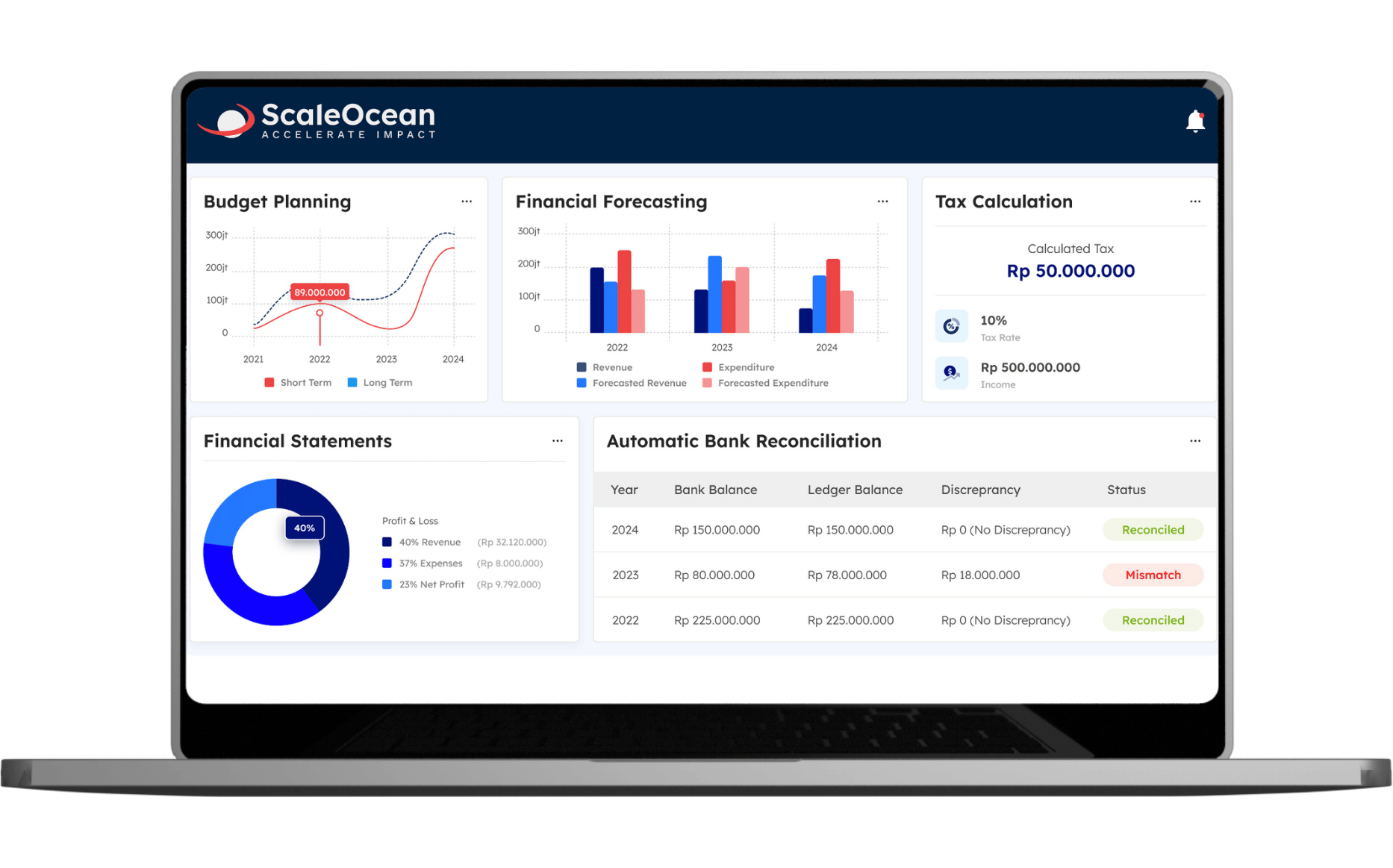
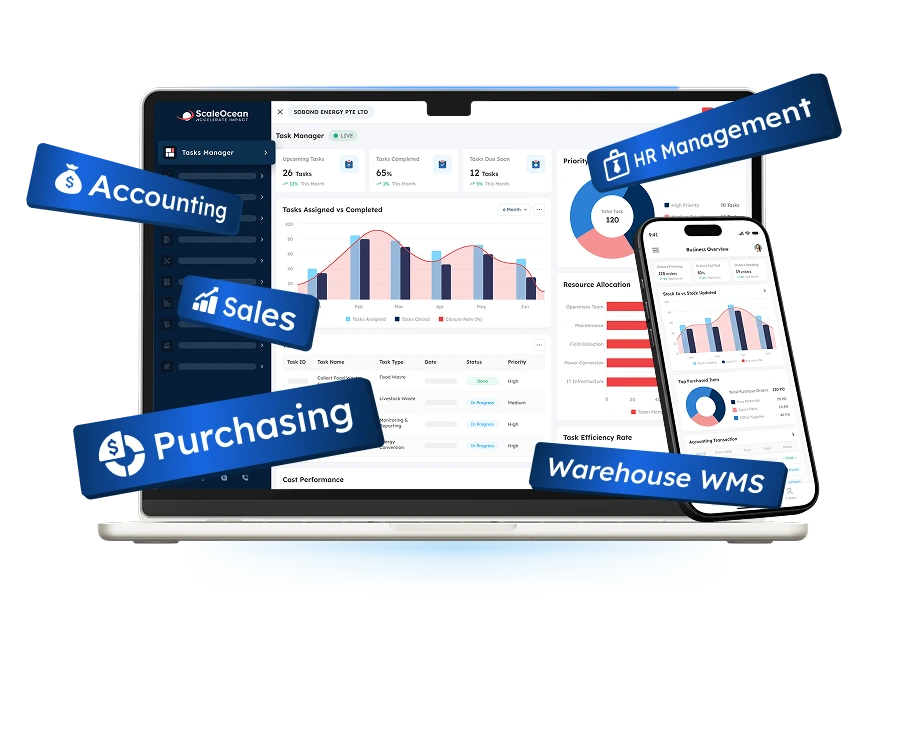
ScaleOcean’s top accounting system presents an innovative accounting system specially designed for Singapore companies to comply with IFRS flawlessly. The holistic solution ensures accuracy and efficiency, and eradicates the troubles of manual reporting.
ScaleOcean automates IFRS compliance, freeing companies from manual reporting and allowing them to concentrate on business growth. Businesses wanting to know more about what ScaleOcean has in store for them can avail a free demo.
a. Key Advantages
ScaleOcean’s powerful features handle the exact needs of Singaporean businesses and ensure compliance and efficiency. Easy-to-use tools eliminate the difficulties in implementing complex accounting standards and facilitate efficiency.
- Pre-Built IFRS templates: The time-consuming task of updating templates is eliminated from the accounts staff’s workload and given to analytical responsibilities. Templates meet the updated standards of IFRS and SFRS with minimal or no adjustments.
- Integrated features: Streamline accounts payable, receivables, and general ledger functions with the integrated functionality of the software. The link between accounting activities promotes accuracy and efficiency in the workflow, while enhancing team collaboration.
- Easy to use: With an approachable interface, accounting experts can easily prepare compliant reports. An intuitive design simplifies the process of adaptation and helps maximize the staff’s productivity.
b. Benefits
ScaleOcean is created for the regulatory needs of Singapore and can help companies compete and adhere to all rules. ScaleOcean is a configurable solution that can be scaled, making it a smart choice for companies of all types, from small organizations to large enterprises.
- Compliance assurance: Automated updates guarantee conformity with current IFRS and SFRS standards. Businesses can stop worrying about manual adjustments and failure to comply with any of the regulations. The accounting staff is at peace, with the fact that ScaleOcean ensures compliance.
- Scalability: Accommodate larger transaction volumes of both small and big companies. ScaleOcean grows along with your company, and the feature-set also scales with it.
- Time savings: Reduction in manual work to allow accounting staff to take up tasks in the growth strategies of the business. The automated procedures promote efficiency, hence allowing companies to focus on innovation and growth.
10. Conclusion
IFRS compliance is a critical element for Singapore businesses that want to remain transparent, attract foreign investors, and compete globally. Utilizing accounting software like ScaleOcean facilitates compliance without any manual updates and ensures the report’s accuracy.
It boosts your decision-making power by providing real-time financial performance reports and allowing businesses to adjust accordingly to market dynamics. Find out how you can improve your financial reports by registering for a free demo of ScaleOcean and experience IFRS compliance with ease.
FAQ:
1. Who Uses IFRS?
IFRS is implemented in over 140 countries, including regions in Europe, Asia, Africa, the Americas, and Oceania. It is either required or permitted for public companies to ensure global consistency in financial reporting.
2. Does Singapore use IFRS or GAAP?
Singapore follows the International Financial Reporting Standards (IFRS) with slight adjustments, known as the Singapore Financial Reporting Standards (SFRS), aligning closely with IFRS to ensure global consistency while catering to local needs.
3. What are the 4 pillars of IFRS?
The four core pillars of IFRS S1 and S2 are governance, strategy, risk management, and metrics & targets, which outline how sustainability-related disclosures should be structured in line with global standards.
4. How many rules are in IFRS?
There are 17 core IFRS standards, from IFRS 1 to IFRS 17, addressing different aspects of financial reporting. The total number may change as new standards are introduced or older ones are updated or replaced.





















.png)