




A sales pipeline provides structure, a graphic depiction of prospects’ purchasing stages to monitor, manage, and project revenue. It describes the steps from initial prospecting to closing, enabling teams to assess performance, find bottlenecks, and guarantee a consistent flow of deals.
Based on a report we found, according to IMDA, SMEs that adopted digital technologies, including business software, reported average cost savings of around 50%, highlighting the business impact of software implementations in areas like sales, marketing, and customer service.
This article outlines the true meaning of a sales pipeline and why it matters. You’ll get step-by-step instructions for designing one, along with practical implementation ideas and methods to maximize outcomes. Business owners should read these ideas, including the core five stages of the sales pipeline, to improve their sales strategies.
 Key Takeaways
- A sales pipeline is a visual framework that tracks a prospect’s journey, providing clarity on your entire sales process.
- The process is broken down into seven key stages, from initial lead generation and qualification all the way to closing the deal and nurturing the client relationship.
- Before building your pipeline, you need four inputs: a clear ICP, a defined process, revenue targets, and alignment between sales and marketing.
- Creating a sales pipeline requires defining buyer-based stages, setting clear activities, calculating opportunities, using the right CRM, and continuously filling it with quality leads.
- ScaleOcean’s sales system helps you build, manage, and optimize your pipeline, providing the insights needed to drive consistent sales performance.
What is a Sales Pipeline?
Hence, what is the sales pipeline, in other words, that is frequently talked about in the sales circles? In simple words, it is a visual method to see precisely where the prospects are in your current sales process, and allows you a glance at everything. The method is effective in sales management by monitoring all opportunities at each stage of first contact to closing.
A sales pipeline resembles a roadmap to your team, and it will indicate the steps followed in converting leads to customers. This is the reflection of the sales pipeline, for example, giving clarity, organization, and easier tracking of the five crucial stages to effective sales management.
The difference between the sales pipeline and the sales funnel is that the sales pipeline tracks the internal stages and specific actions your team performs to manage active deals from start to finish. Conversely, the sales funnel visualizes the external buyer’s journey and measures the conversion rates of leads as they filter down toward a final purchase.
Key Characteristics of a Sales Pipeline

When we discuss a truly useful sales pipeline, we usually end up discussing a few basic features that simply make it an invaluable business tool. All these interweave to make a really powerful tool to manage as well as even predict future streams of revenue. The following are the key characteristics of a good sales pipeline:
Visual Representation
It is, perhaps, one of the most vital aspects of a sales pipeline, and in fact, what makes a sales pipeline stand out is simply how visual it is. Usually, it will be presented as a dashboard, typically with columns representing each stage of the sales pipeline, which would give sales managers a way to see at a glance the state of every deal.
It is really handy in that you could just look and see how many deals are deep in the negotiation process and how many are still in the early discovery phase. It is, literally, this kind of birds-eye view which is what makes it so much more effective than a plain old spreadsheet or just a list of contacts that you may be working off.
Stage-Based Framework
What is also very important is that a sales pipeline is always created on the basis of a chain of very specific, clearly defined stages. All of these stages represent a fairly substantial milestone in the journey of the buyer, say Lead Qualification or perhaps Proposal Sent, and so on.
The manner in which deals are passing through, it is a logical progression, just a deal flowing in one direction to the other. This will assist in standardizing the entire sales strategy of the team, which is a huge plus to any sales management strategy. It eliminates guesswork, and thus the sales process is repeatable and scalable, which is the ultimate aim of every business.
Activity Tracking
Effective pipelines are not the ones that merely display to you the current position of a deal. They also keep a check on all the particular activities that are associated with it. This includes calls made and emails sent to meetings to be scheduled whenever the chance arises. This is the detailed activity tracking, which, indeed, provides you with the entire context that you will need.
To the managers, this is quite large since you can easily tell whether a deal has, say, just stalled out due to the lack of follow-up or whether the appropriate actions are being taken to move it along. This fact is vital to coaching sales representatives and avoiding the loss of opportunities when information is not taken.
Sales Process Management
A sales pipeline is indeed a management instrument that is meant to be actively managed and not merely a passive reporting tool. It’s more than a dashboard. It is a dynamic system that really assists in guiding and controlling the entire sales process. So, in essence, it’s all about proactive sales management, making sure things are moving.
With a pipeline, you can tell to the minute where deals are getting roadblocked, which is of great value to sales management. Sales management system software enables you to better predict future sales with a lot more certainty. You are also able to allocate your resources more efficiently, and this is a big deal in efficiency.
Why is a Sales Pipeline Crucial for Business Growth in Singapore?
A business basically has everything in the form of an efficient and predictable business operation. A sales pipeline isn’t just some nice-to-have extra. It leads to sustainable growth by introducing order to the complex markets and developing a competitive advantage. This is why a sales pipeline is essential to business development in Singapore:
Improved Organization & Prioritization
It is a great sales pipeline that will give your salespeople a clear, well-organized view of every single lead and opportunity that they are working on. That way, they can just give more priority to what is most important, which seems most likely to close within the near future, which has a direct effect on productivity, which is quite significant.
Once all is correctly laid out like this, sales reps are usually aware of what their next steps are each day to keep deals moving forward. This organization eliminates the occurrence of missed opportunities and implements a uniform follow-up procedure for the whole team.
Accurate Revenue Forecasting
Proper forecasting extends beyond in-house planning. It is necessary to be ahead of both local and global competitors who have a considerable market presence, which allows businesses to plan confidently and take decisive action.
Knowing your projected income like this really allows you to make much better decisions about hiring, your spending, and where to invest. It helps you to clearly understand if you’re actually on track to hit your targets, and what your break-even point looks like for the quarter, which is always important for any sales management team.
Process Optimization to Identify Sales Bottlenecks
The high prices of renting, salary, and other necessities in Singapore are costly and require efficiency. Such an efficient sales process is achieved by removing wasteful effort, reducing bottlenecks, improving team performance, and directly increasing profitability under such a competitive environment.
As an example, then, when you begin to notice that you have a lot of deals just dropping off, just after the ‘Demo’ stage, then it may be an indication that you need to make minor adjustments to your presentation, or even better, you should qualify your leads before they get that far. This is a data-driven method to allow continuous improvement and create a more efficient sales cycle to manage it smarter.
Increased Accountability Within Your Sales Team
Singapore’s professional work culture emphasizes clarity, efficiency, and quantitative results. A sales pipeline provides a clear and updated data-driven CRM framework that assures accountability, meets expectations, and produces consistent individual and team results.
With key metrics that include the number of deals, average deal size, and closing ratio is very easy for the managers to know who is achieving their goals and who, perhaps, may require a little more coaching or encouragement to get there. This transparency gives clear expectations and is a way of making sure that all members of the team work towards achieving the overall objectives of the company.
The 7 Key Stages of a Sales Pipeline
In fact, the details of how things are done can differ quite a lot between one business and another, but most of the sales pipelines that succeed at all tend to be developed around a fairly consistent set of core stages. These are the steps by which a prospect goes through the process of purchase. The following 7 phases of the sales pipeline are:
1. Lead Generation
Lead generation is the first step in finding potential clients that can be accessed through effective channels to be used in Singapore. The mix of using digital marketing and a substantial face-to-face connection is the key to filling your sales pipeline.
Things such as marketing campaigns, content marketing efforts, even cold outreach, and networking events are all taking place quite frequently at this point, as we attempt to reach out. The entire idea, the overall objective, is simply to fill the upper end of your sales pipeline with as many potential deals as you can make ready to take that next step.
2. Lead Qualification
All leads that appear are not going to suit your specific business, and that is quite natural. It just happens. The process of evaluating prospects based on needs, budget, authority, and timeline to fit your ideal customer profile is known as Lead qualification.
This particular stage is immensely crucial to overall efficiency, and this is primarily because it prevents your sales team from wasting precious time on prospects who, when it all comes down to it, are most likely never going to make a purchase, and which you would want to avoid. A qualified lead is a person with an actual issue that your product can address.
3. Initial Contact/Discovery
Once a lead has been qualified, the initial conversation commences. The communication in Singapore should be professional, transparent, and efficient. Listening, knowing the challenges, and goal-setting should be part of the process before submitting a formal solution offer.
It is commonplace to start with a formal introduction through email or LinkedIn. To speed up follow-ups, numerous companies rely on WhatsApp Business, a well-known application. Such a combination of formal and convenient is a stimulus for a deep bond and effective communication.
4. Presentation/Demo
The presentation stage in the sales pipeline in Singapore has to be more than a mere pitch. The audience is typically highly technical, demanding a slick presentation, and appreciating data-driven analysis. To achieve the real interest, it is necessary to show a definite ROI.
Recognize the different business ecosystems in which reps may present to Singaporeans, expats, and regional stakeholders. Tailoring solutions to unique demands while demonstrating cultural understanding ensures that the presentation connects and creates confidence.
5. Negotiation
If the prospect is still showing a good level of interest after your presentation, the process may be moving into the negotiation stage of the sales pipeline. This is where you are discussing such things as pricing, the exact terms, and the general extent of the agreement.
A certain amount of fluidity, but a really solid, clear conception of your own bottom line, is quite essential here. The final objective of the course is to strike that comfortable middle ground that will not only fulfill the needs of the customer, but it will also make it profitable to your business, which is just good sales management practices.
6. Closing the Deal
Closing is the culmination of your entire sales pipeline journey. Closing the deal is that really satisfying, final step where the prospect agrees to all the terms and signs on that dotted line, bringing together all of your efforts up to this point, making it the most critical stage of all, for sure.
What you’ll typically be doing here involves sending over the final proposal and, obviously, getting that official sales contract signed and sealed. A really smooth, professional closing process can honestly make a massive difference in not only securing the win but also in starting that new customer relationship off on a truly positive, strong note.
7. Follow-up and Nurturing
The work doesn’t just stop once the deal is closed; in fact, the final stage in a good sales pipeline post-purchase involves thorough post-sale follow-up and actively nurturing that new customer relationship. This is essential for making sure customers are happy and satisfied.
This part of the process might include things like dedicated onboarding support, regular check-ins to see how they’re doing, and also sharing genuinely useful content that can help them. A customer who’s happy and well-supported is not only very likely to stay with you, but they’ll often become a powerful advocate for your brand.
Required Data to Build A Sales Pipeline from Scratch
Starting a sales pipeline from scratch? It can feel like a huge task, but honestly, it all boils down to having the right information from the get-go. Without some essential data points, you just can’t build a pipeline that works and makes sense for your team. Here’s the essential data you need to build a sales pipeline from scratch:
A Clear List of Your Prospects (Ideal Customer Profile)
You absolutely need to know who you’re aiming for, right from the start; this means developing a really detailed Ideal Customer Profile, or ICP. This profile lays out all the traits of your ideal customer, and without a well-defined target audience, your sales efforts are just going to be all over the place, not really hitting anything effectively.
Your ICP should cover things like their industry, how big their company is, who the decision-makers are by job title, and, importantly, what specific problems they’re struggling with. This detailed list of prospects, once you have it, basically becomes the raw material that feeds into the top of your pipeline, kicking off everything.
Your Defined Sales Process
It’s really crucial to have a clear, documented sales process in place because without it, things just get messy. This means mapping out every single step your team follows to guide a lead from that first touchpoint all the way to a closed deal, and it really should be consistent and repeatable across the board.
Without a proper, defined process, your team will end up operating mostly on guesswork, making it impossible to truly build a meaningful sales pipeline. So, take the time to sit down with everyone and agree on the key stages and activities involved in your sales cycle; it makes all the difference.
Your Quarterly and Annual Revenue Targets
Think of your sales pipeline as essentially a compass, guiding you toward your financial objectives, so it’s critical to have those clear quarterly and annual revenue targets locked down first. These targets are what will then help you figure out the required size and value of your pipeline, ensuring it’s built to meet those goals.
Once you know your specific targets, you can pretty much work backward, calculating exactly how many leads are needed and how many deals you need to close each month or quarter. This kind of planning just makes your entire approach to sales much more strategic and genuinely goal-oriented, which is vital for good sales management.
Alignment with Your Sales Colleagues and Marketing Team
Sales don’t operate in a bubble. Teams must align for an effective pipeline. According to the International Trade Administration, in Singapore, local distributors understand regional rules, making alignment crucial when defining qualified leads and ensuring smooth handoffs between sales and marketing.
Marketing really needs to grasp the types of leads that sales can genuinely convert, while sales, in turn, has to offer solid feedback on lead quality. This kind of strong collaboration makes sure your pipeline is genuinely filled with high-potential opportunities, rather than just a bunch of irrelevant contacts that won’t go anywhere.
Step-by-Step Guide to Creating Your Pipeline
With your core data in hand, it’s really time to start building out your actual sales pipeline, which can feel like a big task. This guide is here to break that down, offering practical, step-by-step actions you can follow. Sticking with these steps will help you put together a structured and effective pipeline that truly fits what your business needs.
1. Define Your Sales Pipeline Stages Based on Your Buyer’s Journey
When creating sales pipeline stages, match them with the buyer’s journey rather than relying just on internal actions. Each stage should mirror what prospects are going through, from problem recognition to evaluating solutions and making a final decision.
For example, a Singapore-based B2B IT firm selling SaaS to ASEAN SMEs could name a stage as “Evaluating Options” rather than “Proposal Sent.” This allows the sales staff to better understand how prospects think and feel at each stage, resulting in increased engagement and outcomes.
2. Identify Key Activities and Goals for Each Stage
Once you have your stages down, it’s crucial to pin down exactly which sales activities need to happen to push a deal forward into the next stage. You also want to make sure you’re setting a really clear goal for each one, which gives clarity and purpose to every action your team takes.
So, for example for the ‘Discovery Call’ stage, your main aim might be figuring out the prospect’s top three big challenges. The actual activity then could involve going through a specific checklist of questions, ensuring you’re always qualifying consistently.
To track and organize these activities effectively, use a sales account tool, which is one of the best features of ScaleOcean’s sales management software. It can help maintain a detailed record of each prospect’s journey, allowing your team to stay focused and aligned with clear objectives at every stage.
3. Calculate the Number of Opportunities Needed to Hit Revenue Targets
Alright, time to do a bit of straightforward math here. By looking at your past performance data, things like your average win rate and how big your typical deal is, you can pretty much reverse-engineer from your revenue target to figure out how many opportunities are needed at each stage.
For example, if you’re aiming for $100,000 in revenue and your average deal brings in $10,000, that means you’ll need to close 10 deals. But if your win rate is only 20%, you’ll actually need at least 50 qualified opportunities sitting in your pipeline to even get close to that goal.
4. Choose the Right Sales CRM Tool to Manage Your Pipeline
Spreadsheets can be used by small teams, but they soon become disorganized and error-prone. A solid CRM platform is required to successfully manage a sales pipeline, ensuring smooth operations and precise tracking.
In Singapore, businesses often choose CRMs with strong local support and links to gateways like Stripe SG or GrabPay. Beyond automation and reporting, a sales management system enhances control, helping teams track performance, refine strategies, and drive growth.
5. Continuously Fill Your Pipeline with Quality Leads
Think of your sales pipeline as a living, breathing system that absolutely requires a steady stream of new opportunities coming in all the time. After you’ve got it set up, your main job then becomes keeping it consistently topped up with really high-quality leads, because a pipeline that doesn’t get fed is just going to dry up quickly.
This means your marketing and sales teams need to be constantly working on lead generation. It’s truly a never-ending cycle of finding new prospects, qualifying them carefully, and then adding those new opportunities to make sure you always have a good, healthy backlog of potential deals ready to go.
How to Manage and Maintain Your Sales Pipeline Effectively
Sure, building out a sales pipeline is one thing, but that’s only half the story. The real heavy lifting, and what truly makes a difference in sales management, is keeping it well-managed and maintained. A pipeline that is ignored will quickly become pretty useless for any real decision-making. Here’s how to effectively manage and maintain your sales pipeline:
1. Conduct Regular Sales Pipeline Reviews
Regular sales pipeline reviews, honestly, are just non-negotiable if you want effective sales management. You really can’t skip these. These often mean weekly catch-ups where the sales team digs into key deals, points out potential risks, and figures out how to push opportunities forward.
When you’re in these meetings, a practical thing to do is really zone in on what’s shifted since the last time you all met. This kind of proactive approach tends to work well, spotting problems much earlier and keeping everyone on the team aligned and zeroed in on the most important deals.
2. Keep Your Pipeline Clean and Up-to-Date
Let’s be real: an out-of-date sales pipeline is just a misleading one, and that’s not what you want for good sales management. Your sales team must keep the status of their deals updated in real-time, moving things along to the next stage promptly, adjusting deal values, and clearing out dead opportunities.
A clean pipeline, it’s simple, really, gives you the most honest picture of your sales health and allows for much more accurate forecasting down the line using the best sales forecast software. That’s why putting a strict policy in place for data entry and consistent updates isn’t just a suggestion. It’s essential for maintaining this cleanliness.
3. Focus on Improving Sales Pipeline Conversion Rates
Think of your sales pipeline data as this incredible goldmine of insights, truly, just waiting to be explored. Regularly review conversion rates at each stage to identify areas for improvement. Even a tiny bump in your conversion rate is pretty amazing how it can have a significant impact on your overall revenue.
Say you’re seeing a low conversion rate from ‘Demo’ to ‘Negotiation,’ which is a common scenario; that could really be a signal to get your team some better training on how to handle objections. This is where the real value comes in, using that hard data to make targeted improvements to your sales process.
4. Take Dead Deals Off Your Radar
We’ve all been there, feeling that pull to keep those long-shot deals sitting in the sales pipeline, hoping they’ll magically close one day. But this practice, often known as ‘pipeline padding,’ just inflates your forecast and clutters up your whole view of things. It’s truly important to be realistic here and remove dead deals promptly.
Look, marking a deal as ‘Closed-Lost’ isn’t some sort of failure. It’s a really necessary step in maintaining an accurate sales pipeline. Doing this lets your team really focus their precious energy on active opportunities, the ones that genuinely have a solid chance of closing.
5. Always Follow Up with Both Active and Cold Leads
Persistence, this is a big one in sales, and it truly is key. You absolutely need a systematic way to follow up on active deals to keep them rolling forward, and please, don’t overlook those leads that have gone cold, because a consistent follow-up strategy can often, quite surprisingly, bring old opportunities back to life.
It happens all the time: a prospect’s priorities shift, and what was a firm ‘no’ six months back might very well be a ‘yes’ today. So, having a structured follow-up cadence for both your active and inactive leads it’s just smart sales management, making sure that no potential revenue is left on the table.
Key Sales Pipeline Metrics to Track for Success
If you really want to get a handle on your sales pipeline’s health and how well it’s performing, you absolutely need to track the right metrics. These key performance indicators, or KPIs, give you clear, quantitative insights into what’s clicking and what might be off. Here are the key sales pipeline metrics you should track for success:
Number of Qualified Leads (MQLs & SQLs)
This particular metric is all about watching the volume of those new, qualified opportunities that are making their way into your sales pipeline. It’s really key to know the difference between Marketing Qualified Leads (MQLs) and Sales Qualified Leads (SQLs) here, because this number truly is the lifeblood of your sales pipeline.
You see, having a really steady flow of these qualified leads is totally essential for any kind of consistent growth. If this number starts to dip too low, it’s often a pretty early warning sign that you might face some challenges hitting your future revenue targets down the line.
Lead Conversion Rate (Stage-by-Stage)
What this one really measures is the percentage of deals that successfully push through from one stage of your sales pipeline to the very next. Taking the time to analyze your conversion rates at each stage is super helpful for pinpointing those stubborn bottlenecks in your sales process stages, and it’s all about understanding the flow of your pipeline.
Now, if you see a low conversion rate hanging around at a particular stage, that’s usually a pretty clear indicator of a problem that absolutely needs your attention. Honestly, focusing on improving these smaller, “micro-conversions” is one of the most effective ways you can boost your overall win rate significantly.
Win Rate
Your win rate, or sometimes we call it the close rate, is essentially the percentage of all the opportunities in your sales pipeline that make it to become closed deals. It’s truly one of the most important metrics out there for getting a real feel for the overall effectiveness of your sales efforts, making it the ultimate measure of sales success.
Keeping a close eye on your win rate over time lets you see if those process improvements you’re putting in place are truly having a positive impact, which is really valuable insight. A rising win rate, for example, is usually a pretty strong sign that your team and your entire sales process are just getting stronger and more effective.
Average Deal Size
The average transaction size reflects the typical revenue per closed contract, making it critical for effective forecasting. Businesses should compare their data to local industry benchmarks, which are generally published in studies from the Singapore Business Federation or Enterprise Singapore.
Monitoring this measure enables businesses to fine-tune revenue-growth initiatives. Knowing whether deals fall above or below industry averages allows teams to prioritize growing win rates or increasing deal values, ensuring efforts correspond with market expectations.
Average Sales Cycle Length
This statistic varies significantly between industries in Singapore. FinTech enterprises, for example, that operate with major financial institutions under MAS laws frequently have longer cycles than faster-moving sectors.
In contrast, a logistics startup may have shorter sales cycles due to faster operations and decision-making. Tracking this measure enables firms to identify delays, alter strategy, and enhance efficiency for faster revenue creation.
Sales Pipeline Velocity
Now, pipeline velocity is a bit more of an advanced metric, one that really measures just how quickly deals are moving through your sales pipeline and, importantly, generating revenue. It cleverly combines a few things: your number of opportunities, your win rate, and your average deal size, all divided by your sales cycle length.
When you have a higher pipeline velocity, it pretty much means your sales engine is running more efficiently, which is always the goal. It’s a super comprehensive metric, offering a really holistic view of your entire pipeline’s overall health and performance.
Adapting Your Sales Pipeline for the Singaporean Market
While the fundamental ideas of a sales pipeline pretty much apply universally, putting them into practice for the Singaporean market really does need some careful adaptation. Business culture, buyer expectations, and the technological landscape in Singapore each have unique characteristics. Here’s how to adapt your sales pipeline for the Singaporean market:
Understanding Local Buyer Behaviour and Expectations
Singaporean purchasers are realistic and value-driven, prioritizing demonstrable economic benefits over surface-level promises. While excellent relationships are important, decisions frequently require a compelling case that demonstrates efficiency, quantitative benefits, and long-term growth potential.
Decision-making can also be consensus-driven, including several stakeholders. To gain buy-in within the organization, your sales strategy must address various priorities, deliver concise, convincing data, and demonstrate alignment with organizational goals.
Leveraging Digital Tools in a Tech-Savvy Environment
Leveraging Digital Tools: Singapore promotes itself as a “Smart Nation,” with firms ready to adopt new technologies. Companies with excellent infrastructure and digital readiness are more likely to embrace solutions that modernize their sales and marketing activities.
Government efforts such as the SMEs Go Digital project encourage the use of digital technologies. This makes organizations more open to CRMs, e-signatures, and digital communication platforms, ensuring that sales pipelines correspond with Singapore’s tech-driven market.
Navigating Industry-Specific Sales Cycles in Singapore
Navigating industry-specific sales cycles in Singapore necessitates flexibility. Relationships are key in maritime and logistics, as is Singapore’s status as a worldwide port. Meanwhile, biological sciences confront lengthy R&D and regulatory approvals, which influence their purchasing decisions.
B2C retail tells a different story, with NTUC FairPrice, Lazada SG, and Shopee SG leading a very competitive market. Customizing pipeline stages to each industry’s particular rhythm ensures that sales teams remain relevant, effective, and in sync with client expectations.
Conclusion
A sales pipeline is more than just tracking. It’s the foundation of successful sales. In Singapore’s dynamic market, it transforms chaos into structure by providing clarity, responsibility, and insights for forecasting, continuous improvement, and long-term growth.
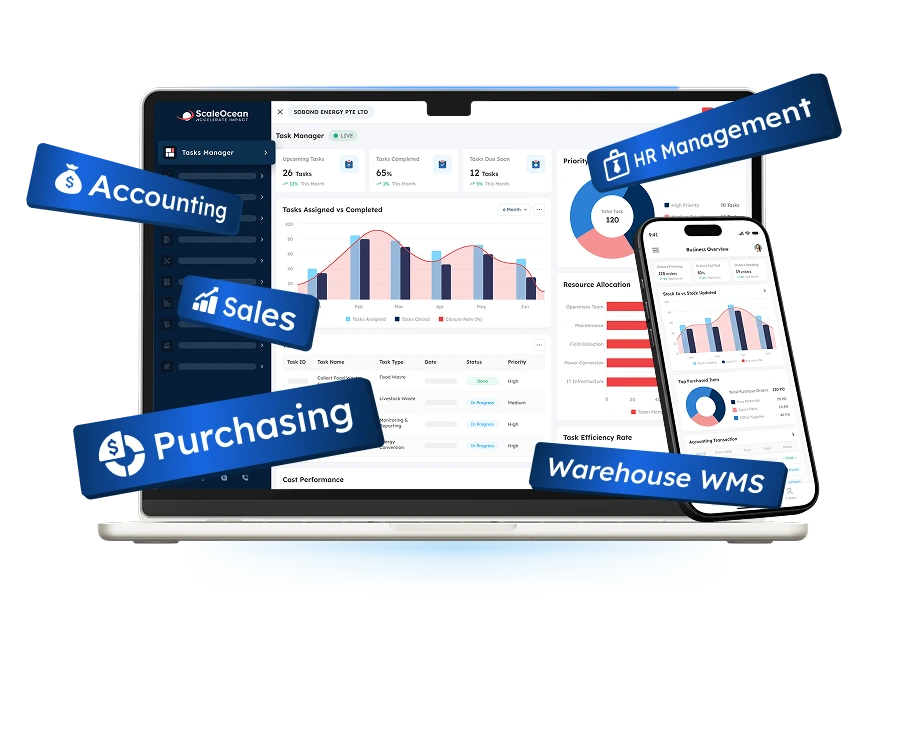
ScaleOcean’s sales management tools offer integrated solutions to maintain strong pipelines, including CRM, analytics, and reporting tools. Businesses can also take advantage of a free demo to explore how ScaleOcean’s features support smarter decisions and long-term growth.
FAQ:
1. What is a sales pipeline?
A sales pipeline is a visual framework outlining the entire sales process, beginning with initial contact and ending with deal closure. It enables companies to organize opportunities, oversee progress, and estimate revenue with greater accuracy.
2. What are the 7 stages of a sales pipeline?
The core stages often include lead generation, lead qualification, initial contact/discovery, presenting proposals/demo, handling negotiations, closing the sale, and last follow-up and nurturing. These steps guide prospects through the buying journey, helping teams improve efficiency and boost revenue outcomes.
3. What is the difference between CRM and sales pipeline?
CRM refers to software that stores and manages customer information and communication history. A sales pipeline, in contrast, illustrates the progression of deals through defined stages, focusing more on opportunity tracking and deal advancement.
4. How does a sales pipeline look?
A typical sales pipeline is displayed as a chart or board with segmented stages. Leads or deals are moved along these columns, showing progress clearly from first interaction to closing, which helps monitor activity and forecast business growth.
5. What is the 30 60 90 day sales pipeline?
The foundation for both short-term and long-term success is laid by a sales manager using a comprehensive 30-60-90 sales plan. Use the first 30 days to observe and evaluate; the following 30 to make small adjustments in response to your observations; and the last 30 to improve tactics and match team objectives with your overarching vision.
6. What makes a good sales pipeline?
You need efficient tools to track and move deals through each stage to keep your sales pipeline healthy. This includes tools for coordinating team work, organizing customer data, and giving representatives clear images to help them prioritize jobs.




















.png)