

Workforce management (WFM) is the suite of processes, technologies, and techniques applied to a workforce to meet an organization’s needs. The ultimate aim is to optimize productivity, forecast staffing needs, ensure compliance, and regulate labor costs. It ensures the right number of qualified people are available at the right times.
The main issue for many enterprise organizations in Singapore concerns not only the quantity of employees but also the quality of employees. HR teams often struggle to estimate workforce needs based on projects, peak seasons, and business growth plans.
For companies that manage hybrid or flexible work arrangements, workforce visibility becomes even more important. Workforce management helps standardize requests, approvals, attendance tracking, productivity reports, and schedule coordination across teams. This allows businesses to support flexible work models while still maintaining accountability, workforce control, and consistent operational performance.
Furthermore, Singapore’s labor market figures also suggest a need for greater workforce management. According to statistics we collected from the Ministry of Manpower (MOM), job openings increased by 6,100 in Sept 2025, and 7,700 in December 2025. These numbers meant the ratio of job vacancies to unemployed employees stood at 1.50:1 and 1.58:1, respectively.
This article would give you a more in-depth understanding of Workforce Management (WFM), detailing its importance, challenges, users, various components, key functions, differences in meanings from workforce planning, optimization steps, and how it tracks employees through workforce management software.
 Key Takeaways
- Workforce management (WFM) is a strategic approach to optimizing employee productivity by integrating forecasting, scheduling, and performance tracking into one system.
- WFM is important for businesses to control labor costs, reduce employee burnout, streamline administrative tasks, support strategic workforce planning, and create a fairer employee experience through data-driven workforce decisions.
- Workforce management helps businesses manage employee data, track time, control labor costs, reduce operational risks, support compliance, and use workforce analytics to make better HR and business decisions.
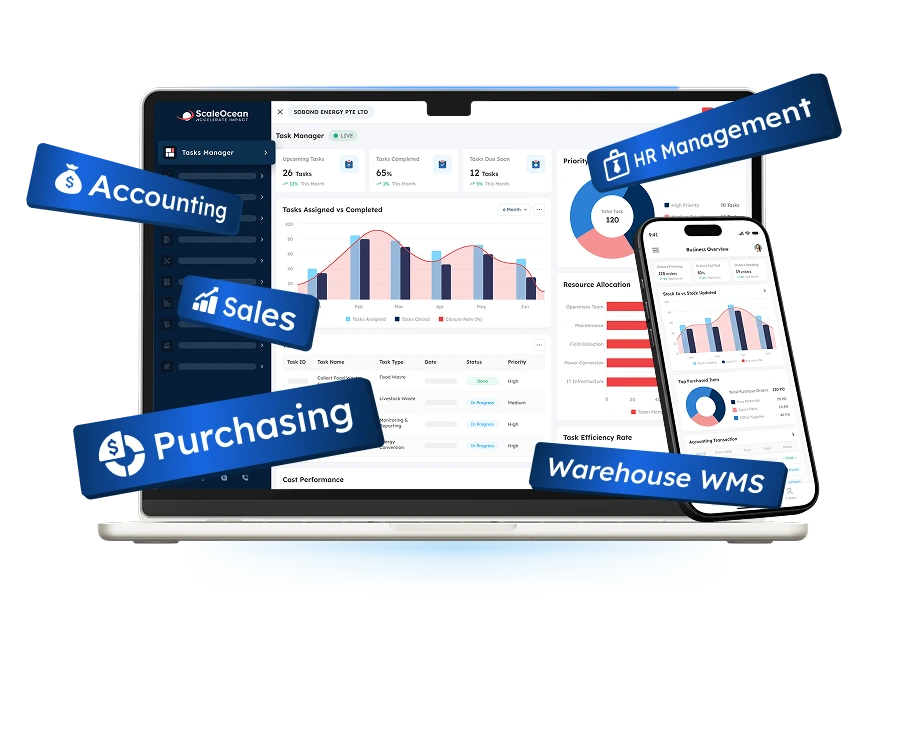
- ScaleOcean’s talent management software provides an integrated solution to automate tasks, improve forecasting, and solve the core challenges of workforce management.
What is Workforce Management (WFM)?
Workforce Management (WFM) is a systematic approach where organizations utilize WFM software to efficiently manage employee time, scheduling, work assignments, attendance, and labor costs to increase workforce productivity. This can ensure the right workers are at the right job at the right time and that operational visibility is adequately obtained.
It also connects employee roles, skills, productivity, performance, training needs, internal mobility, and retention risks. When this data is centralized, managers can assign employees more fairly, identify skill gaps earlier, support succession planning, and improve employee retention through better workforce visibility.
The workforce management system will enable enterprise organizations to easily see how employees from different departments, offices, or functional roles are performing together. Instead of trying to decipher figures from separate spreadsheets or inconsistent reports, leaders will have a clearer view of employee availability, workload distribution, and attendance rates, to name a few parameters.
For enterprise companies, an integrated WFM system gives HR teams and managers a clearer picture of how employees work across departments, branches, and roles. Instead of relying on scattered spreadsheets or disconnected reports, leaders can understand workforce availability, workload distribution, attendance patterns, and productivity trends in a more structured way.
 Also Read: What Is Talent Management? (With Strategy and its Processes)
Why is Workforce Management Important?
The importance of WFM arises from the fact that employees are pivotal to controlling costs, influencing productivity and quality of services, and business continuity.
WFM allows executives and decision-makers to monitor how human resources are utilized on a daily basis. This enables the control of labor costs, minimizes inefficiencies, and improves employee satisfaction, allowing for growth and development in the long run.
1. Minimal Labor Overhead
Too many employees are booked without actual need, additional overtime is allowed without proper monitoring, or employees are hired without fully understanding their exact requirements. All these scenarios contribute to an escalation of labor overheads.
The primary reason for all these problems is often manual or estimation-based workforce decisions. Workforce management software helps by allowing organizations to quantify labor needs, evaluate employee availability, working hours, and workload before work scheduling.
2. Reduced Burnout
The same workers are frequently given the heaviest workload, the most critical tasks, or the most hours in a work week, which leads to stress and burnout. This can happen because of a lack of visibility among managers into how workloads are distributed among workers.
Workforce Management allows equitable distribution of tasks among workers by analyzing their schedules, attendance records, overtime history, and hours of work. By preemptively managing employee fatigue, the organization can prevent loss in performance, employee morale, and turnover.
Increased employee engagement is also spurred by equitable working hours, realistic workloads, and sensitivity towards working conditions.
3. Lower Administrative Burden
Manual administrative processes relating to an organization’s workforce take considerable time as the HR department needs to synchronize overtime balances, leave balances, attendance logs, approval status for overtime applications, payroll, and performance data. Such duplication of effort increases the possibility of human errors.
Workforce management software helps to systematize and automate tedious and repetitive tasks. HR personnel can handle attendance and leave requests efficiently, process payroll effectively, and address employee issues with higher levels of accuracy and speed, thereby enabling managers to be more accurate in their decision-making during their daily task allocation.
4. Strategic Planning
Through workforce management, companies are enabled with more foresight in planning their workforce by obtaining precise data about workforce availability, the mix of skills, employee turnover, and absence rate, as well as business demands, well before manpower shortages arise.
This allows more effective planning regarding worker development through informed decision-making related to hiring, training, rotation, and skill development based on actual data regarding employees. The overall workforce planning becomes more systemic and less speculative.
5. Improved Productivity
Productivity is difficult to improve when companies cannot see how employees spend their time or how work is distributed. A team may look busy, but leaders may not know whether the work supports business targets effectively.
Workforce management helps connect employee time, workload, attendance, performance, and output. This allows companies to evaluate productivity more objectively and identify where delays, inefficiencies, or skill gaps occur.
By linking WFM with KPI (Key Performance Indicator), companies can measure employee contribution more clearly. Managers can review whether teams are meeting targets, using time efficiently, and supporting business priorities.
6. Enhanced Employee Satisfaction
Employee satisfaction improves when employees experience fairness, clarity, and transparency in workforce processes. Sudden schedule changes, delayed leave approval, unclear overtime rules, and inconsistent workload distribution can reduce trust in management.
A well-managed WFM process gives employees better visibility into schedules, leave status, attendance records, and assigned responsibilities. This reduces confusion and helps employees feel more supported in their daily work.
The Biggest Challenges Faced in Workforce Management

When your business grows, managing staff becomes an issue if your company is expanding faster than the management of HR itself. With larger teams, manual processes can very easily become prone to error, leading to inaccurate scheduling, excessive overtime and understaffing, poor talent visibility, and an inability to conduct unified reporting.
Issues can become further complicated with Singapore businesses, given their workforce will often have a hybrid workforce, project-based teams, shift-based operations, and multi-branch operations. If poorly managed, employee complexity may hinder productivity and increase operational risk.
1. High Overtime Costs
The cost of overtime generally increases when there is insufficient staffing to meet the demands of the business. Additional hours may be allocated when managers are unsure if additional resources are available or if their tasks could be re-allocated.
This may directly impact the company’s profitability. While overtime may alleviate immediate pressures in the short term, its increased usage may result in greater labor costs, reduced employee well-being, and potentially longer-term workforce imbalances.
2. Understaffing
Understaffing occurs when there is insufficient staff available for operations to continue. This may negatively affect service delivery, project implementation, production, and employee morale, especially if additional work is pushed on existing employees.
This can be due to poor forecasting, lack of talent visibility, and late hiring decisions. This is often where a company realizes its shortcomings when its business is already feeling the effects.
3. Manual Scheduling
Common causes for conflict within an organization are often due to manual scheduling. Managers may fail in the hiring process, overlook certain skills, or schedule employees for overtime and work imbalance.
As businesses expand, it becomes difficult to manage through manual means. It may be the case that spreadsheets are not applicable for more than one team, department, or shift group.
By taking into account the availability of employees, their leave, workload, and skills or approvals needed, the task of workforce scheduling is made much easier through automated means to ensure maximum accuracy.
The talent management software will help avoid overlapping schedules, last-minute changes, and conflicts. Smart scheduling, or configurable workflows, enables automated and routine employee scheduling while retaining managerial control, especially at scale. T
o address these challenges more effectively, businesses can consider ScaleOcean Talent Management Software, which supports automated scheduling, centralized workforce data, and flexible workflows tailored to operational needs. Try a free demo to see how the system can simplify scheduling and improve team productivity.
Who Uses Workforce Management?
Workforce management is used by organizations that depend on accurate employee scheduling, labor cost control, workforce availability, and consistent service delivery. It is especially valuable for industries with shift work, customer-facing operations, strict compliance needs, or fluctuating demand.
Although WFM is often associated with hourly employees, it is also useful for salaried teams, hybrid employees, project teams, and professional staff. Any company that needs to manage people, time, workload, and productivity can benefit from workforce management.
1. Retail
Businesses in the retail sector use Workforce Management to align their number of employees with store traffic, promotions, seasonal periods, weekends, and holidays. If the number of employees is insufficient, customer service will likely suffer. Overstaffing may cause wasted expenses.
Through Workforce Management, retail managers can efficiently manage shifts, attendance, the scheduling of part-time staff, and the overall performance of their stores. It is also useful for managers who need to schedule adequate staff for each store to better serve its customers.
2. Healthcare
Health care facilities rely on Workforce Management to keep the doors open, manage staff schedules, balance workloads, and reduce stress and burnout of health care professionals. In the health care sector, staffing is often crucial due to the impact it has on patient care, employee safety, and operational stability.
For this sector, Workforce Management ensures the most efficient staffing level to match demand and patient needs. It allows businesses to anticipate leave, schedule shifts, provide training and workforce continuity, and even plan for the future.
3. Call Center
Workforce Management helps call centers predict how many people they will need at any given time in the day to take customer calls and ensure they can meet customer demand at peak periods while having minimal idle time during off-peak hours.
In order for a company’s service level performance to be as efficient as possible, Workforce Management plays an essential role in call centers. It can provide call center managers with information they need to create optimal employee schedules to guarantee efficient staffing levels at any time during the day and reduce employee downtime during non-peak periods.
Important Components in Workforce Management?
Workforce management consists of several connected components that help companies manage employees more accurately. These components include time and labor, absence management, health and safety, forecasting, scheduling, attendance, team management, and analytics.
The value of WFM becomes stronger when these components are integrated. Instead of treating each process separately, companies can manage workforce operations through one connected HR ecosystem.
1. Time and Labor
Time and labor management records time and labor worked on shifts, tasks, projects, departments, and locations to demonstrate how efficiently paid working hours are utilized.
This system is integral for accurate payroll, labor cost control, and performance analysis, allowing managers to calculate what their true labor costs are and to identify potential areas of inefficiency within the business.
2. Absence Management
Absence management controls leave requests, sick leave, emergency absence, and other time-off records. Without a structured process, absences can create scheduling gaps and increase workload for other employees.
A workforce management system helps managers review absence requests with better visibility into team capacity. This ensures leave decisions are not made in isolation but based on operational impact.
3. Workforce Health and Safety
The Health and Safety element of workforce management ensures employees are not overworked, working long shifts without breaks, suffering from fatigue, or exposed to any other relevant occupational risks. This element is essential for companies that use shift-based or field-based workers or operate in physically demanding workplaces.
Inefficient labor and scheduling could lead to safety issues within the workplace, such as increased fatigue or an unstable work environment if employees have lengthy periods without breaks.
4. Forecasting & Staff Planning
Forecasting and staff planning utilize business data and historical trends, combined with project deadlines, seasonal demands, and sales activity, to anticipate the amount of labor that will be required in the coming days, weeks, and months. This allows for advanced preparation in relation to workforce staffing.
Instead of being forced to respond to a workforce shortage once the problem is already apparent, companies are equipped to respond proactively, either by seeking additional resources, overtime, or temporary staff members.
5. Employee Scheduling
Employee scheduling matches individual staff with work tasks or shifts based on various parameters, including demand, staff availability, employee skills, and various business rules.
This ultimately serves to improve the efficiency of the workforce and reduce operational disruption, enabling managers to make the most effective possible employee scheduling decisions.
6. Time & Attendance
Time and attendance management records when employees start work, end work, take breaks, or miss scheduled hours. This data is important for payroll, compliance, productivity tracking, and workforce planning.
Accurate attendance data helps companies avoid payroll errors and improve workforce accountability. It also gives managers a clearer view of employee punctuality and schedule adherence.
7. Team Management
Team management helps companies organize employees by department, role, location, project, skill, or reporting structure. This gives leaders a clearer understanding of workforce distribution.
Without proper team management, companies may struggle to identify available employees, assign tasks, or prepare internal replacements when key roles become vacant.
8. Reporting and Analytics
Reporting and analytics turn workforce data into insights for decision-making. Instead of reviewing raw spreadsheets, managers can monitor overtime, attendance, productivity, absence trends, and employee performance more clearly.
Analytics helps companies understand why workforce problems happen. For example, high overtime may indicate understaffing, poor forecasting, or inefficient scheduling.
Through workforce analytics, companies can identify patterns that affect labor costs, productivity, and employee retention. This makes workforce decisions more objective and strategic.
ScaleOcean provides real-time HR reports, attendance reports, performance reports, and customizable dashboards. These features help leaders monitor workforce conditions and make faster decisions.
What are the Key Functions in Workforce Management?

The main workforce management functions involve workface operations and strategic HR decision-making. They allow the business to effectively manage employees’ details, forecast workforce needs, increase productivity, decrease costs, maintain safety, and manage compliance.
WFM needs to facilitate HR management for enterprise leaders. It should also have the capacity to connect workforce actions to business goals, employee performance to future readiness.
1. Efficient Personnel Management
Effective employee management provides accurate, easily accessible, and well-organized employee data. Employee information that needs to be included, such as employee data, job title, department, employment status, skill sets, time and attendance, and employee performance.
When this information is scattered across different systems, it leads to wasted HR time spent looking for information, validating it, and manually updating it; ultimately resulting in delayed decisions, slowdown of the working force, and administrative mistakes.
2. Workforce Planning
Workforce planning helps companies estimate how many employees are needed, what skills are required, and when those employees should be available. It connects business growth plans with human resource strategy.
This function is important because companies cannot depend only on reactive hiring. They need to prepare future workforce capacity through training, succession planning, internal mobility, and recruitment.
3. Enhance Workforce Productivity
Ensuring employees are doing the right tasks, schedule, and role is the main aspect of an optimized workforce and increased productivity. The correct workforce allocation enables the teams to run more efficiently and reduce delays.
The other benefit of productivity is that it helps a manager pinpoint the issue source in case of a performance problem. Some of the reasons for poor productivity include improper scheduling, unclear objectives, lack of skills, excess time off, and over-burdening of the workforce.
4. Lower Costs and Minimize Risks
Workforce management helps minimize costs relating to overworking, overstaffing, manual HR and payroll operations, and poor scheduling. These optimizations will have a positive effect on the overall profitability.
It also minimizes costs related to compliance issues, workforce fatigue, wrong records, and inconsistent approval workflow. Any small errors by the workforce could lead to significant problems down the road if not controlled well.
5. Build a Safer Work Environment
The aspect of cost reduction due to overtime, over-staffing, manual HR, payroll mistakes, and inefficient scheduling will impact profitability directly.
It also minimizes costs related to the risks of legal compliance, employee fatigue, false records, and inconsistent authorization procedures, which, if not controlled, would pose an issue with the entire operation and its finances.
6. Forecasting and Capacity Planning
Capacity and forecast planning enable demand and supply management for the workforce. This means determining the exact workforce number for different periods, including working hours, projects, service points, or branches.
If capacity planning is missing, the company could have both a shortage of workers during peak seasons and extra people when it’s not busy, resulting in lower productivity and higher expenses.
7. Time Management and Time Tracking
Time management and time tracking help companies understand how employees use working hours. This is useful for payroll, project costing, attendance control, and productivity analysis.
Digital time tracking reduces manual reconciliation and improves data accuracy. It also helps managers identify late arrivals, excessive overtime, absenteeism, and inefficient work patterns.
When time tracking is connected with payroll and performance data, companies can evaluate workforce contribution more fairly. This also reduces disputes related to working hours or overtime claims.
ScaleOcean integrates time tracking with attendance, payroll, HRIS, and reports. This creates a reliable data flow from employee work hours to management decision-making.
8. Workforce Analytics
Workforce analytics enables the business to use workforce-related data for making business decisions. Trends for absentees, over time, workforce productivity, risks of attrition, lack of skills, and workforce performance are identified.
Instead of making assumptions, leaders will use this information to discover actual reasons why there is a workforce problem and where the issue lies. This allows for a more fact-based HR strategy and improved operations.
9. Compliance with Laws and Regulations
Compliance is a key function of workforce management because companies must manage working hours, overtime, leave, payroll, and employment records according to applicable rules. Poor compliance can create financial, legal, and reputational risks.
A workforce management system helps companies create structured records and approval trails. This supports better audit readiness and reduces the risk of inconsistent workforce practices.
The Difference Between Workforce Planning and Workforce Management
Workforce planning and management are related but different functions. Workplace planning is concerned with the future workforce requirements, whereas workforce management looks after its day-to-day utilization and operation.
Both functions are crucial for the effective management of talent. Workplace planning is to enable leaders to be equipped with the workforce and skillset that will be required in the future, whereas workforce management is about running the day-to-day operation.
| Aspect | Workforce Planning | Workforce Management |
|---|---|---|
| Main Focus | Future workforce needs and long-term talent capacity | Daily workforce execution and operational control |
| Time Horizon | Medium to long term | Daily, weekly, monthly, and real-time |
| Core Question | What people and skills will the business need? | How should current employees be scheduled and managed? |
| Main Activities | Headcount forecasting, skills planning, succession, and hiring plans | Scheduling, attendance, overtime, leave, and productivity tracking |
| Data Used | Business plans, project pipelines, skill gaps, and turnover trends | Attendance, shifts, leave, timesheets, workload, and availability |
| Business Impact | Prepares future talent capacity | Controls cost, productivity, compliance, and service quality |
| HR Role | Strategic workforce advisor | Operational workforce controller |
| Technology Support | Talent management, succession planning, and workforce analytics | WFM software, attendance system, scheduling, and payroll integration |
An example of this is a company that plans workforce planning, where additional certified supervisors will be required by next year in workforce management. The company will ensure all present supervisors are utilized, monitored, and scheduled properly.
ScaleOcean helps connect both processes. Its talent management features support skills mapping, employee profiles, readiness levels, and performance tracking, while its HRIS, attendance, payroll, and reporting modules support daily workforce execution.
Steps That Must Be Taken to Optimize Workforce Management
Optimizing workforce management requires more than installing software. Companies must first understand existing workforce problems, standardize workflows, define clear rules, automate repetitive tasks, and review workforce performance regularly.
For enterprise companies, optimization should also consider remote work, hybrid arrangements, contingent workers, employee autonomy, and multi-location operations. These realities require flexible systems that can support both centralized control and local execution.
1. Remote and Hybrid Workflows
Remote and hybrid work make workforce visibility more complex. Managers need to understand employee working hours, task progress, collaboration patterns, and availability without relying on physical presence.
A good WFM process focuses on measurable output, transparent schedules, and clear accountability. ScaleOcean helps companies monitor attendance, approvals, project teams, and performance data so hybrid work can remain flexible without losing control.
2. Contingent Workforce Models
Contingent workforce models include temporary workers, contract employees, freelancers, outsourced staff, and project-based teams. These workers can help companies manage fluctuating demand, but they also make scheduling and compliance more complex.
Workforce management helps companies track contingent employees separately while still aligning them with operational demand. With configurable employee records and contract management, ScaleOcean supports companies that need flexible workforce models without losing data consistency.
3. Employee Autonomy
Employee autonomy allows workers to manage certain HR activities themselves, such as checking schedules, submitting leave, updating profiles, or viewing attendance records. This reduces HR dependency and improves employee retention through a better employee experience.
However, autonomy still needs structure. ScaleOcean’s employee portal helps employees access relevant workforce information, while approval workflows ensure that leave, overtime, schedule changes, and other requests remain controlled by company policy.
4. Audit and Standardize Existing Workflows
Before optimizing WFM, companies should audit how workforce processes currently run. This includes reviewing scheduling rules, attendance methods, leave approvals, overtime workflows, payroll reconciliation, and reporting formats.
After the audit, standardization becomes easier. Companies can define which performance management processes must be consistent across the organization and which rules can vary by department, location, employment type, or project requirement.
5. Automate Smart Scheduling
Smart scheduling uses data to assign employees based on availability, skills, workload, leave, and demand. This reduces scheduling conflict and helps managers avoid assigning the wrong employee to the wrong shift or project.
Automation does not remove managerial control. Instead, it gives managers better recommendations and faster visibility. ScaleOcean supports smart scheduling with configurable workflows, allowing companies to automate routine decisions while keeping approval authority clear.
6. Review Analytics and Refine
Workforce optimization is an ongoing process. Managers should regularly review workforce analytics to see whether overtime, absenteeism, productivity, scheduling accuracy, and employee satisfaction are improving.
These insights help companies refine policies and operations. If overtime remains high, the issue may be poor forecasting. If absenteeism rises, HR may need to investigate workload, engagement, leadership, or work environment factors.
How Does Workforce Management Software Track Employees?
A workforce management system records your workers by accessing their time and attendance logs, time sheets, leave requests, overtime authorized sheets, task management, and employee performance reports.
This allows management to identify the employees who have the bandwidth, overworked employees, opportunities within the staffing, and areas to keep labor costs under control.
With the integration of payroll, performance & workforce data, businesses can lessen the burden of manual validation and increase their ability to provide efficient and data-informed decision-making for their workforce.
Case study: AI’s Real Impact on Hotel Workforce Management.
Based on data our team collected from hotel management, operations in hotels need workforce management tools that can consolidate fragmented systems, surface workforce data proactively, and replace scheduling guesswork with more precise forecasting.
The case explains that labor scheduling can be improved by using seasonality and local demand data, while AI-powered workflows help reduce manual work so hotel teams can focus more on guest service.
Therefore, it is so relevant for shift-based industries such as hospitality, retail, healthcare, and call centers, where workforce demand can change quickly depending on customer traffic, occupancy, or service volume.
A strong workforce management system should help managers understand staffing patterns, workload pressure, schedule accuracy, and service demand in real time. This way, workforce decisions can be made based on operational data, not only manager intuition or last-minute adjustments.
For enterprise companies, this approach becomes more valuable when workforce data is connected across departments, branches, and employee groups.
ScaleOcean Talent Management Software can support this process by unifying employee profiles, attendance, scheduling, payroll, performance, and reporting in one platform, helping businesses improve workforce visibility while keeping operations more scalable and controlled.
Conclusion
Workforce Management (WFM) is a strategic set of processes and software solutions designed to optimize employee productivity, streamline labor scheduling, and align staffing levels with business demand. Its core goals are to minimize labor costs while maintaining high service levels, workforce efficiency, and employee satisfaction across daily operations.
For many companies, the biggest challenge lies in managing employees through manual schedules, scattered attendance data, high overtime costs, and limited visibility into workforce performance.
ScaleOcean Talent Management Software helps companies manage workforce operations more efficiently through integrated HRIS, attendance, payroll, performance, scheduling, and analytics features. Request a free demo today and see how this software can help your business build a more productive, compliant, and future-ready workforce.
FAQ:
1. What is meant by workforce management?
Workforce management (WFM) is an integrated set of business processes and software tools designed to optimize employee productivity, streamline labor scheduling, and manage time tracking.
2. Is workforce management part of HR?
Workforce management (WFM) is closely connected to human resources, but both serve different business purposes. Human Resources focuses on managing people-related functions, including recruitment, employee relations, workplace culture, compensation, and benefits. Meanwhile, workforce management supports the operational side of employee management, such as shift scheduling, time and attendance tracking, labor forecasting, and productivity optimization.
3. What is another name for workforce management?
Common synonyms of workforce management are human resource management (HRM), human capital management (HCM), staff management, people management, and personnel administration.
4. Is WFM a good career?
Yes, workforce management (WFM) can be a promising career path, especially for professionals interested in operations, employee scheduling, and workforce optimization. This field offers strong growth opportunities across industries such as customer service, retail, healthcare, and other sectors that rely on efficient labor planning.



















.png)