

An external audit is the independent inspection of the financial statements, internal controls, and operations of a business by a third-party Certified Public Accountant (CPA). The main goal of the external audit is to produce an unbiased opinion statement verifying the accuracy of your financial statement and your compliance with requirements, such as GAAP or SOX requirements.
Organizations still face obstacles in ensuring accuracy and clarity in their financial statement reporting due to manual accounting or segmented processes, which may prevent management from understanding the current situation of the business accurately, timely detection of reporting errors, and identifying potential risks in making business decisions.
An external audit can be of help to solve these kinds of issues through checking on financial statements, internal control, and related documents from external perspectives, helping auditors identify irregularities, discover any non-compliance, and make recommendations on how to overcome them that may enhance an organization’s accuracy of reporting and reduce operating risks.
Based on the report our team collected from ACFE’s 2024, there is about 5% annual loss that an average organization encounters due to fraud, and 22% of the fraud reported in practice accounted for more than $1 million loss. These data emphasize the necessity of performing an external audit, which can improve the accountability of financial information.
Let us see why external audit matters in transparency and how a process of auditing works, from the planning phase until the reporting stage, and how performing external audits benefits a company through increasing the accuracy of the financial statement, strengthening the internal control, and also enabling decision makers with confidence for business.
 Key Takeaways
- An external audit is an independent examination of financial statements to ensure they are a fair and accurate representation of a company’s financial health.
- The external audit process involves meticulous planning, data collection, internal control evaluation, substantive testing, and detailed reporting to validate financial accuracy.
- An external audit is crucial for maintaining financial integrity, ensuring compliance with regulations, and boosting investor confidence in your business operations.
- ScaleOcean’s accounting software helps streamline the audit by centralizing data, automating records, and providing a clear audit trail for easy verification.

What Is An External Audit?
An external audit is the independent and unbiased examination of a company’s financial statements, records, and internal controls. It is performed by an external auditor (an independent third party), such as an independent CPA or chartered accountant, in order to ascertain that all the figures shown are fair and correct, and comply with the relevant laws and regulations.
The process helps build the credibility of the financial information that is provided to potential investors, creditors, regulators, and other parties external to the company. In addition to detecting errors, an external audit also confirms that financial statements contain no material misstatements, whether caused by fraud or inadvertent error.
For the external parties, the final audit report is a key document, as they are then in a stronger position to trust the financial standing of the company. Public companies, in many jurisdictions like Singapore, must undergo external audits regularly for compliance purposes, and privately held companies can also do so to show good governance and transparency.
In essence, an external audit is a third party’s independent validation that confirms the company’s financial statements are accurate, reliable, and comply with appropriate rules and guidelines. It helps the users distinguish it from an internal review and offers them a perspective on the financial information.
What External Audit Process Should a Company Undertake?
The external audit process is aimed at providing an independent assurance to the investor or stakeholders that the company’s financial statements are reliable, accurate, and compliant with regulations. This process typically spans five phases: planning, evaluation of internal controls, substantial testing, review, and reporting.
The 8-Stage External Audit Process:
1. Planning and Preparation
The external audit process begins with preparation and planning. During this phase, the auditors will interact with the company’s management to understand its business, how it is conducted, accounting policies followed, and areas posing high risks. This will facilitate developing an audit plan and guide the team on which areas of financial statements need closer examination.
The time, scope, and responsibilities, along with audit requirements, are usually agreed upon by the company and the auditor during this phase. Good planning ensures efficient and relevant audit procedures targeting areas that are considered at high risk of material misstatement and prevents the accumulation of expectations mismatch between the two collection and review of data and documentation.
2. Data/Documentation Collection and Review
Upon acceptance of the audit plan, auditors start compiling the necessary documents to support the review. These could include financial statements, contracts, bills, ledgers, receipts, invoices, tax documents, bank statements, and other related financial records. The goal is to collect adequate information to effectively ascertain the completeness and accuracy of financial statements.
This requires good cooperation with the finance team in the company. The audit team will then examine these documents closely, track transactions, test account balances, and report all transactions backed by appropriate documents. Records that are more organized will greatly simplify this stage.
3. Evaluating Internal Control
Internal control evaluation is a crucial stage as it allows the external auditor to gain insights into the internal controls employed by the company to minimize errors, fraud, and unreliable financial reporting. Internal controls typically include: segregations of duties, approvals and reviews in finance, access policies, etc.
Auditors will evaluate whether controls are implemented effectively in the daily operational activities. For example, whether significant payments need to be authorized or if there are adequate security measures on the company’s internal system. Well-functioning internal controls will reduce audit risk and thus the need for a wider range of test work.
4. Substantive Testing
Substantive testing involves conducting detailed examinations of the transactions, account balances, and other relevant parts of the financial statements. Tests are performed to obtain direct evidence that corroborates the accuracy of the financial data reported.
Auditors can perform less testing if the internal controls are reliable and efficient, but otherwise, if they are weaker, more testing is generally required. Tests such as tracking of payables and customers’ accounts, verification of bank balances, and stock counting, as well as examination of revenues and expenditures, can be performed.
5. Validating the Accuracy of Financial Records
This process involves reconciliations, checks of individual journal entries, and examination of balances against the relevant documentation or other references, which may include comparison with prior year balances or averages of companies in a similar industry to identify unusual items.
The aim is to ensure that the financial data being recorded is accurate, consistent, reasonable, and complete. A reliable financial record is vital for honest and transparent reporting.
6. Analysis and Conclusion
After thoroughly reviewing all the documents, transactions, and test work that have been performed, the auditors will evaluate the findings and communicate any findings or concerns they have in relation to the business risk that has been identified, and conclude whether the financial statements present a true and fair view.
This will entail the exercise of the auditor’s judgment and professional skills, and ensure the financial statements are reasonably free from any material misstatement and are reliable.
7. Reporting and Communicating Audit Report
The audit report is the formal output of the external audit process. It communicates the auditor’s opinion on whether the financial statements are fairly presented and prepared according to the applicable reporting standards. For many stakeholders, this report becomes an important reference when evaluating the company’s financial health.
If the financial statements are fairly presented, the auditor may issue a clean opinion. However, if significant issues are found, the report may include a modified opinion depending on the nature and severity of the findings. This final report is usually shared with management, the board of directors, and external stakeholders when required.
8. Follow-up and Remediation
The external audit process may continue even after the audit report is issued. Auditors may provide management with observations about internal control weaknesses, process gaps, or areas that need improvement. These recommendations can help the company strengthen its financial reporting practices for future periods.
For businesses that want to improve audit readiness and financial transparency, request a free demo of ScaleOcean to see how the system can support cleaner records, faster reporting, and better control across every transaction.
What are the Important Things to Consider for a Successful External Audit?
A successful external audit process depends on a clearly defined scope, well-organized financial records, and strong internal readiness. Companies should reconcile accounts, review internal controls, brief relevant teams, and maintain open communication with auditors to support compliance and avoid unnecessary delays.
1. Collaboration
A good coordination between the internal finance staff and the external auditor needs to be created in order to proceed with an external audit. It’s not a one-way street, but it’s an attempt by a group to confirm the financial statements. When the finance team has the necessary and correct information available promptly, the auditor can complete the process in a shorter time.
Consequently, the company has to designate a lead person from the organization to the team with the right authority to take in information from the involved departments and assist in resolving the conflicts and disputes, which leads to little or no misunderstanding, delay, and better audit results.
2. Preparation of Records
In order to conduct an external audit properly, it is necessary to have good record-keeping beforehand. All financial statements and bank reconciliation should be arranged at suitable places, and all supporting documents (such as copies of invoices, contracts, and supporting schedules) should be stored in appropriate places. Records of well-prepared transactions help the auditor to trace every transaction and hence enhance the trustworthiness of financial reporting.
A messy and incomplete set of records requires more time and money for locating, and might hinder the audit process, giving an impression of a lack of a disciplined approach in reporting. Auditors’ professionalism and efficiency are clearly reflected in prepared records, which are conducive to the effectiveness of auditors’ audit procedures.
3. The Right System and Policies
Internal controls and internal control policies, which are well-documented and effectively designed, are effective tools to audit internal controls. The revenue recognition and approval of expenses should be consistent across all departments. A well-documented policy provides a clear audit trail that may be utilized for tests.
Among the inconsistent practices in accounting adoption, some doubts are raised. A company should make sure that the adopted accounting policies are effective and consistently followed by the departments concerned, and a review of accounting policies should be conducted.
4. Choose the Right Technology and Software
Appropriate technology fosters efficiency, effectiveness, and transparency. Applying current accounting software for keeping track of transactions reduces mistakes and delivers a clean, organized, and dependable representation of financial information to the auditor. It supports the easy identification of the audit trail when evaluating.
Auditors spend a lot of time obtaining financial data, and an audit trail that allows for such data to be quickly retrieved and safely accessed by financial management software will help ensure the accuracy and confidentiality of the data in the company, while supporting compliance and audit.
5. Managing Expectations
A realistic perspective from both a business and an audit firm point of view. Extensive time, energy, and collaboration between departments are needed for external audits. Therefore, it is important for all parties involved to understand and agree upon the timing, scope, deadlines, documents, and each party’s roles within the audit.
Additionally, businesses need to evaluate audit results in an unbiased and objective manner. The auditor may detect weaknesses in the financial statements, which could be corrected even if the financial statements are fair and balanced overall. Businesses would be able to enhance their internal controls effectively if they take audit results as constructive feedback.
External Audit Process Examples in Businesses

An external audit is an examination by an independent auditor (such as a CPA firm) that is objective and conducted on the internal controls, performance of the company, and its books and records. It is essential to ensure that reported information has a high degree of quality and meets the regulatory requirements (such as GAAP or IFRS).
However, the process of an external audit may vary from business to business, depending on the risk profile, the type of transactions, and the organization of the business. The primary purposes are the same: to examine the financial statements, to examine the supporting documents of the financial statements, to evaluate the internal controls, and to issue an opinion on the fairness of the statements.
An external audit of a manufacturing firm will principally look into the level of inventories, the manufacturing costs, and the sales costs. Auditors will evaluate the business and verify the accuracy of stock by performing a range of audits, including physical counts, material flow through production, and finished product flow through stock. This will help in maintaining an up-to-date inventory and stock valuation.
A relevant example can be seen in Sandvik’s auditor report, where inventory measurement was discussed as a key audit matter. The auditors reviewed inventory systems, product costing, stock takes, delivery cut-off, and slow-moving stock assessment. This case shows how external audit procedures in manufacturing require detailed checks on stock accuracy and cost allocation.
A retail business is likely to experience an external audit covering point of sale transactions, cash handling procedures, discounts, customer returned merchandise, and inventory movement. Retail businesses have a lot of transactions each day, and auditors would ensure sales and stock levels are accurately reflected.
A service company, when audited, will likely undergo procedures testing client contract management, revenue recognition, and client receivables, as well as the performance records for the service delivered. Service contracts are of particular interest when an external audit is conducted by auditors on a consulting firm, as the business would be expected to demonstrate that revenue recognition criteria have been met and that work performed has been billed in the appropriate reporting period.
The subscription model of a tech company can be one of the main areas of audit, depending on the method used to value subscription income, stock-based compensation, software development costs, and intangible assets. The auditors will also ensure that the annual subscriptions are spread evenly over the contract period and that the development costs are not excessive relative to the business policy.
Why Should an External Audit Be Conducted?
An external audit helps to provide an independent and unbiased review of a company’s financial statements and internal controls. Financial integrity can be tested and ensure compliance with regulations, giving stakeholders, investors, and lenders a greater level of trust regarding the company’s financial performance.
1. Financial Integrity
An external audit is the independent appraisal of a company’s financial report, which helps to assure financial integrity. It also allows investors, lenders, suppliers, and stakeholders to gain greater confidence that financial information is reliable, transparent, and accurate.
The business’s reliability to others will be improved through greater financial integrity. Lenders, investors, and suppliers are more likely to trust a business where they know that the statements have undergone professional external audit procedures. A trusted business will attract investment and loan support in the long term and develop partnerships easily.
2. Ensuring Compliance
External audit can also assess the company’s adherence to accounting and financial reporting standards it falls under, such as IFRS and GAAP. This becomes part of a company’s overall corporate compliance requirements, particularly if the company is regulated or publicly traded.
It is, in many cases, a legal requirement, and penalties may be imposed if the financial reports do not comply. Not complying with these financial reporting regulations can lead to penalties and a negative image, and the external audit process strengthens compliance.
3. Validating Internal Controls
Through an external audit, the effectiveness of internal controls within a company is reviewed. Weaknesses can appear that management may not have previously been aware of, such as within approval processes, transaction logging, or access controls.
Through the audit, potential improvements to internal controls can become known to the company, allowing internal controls to be stronger, reducing fraud risk for company assets, and improving efficiency to be improved. As a result, an external audit isn’t just about compliance; it’s also about business improvement.
4. Enhance Decision Making
When it comes to business decisions such as financial planning and investment opportunities, accurate financial information is key. An external audit provides the board of directors and the senior management team with greater confidence in the data they use.
Decisions that are made based on financial statements that have been independently reviewed and verified are far more likely to be wise ones. Information in financial statements and a positive audit opinion can allow businesses to more easily attract investment, fundraise, and apply for loans. An external audit has a great deal of impact in the eyes of an investor.
5. Investor Confidence
When a business wishes to seek investment from external parties, the business has to allow an external audit of its accounts. Before investing in any business, an investor has to be fully assured that the business itself is financially stable, well-managed, and fully transparent with its accounts.
Investors will see the financial reports with great confidence when accompanied by an independent external audit opinion, thus also benefiting lenders, suppliers, and any parties wishing to lend money to the business, and giving the investment relationship greater trust.
6. Helps in preparing a business budget
An externally audited financial report can aid a business in business budget preparation. It can provide information about previously used expenditure, income trends, financial position, and structures, which can help create an accurate view of financial patterns within a business and enable detailed business budgeting.
Previous accounting information, coupled with an internal audit opinion, will allow future budgets to be more practical, and in keeping with a business’s overall goals, as well as highlighting areas where finances need to be improved and investment in terms of business growth planned.
What are the Common Mistakes in the External Audit Process?

Common external audit mistakes include messy or delayed provided-by-client (PBC) submissions, poor communication with the audit team, weak internal controls, and misclassification of revenue and expenses. These errors frequently cause delays, increased audit fees, and compliance findings.
Below are typical common pitfalls when performing an external audit, both in business operations and accounting.
1. Restricted Access to Financial Data
It can take some time before the audit begins if there is limited access to financial data. Auditors need full access to ledgers, contracts, statements, invoices, and other documents relevant to the financial statements to be able to conduct their work.
If this is not provided efficiently, problems could arise concerning the transparency of financial information, and it can slow down an audit immensely. More tests could be required to reduce risk, and therefore, this would lead to an increased cost of the audit. If unable to get a reasonable amount of data, the opinion of the auditors can be affected.
2. Conflicts of Interest
An independent auditor has several key duties in a financial audit, and one of the most important is maintaining auditor independence. When independence is compromised, the audit process can lose credibility and create serious risks for the company.
This would be caused by if an auditor provided consulting services to the business they are currently auditing, or if an auditor had close relationships with the management in the company. Both businesses and auditors need to be sure that risks are managed.
3. The Limited Scope of the Audit
When there is an insufficient or limited audit scope, it can lead to a reduction in the quality and effectiveness of the audit work being conducted. The limitations might be a decision of management to reduce the costs of the audit, or perhaps some other business reasons prevent management from allowing auditors full access.
This may prevent the auditor from gaining the required evidence to come to a reasoned conclusion in the financial statements. The audit scope must be determined by the auditor, not management, and must allow evidence of a variety of issues within the finance aspect of the business to be reviewed.
4. Time Shortage
Time shortage is another common issue that can affect the quality of an external audit. When companies prepare audit documents too late, both internal teams and auditors may face unnecessary pressure. A rushed process increases the risk of missing important records, making errors, or delaying the completion of audit procedures.
To avoid this issue, companies should plan the audit timeline early with the audit firm. Clear deadlines, prepared documents, and assigned responsibilities help the process run more smoothly. Proper time management gives auditors enough room to perform testing, resolve findings, and complete the external audit process with better accuracy.
What Should an External Auditor Do?
The external auditors examine a company’s financial statements on a standalone basis in order to verify that the reports are reliable and do not contain material misstatements, fraud, or non-compliance with rules. The primary aim is to provide information to stakeholders in an impartial way to provide assurances to them.
To provide better clarification as to what the external audit process is about, a listing of some of the main areas that external auditors are expected to deal with can be summarized as a classification into competency areas as follows:
1. Auditing Duties
The main aspect of an external auditor’s job is to plan and perform the audit in line with established auditing standards. This will involve assessing the risks of misstatement due to fraud, preparing the audit strategy, gathering sufficient evidence, and evaluating management’s assertions in relation to it.
They conclude by producing an audit report, declaring whether the company’s accounts and financial statements give a true and fair view in all material aspects. Auditors need to understand the accounting principles and apply them to complicated situations to obtain sufficient support.
2. Technical Duties
The auditor requires the utmost technical know-how of accounting and audit standards, financial reporting, and statutory regulations. Changes to accounting and audit rules take place regularly, and thus, the auditor has to make sure that their knowledge remains updated to uphold audit quality and correctness professionally.
External auditors are also expected to be able to use certain technical tools in their work, such as data analysis tools, and know how to extract information and analyze substantial amounts of financial data. Similarly, the use of accounting software that the business uses is of importance for them to understand how transactions are recorded in order to detect any anomalies.
3. Soft Skills
Soft skills will also play a major role in the work of external auditors as they would need to correspond with various levels of individuals in a client’s firm to accomplish audit tasks, and communicate effectively throughout the audit process. Auditors must question the right people.
Other skills that are essential while conducting external audits include teamwork, time management, project management, and problem-solving skills. Audits are tight in time limits and have various stakeholders involved, thus external auditors would have to interact positively with their audit team and the client as a whole to achieve the desired results effectively and efficiently while conducting audit work.
How are External Audit and Internal Audit Different
External and internal audits both examine an organization’s financial transactions, internal controls, and processes. Both processes are used for varying purposes. The external audit has a primary role to present an objective view of the company’s financial statements, while the internal audit functions as assistance for management to enhance internal controls, risk management, and the company’s performance.
The differences include their reporting, their independence level, the scope of their audits, and their intended audience. Typically, external auditors report to parties outside of the organization, such as external investors and regulatory bodies, while the internal auditors report to the management of the organization or the audit committee to aid management in their decision-making processes within the organization.
| Feature | External Audit | Internal Audit |
|---|---|---|
| Main Purpose | Provides an independent opinion on whether the company’s financial statements are fairly presented | Helps management evaluate internal controls, risks, compliance, and operational efficiency |
| Auditor Position | Performed by independent external auditors or certified public accountants appointed by the company | Performed by employees or an internal audit team within the company |
| Reporting Line | Reports are mainly intended for investors, lenders, regulators, shareholders, and other external stakeholders. | Reports are submitted to management, directors, or the audit committee for internal improvement. |
| Audit Scope | Focuses mainly on financial statements, accounting records, audit evidence, and compliance with reporting standards | Covers broader areas such as operations, internal policies, risk management, governance, and process efficiency |
| Independence Level | Requires strong independence because the auditor provides an objective opinion for external users | Has organizational independence but still operates within the company structure |
| Business Value | Builds trust in financial reporting and strengthens credibility with investors, banks, and regulators | Improves business processes, strengthens controls, and helps management reduce operational risks |
How to Optimize an External Audit Easily in Your Business?
If a company possesses suitable accounting software, the preparation for an external audit will be significantly more straightforward. Documents can be sorted out at the time of the audit by external auditors, but with digital systems, firms are equipped with actual records of transactions, statements, or documents that contain records or supporting documents throughout the year.
This cuts out work for accounting departments and increases data accuracy, but also allows external auditors access to the documents needed during their external audit. For firms with numerous departments and branches, accounting software also allows businesses to gain a clearer perspective of company transactions. With automated reporting, central documents, and an easier-to-follow audit trail, the auditors can make efficient work of tracing transaction movements.
This can greatly reduce the time spent on document preparation and compilation, document inaccuracies, and the conformity of financial statements with relevant financial accounting standards. One good choice in terms of a company’s accounting software for external audits would be the Accounting software ScaleOcean.
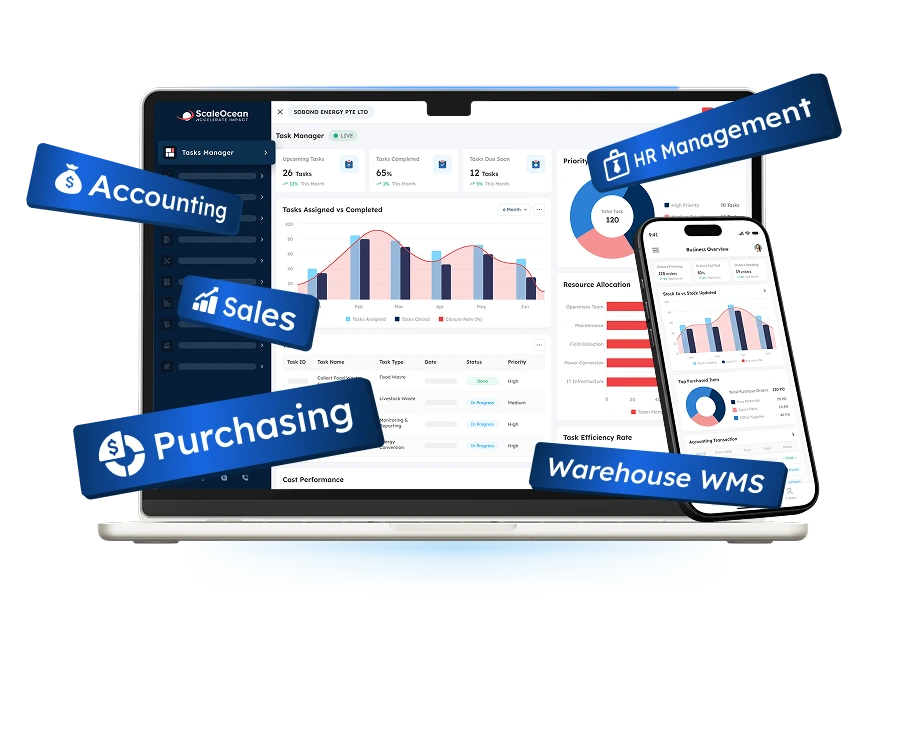
It integrates with business modules such as finance, accounting, reporting, purchasing, inventory, and other components within the software as one overall solution and contains over 200 modules, a limited number of users, a flat fee, along with flexibility in customizing the way the financial statements are generated and reported on, so internal and external personnel can easily assess information.
In addition to streamlining the audit process with automatically integrated data as well as automating workflows, centralized reports, and inter-departmental transactions, there is the availability of a more efficient and precise accounting for manufacturing or production industries. The integration with IIoT means companies can automate and track the use of inventory, raw material consumption, and production cost.
ScaleOcean also supports Singapore compliance needs through SFRS/SFRS(I) aligned financial reporting and an IRAS Audit File (IAF) Generator. With this feature, businesses can export audit documents in the required IAF format automatically, making tax audit preparation more efficient, structured, and easier to verify.
Stay ready for audits, improve long-term financial controls, enjoy top-tier support and best practices with a workflow developed over the years, get your free demo, and find out how easy your external audit process can be with ScaleOcean!
Conclusion
An external audit is a review of a firm’s accounts, statements, and any supporting documents by an independent external entity in order to ensure that the statements are presented faithfully and accurately in accordance with all relevant accounting standards. Through audits, firms can establish their financial credibility, demonstrate a degree of confidence with stakeholders, and also reveal areas that need additional controls or enhancement.
Unfortunately, many businesses encounter challenges with their audits, such as a lack of integration between financial information, reliance on manual reporting, incomplete documentation, and no visibility of transactions.
Accounting software ScaleOcean can assist in resolving these problems through centralized financial accounting, a simpler report format, and clear transactional audit trails for all entries within the accounting software. You can receive a free demo of the software and learn how you can make your company audit-ready without working tedious overtime on the problem.
FAQ:
1. What is the meaning of an external audit?
An external audit is an independent, objective examination of an organization’s financial statements, records, and internal controls. It is conducted by a third-party, certified professional (such as a CPA or chartered accountant) to verify that the reported figures are accurate, fair, and legally compliant.
2. What are the types of external audits?
It is important to note that external audits can be conducted in a variety of areas, including financial audits, ISO certification audits, IT security audits, and environmental audits. The exact process may vary depending on the type of audit and the standards and regulations involved.
3. Who can do an external audit?
External auditors must be qualified accountants and members of a professional body such as ACCA.
4. What is the main purpose of an external audit?
The main purpose of an external audit is to provide an independent, objective opinion on whether an organization’s financial statements are accurate, complete, and comply with relevant accounting standards. By evaluating internal controls and verifying financial data, they assure shareholders, regulators, and investors, fostering transparency and trust.






















.png)