Internal audit in Singapore refers to an independent evaluation conducted within an organisation to assess the effectiveness of its internal controls, risk management, and governance processes. We found that Attlassystem has discovered that many companies struggle to keep their internal audit processes aligned with frequent updates.
These struggles eventually, has led to an increase in the risk of non-compliance and potential financial penalties. Financial challenge becomes more critical when teams still rely on manual processes or disconnected systems.
Regulatory changes are often implemented too late, while limited real-time visibility makes it difficult to identify compliance gaps early. As a result, internal audits tend to be reactive rather than preventive.
To address this, businesses need a more integrated approach that enables automated control updates, centralised data access, and continuous compliance monitoring.
With the right system in place, It can shift from a compliance burden into a strategic function that supports stability and confidence in navigating regulatory changes. Continue reading this article to explore practical strategies and solutions that can help strengthen your internal audit processes in Singapore.
Key Takeaways
An internal audit is an independent, objective activity that helps an organisation accomplish its objectives by evaluating and improving risk management, control, and governance processes.
The audit process involves a systematic approach, including planning, fieldwork, reporting on findings, and following up on corrective actions to ensure issues are resolved effectively.
Internal audit report uses the 5 Cs—Criteria, Condition, Cause, Consequence, and Corrective Action—to clearly communicate findings and drive meaningful improvements.
The key importance of internal audits is crucial for CEOs, as they provide vital assurance to the board and management that business risks are being managed properly.
With ScaleOcean’s Accounting Software, you can automate data gathering and monitoring, which simplifies the internal audit process and provides real-time insights for better decision-making.
An internal audit is totally independent, and it essentially is a review of how effective or ineffective all things are, to make sure that a company’s functions run smoothly.
At the very least, it gives you that invaluable peace of mind that your risk in business is under control, which is so critical. In this case, the purpose is to enhance the operation in order to improve the way things are managed.
It’s noteworthy for the impact of the internal audit’s significance. It is a more valuable Critical Friend to the whole organisation if looking for problems is not the only important thing, it’s also where you can offer ideas for real improvement.
This is a critical aspect as it is basically a way to consistently and discipline push the business towards strategic targets that can be used to review and improve the effectiveness of our existing processes.
How an Internal Audit Works?
When we look at how it works, it’s pretty much a situation where dedicated auditors step in to assess various parts of the company, which is a key part of the whole process.
They really dive into policies, procedures, and even day-to-day operations, just to check if everything aligns with the company’s main objectives and what are considered best practices in the accounting world; truly, it’s a very thorough and systematic review.
Once that assessment phase is done, the next step in the process usually involves these auditors putting together a comprehensive report specifically for management and the board of directors.
It is not a formality; this report is actually detailed and provides leadership with a clear indication of where there is potential for problems or inefficiency in the premises, followed, crucially, by practical advice on how to improve, so that leadership has a picture of the health of the premises to inform decision-making.
What are the Different Types of Internal Audits?
Of course, internally auditing it, it’s not one particular internal audit; you have probably various sorts of internal audits, and they’re used for a varied type of particular component in the organisation, typically.
On the contrary, it foremost relies on a business’s goal, risk, specification of the industry, etc., in addition to anything a lot more particular and useful. This is typically a lot more convenient for an accounting group significantly.
1. Operational Audits
Auditors will really go through workflow, such as from the actual production lines to, say, your customer service processes, all to find out where those bottlenecks are, or where there’s just a bit of waste.
Then they will start to develop and suggest what changes are needed to truly streamline those operations and, hopefully, to make the business work a little better, since after all, it’s all about making those operations work the way they want and giving the business a once again boost of growth.
2. Compliance Audits
The compliance audit works by comparing the two sets of external laws and regulations against the set of internal procedures carried out by an organisation to determine whether procedures are being carried out.
As you will find out soon, a compliance audit is simply a comparison of two sets: one of external laws and regulations and one set of internal procedures followed by an organisation, to determine whether the organisation is following the internal procedures.
For all such reasons, it’s extremely important to make sure that the firm has gotten the rules of the game right, and that’s essential to staying out of problems and fines down the road.
The findings may be included in a report and have a significant impact on achieving non-compliance should the business find it out in its operations, a major part of business governance and a responsibility of every business to focus on.
3. Financial Audits
A key measure of the process is financial auditing, that is, verifying the integrity of the financial information and data from the inside. This type of financial audit is quite essential to avoid fraud and error, before it really takes root
It provides confidence in the management of the amount they are relying on to make decisions, that they are not making incorrect decisions. But, it’s a really proactive move, part of the process actually, to be sure the financial health of the accounting operations.
4. Information Technology (IT) Audits
Unfortunately, with the IT audits, let’s face the facts; it’s all about a company’s tech infrastructure overall. Whereas with IT audits, it’s about data firm tech setup generally, which is today very much pertinent in our digital-first enterprise setting.
They are entering and auditing how well things work, if they don’t use software for what it’s supposed to be, if there is a vulnerability to hacking, and, of course, the procedures to back up the data, which are important if there is a plan in place.
Overall, its mission is to ensure the technology it employs – from security to processing – is secure, reliable and that it is in fact helping to achieve its overall objectives, which include protecting its critical digital assets.
5. Environmental Audits
This type is definitely gaining in importance – particularly for companies that are striving to focus on sustainability and corporate responsibility. Having a closer look at enterprises’ waste management policies, or even at their energy use, is not an exceptionally rare example of thorough investigation in the field of environmental audits.
It’s just that word, because the findings of these audits can actually be used as effective strategies for your business to help reduce environmental impacts, not just as a tedious undertaking that you’re putting in place to avoid the fines.
6. Performance Audits
Performance audits aren’t just about ticking boxes for compliance or making sure the numbers add up; it’s more about truly measuring actual results against planned outcomes, which is a key part of internal audit meaning for many accounting teams.
The process might involve looking closely at a marketing campaign, just to see if it actually delivered on those crucial ROI targets it was set up for and the feedback from this whole report is crucial for solid strategic decision-making going forward.
Comparing Internal and External Audits
Our team has found a study on ResearchGate that revealed it’s pretty common to find people mixing up internal and external audits, but their underlying purposes are quite distinct when you look closely.
An internal audit firm is generally undertaken by the company’s own staff, and it will report directly to the management and board. Its foremost purpose is to enhance internal transactions and controls of the accounting framework.
An external audit process, on the other hand, is a different story as it tends to be a 3rd party independent firm, which is quite a significant key in transparency.
They are responsible for reporting on the “fairness and accuracy” (often as part of an officially certified report) about the company’s financial statements to those who do not have firsthand knowledge of the situation, including the company’s investors and lenders. It’s simply a pledge to be accountable for the wider accountancy profession.
Here’s a summary table to help you get a better understanding of the differences between Internal and External Audits in Singapore Business:
Aspect
Absorption costing
Variable costing
Scope
Focuses on operational aspects, risk management and internal controls. Be able to encompass different facets of business.
Primarily responsible for the production of financial statements, compliance with financial laws and standards such as Singapore Financial Reporting Standards (SFRS), etc.
Frequency
Ongoing, usually carried out yearly and integrated into the company’s internal processes.
Once a year or as stipulated in law due to regulations.
Independence
Employees vs Employee – may create a conflict of interest.
Objectively executed with an independent third-party company.
Follow-up
An internal audit includes action plans that deal with any issues or shortcomings discovered in the audit.
A report by the auditor contains recommendations, and a company is typically in control of an action plan, which is prepared afterwards.
Example
Checking employees’ expenses, payroll procedures and auditing for fraud.
Auditing of financial statements, balance sheets, income statements and tax returns.
Internal Audit Process
Well, it isn’t like a random walk, does it? – rather a very well structured process with many key stages – and each stage is important to get a good, productive review from, aiming for good practices.
In fact, it is a very systematic way of assessing the operations of a company—this whole process ensures that each audit we conduct is always consistent, objective and complete, so we understand the meaning of internal audit for the health of the business
Step 1: Planning
This is where you truly nail down what you want to do and what your objectives are. So it’s here that auditors are going to be joining management and finding out what these parts of risk are and what they’re going to be looking at in the entire audit process, and that’s a pretty important part of it as well.
They are then going to plan a specific audit programme, a list of every test and procedure which needs to be performed. This strategy just means that the team will remain super-efficient and efficient during fieldwork, so they don’t waste a lot of time during the post-fieldwork phase. efficient and focused during fieldwork, preventing a lot of wasted time later on, which is always a good thing.
Step 2: Conducting the Opening Meeting
So, before any actual fieldwork even gets started, we usually schedule this opening meeting with the management of the department we’re going to be auditing. It’s really key because this meeting kind of sets the whole tone for the process, and it gives everyone a solid chance to chat about the audit’s scope, its objectives, and the timeline.
It’s making sure everyone is on the same page from the very beginning. It really helps clarify what to expect, and honestly, addressing any initial questions or concerns right then and there tends to lead to a much smoother and more productive audit overall, which is what we’re aiming for.
Step 3: Fieldwork
Fieldwork, really, it’s the heart of the process, the stage where auditors truly roll up their sleeves and put the audit program into action. Here, they gather all sorts of evidence by interviewing staff, watching processes unfold, and meticulously testing transactions and controls, which is ultimately where the actual assessment takes place.
Now, during this crucial fieldwork phase, auditors are not just collecting; they’re also meticulously documenting everything they do. They need to be quite thorough and objective when gathering all this evidence, because that’s what makes sure their final report conclusions are supported by solid facts.
Step 4: Documenting Findings
When auditors are out doing their fieldwork, they really get into documenting everything they find. Every single observation, all the test results, and each bit of evidence are all written down, which is a key part of the whole process.
Having clear, well-organised documentation really sets up a path, a kind of trail that another auditor could easily follow to reach the same findings, which is important for the final report. It ensures everything we’ve found is credible and defensible, making sure there’s no question about the integrity of our work.
Step 5: Conducting the Closing Meeting
Once the fieldwork, which is a significant part of the internal audit process, finally comes to its completion, a closing meeting is set up with management, which is really quite key.
Here, the auditors present their preliminary findings and any identified issues that surfaced, and this offers a good chance for management to provide context or to effectively clarify any misunderstandings that might be present. It’s an important part of making sure the audit report reflects everything accurately.
Step 6: Reporting
So, after that closing meeting is all wrapped up, the audit team really gets down to preparing the formal report, which, to be honest, is a pretty essential part of the wholeprocess.
It’s really crucial for this report to be clear, concise, and, honestly, super constructive; we’re not just looking to point fingers here. The main idea isn’t to lay blame, but more to truly drive positive change within the accounting operations. A report that’s put together well, it really is a powerful tool for communicating value and spurring action, making a real difference.
Step 7: Monitoring and Follow-up
The process, it truly doesn’t just end when the report is finally issued; the very final step, and a really important one, involves monitoring and a thorough follow-up.
Without this, it’s pretty clear that many audit recommendations might just get ignored, which isn’t what anyone wants to see, especially in an report. So, this step is absolutely critical for ensuring continuous improvement within the organisation, and that’s the main goal.
As you can see, accounting software plays a vital role in the internal audit process by streamlining financial reporting, ensuring accuracy, and enhancing transparency. Using the right software helps ensure that the organisation operates within legal and financial guidelines.
At ScaleOcean Accounting Software, we understand that efficiency and compliance go hand in hand. Try ScaleOcean’s free demo today and discover how our all-in-one accounting software can help your internal audit team enhance control, improve processes, and contribute to achieving your company’s long-term goals.
What are the 5 Cs of Internal Audit Reports
To really make a report effective, and so it can actually get things done, many auditors, especially in the accounting field, often lean on what’s called the ‘5 Cs’ framework.
This structure, it really helps to ensure those audit findings are communicated clearly, where it also leads to concrete action, which in turn provides a very logical flow that makes the whole report easy for management to understand, and really, to grasp the main points of the process.
1. Criteria
When we’re talking about criteria, it really just refers to the standard, or the policy, or the expectation we use to make an evaluation. It’s truly the benchmark for what ‘should be,’ giving us that baseline for things.
Without having really clear criteria, it becomes almost impossible to judge performance objectively, which is super important for any internal auditing activity. It’s the thing that answers the big question, ‘What’s the correct process here for us?’ This ultimately sets the baseline for the entire audit finding, which, in an internal audit report, really helps to make everything clear.
2. Condition
The Condition really is the cold, hard factual evidence an auditor uncovers, showing us what’s actually happening out there in the real world.
For any audit report, this section really needs to be precise and always backed up by solid evidence because it’s what directly shows the contrast with the established Criteria, highlighting where the actual gap is. It’s not uncommon to see this part just clearly stating the problem that was discovered, which is crucial for understanding the impact on operations.
3. Cause
When we talk about the ’cause’ in a report, we’re really looking at why a particular condition exists—it’s that underlying root reason for the gap, the difference between what should be happening (our criteria) and what actually is happening.
Getting a solid grasp on this ‘why’ really helps management get to the fundamental issue, which then stops the same problem from just happening over and over again, something you often see in less structured audit findings.
4. Consequence
When we talk about ‘consequence’ in a report, it’s really about spelling out the ‘so what’ for any finding, often referring to it as the actual effect or impact that’s been identified. This is where you grab management’s attention, because it directly highlights the potential harm to the business that could happen if things aren’t addressed.
Making an effort to quantify that consequence, when it’s possible, just makes the finding itself so much more impactful and really powerful. This approach tends to demonstrate the urgency of taking action, pushing for a quicker response within the process.
5. Corrective Action
So, in the report, we get to the Corrective Action section. This part really lays out what needs to be done, the actual steps management should be taking to fix the underlying cause of a finding. These recommendations must be practical, specific, and achievable; otherwise, what’s the point, right?
It’s not just about pointing fingers; this whole section is quite forward-looking and truly collaborative in the process. Auditors and management often work pretty closely together here, developing these action plans, which really help ensure the solutions are realistic and that management is truly committed to implementing them.
What is the Importance of Internal Audits?
When we talk about the importance of internal audits, it’s truly about the health and the long-term success that a business can achieve, which is a big deal in accounting. These audits are there to offer objective assurance to both the board and senior management.
Letting them know if the company’s risk management and those crucial internal control systems are really working well, performing as they should be, in essence. It’s a foundational piece, a key part of building and maintaining strong corporate governance, you might say.
Beyond just ticking boxes for compliance, internal audits really step up to help find opportunities where a business can truly improve both its efficiency and its overall effectiveness, which is a core benefit of the process.
What Does an Internal Auditor Do?
Is a professional who evaluates a company’s internal controls, its corporate governance, and all those accounting processes. Their whole job is making sure the company is operating in an efficient and effective way, while also just complying with laws and regulations. They’re kind of the organisation’s internal watchdogs, you could say.
Now, they do a lot of things, like planning and executing the actual audits, documenting all their findings into a report, and then communicating those to management. But really, their role isn’t just about finding faults.
They also very much act as consultants, providing advice and recommendations on how to improve those processes and, importantly, to mitigate risks across the business.
How Does ScaleOcean Manage Internal Audit Automatically?
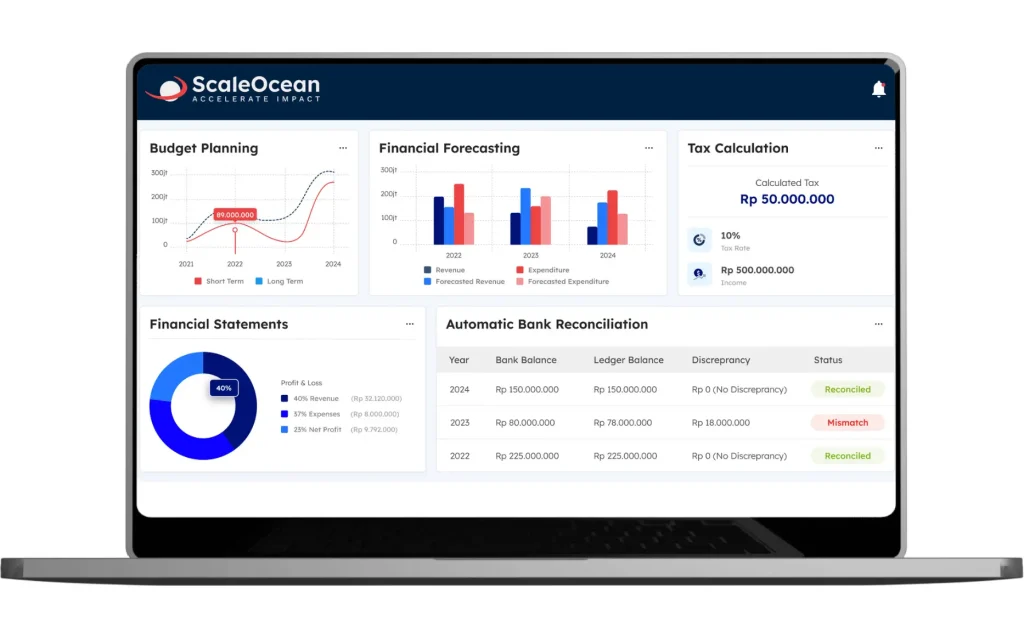
Businesses need an internal audit system that is not only efficient but also scalable. ScaleOcean’s Accounting Software is designed to meet the growing needs of organisations. Our rational and flat pricing structure guarantees that you get full value, without hidden costs, providing unlimited user access at no additional cost.
This means your entire team can seamlessly collaborate and contribute to the auditing process without worrying about extra fees. With over 200 modules integrated into a single platform, ScaleOcean Accounting Software ensures that your team has the tools needed to stay ahead of compliance and regulatory changes.
Furthermore, ScaleOcean meets Singapore grant requirements, offering up to 70% in grants, making it a cost-effective choice for businesses looking to streamline their operations while staying compliant.
Here are the key features of ScaleOcean’s Accounting Software:
Audit Trail and Transparency: Tracking every transaction, decision, and change in the system, to help businesses easily identify discrepancies, verify compliance, and ensure accountability at every level.
Financial Controls & Compliance: A strong internal audit function enables businesses to monitor financial activities to ensure that financial reports are accurate and compliant with all applicable standards, including those set by the Monetary Authority of Singapore (MAS).
Risk Evaluation & Testing: Regularly assessing potential risks and testing controls, businesses can identify vulnerabilities, mitigate exposure, and improve operational effectiveness.
Internal Audit Reporting: Regular reports provide insights into the effectiveness of internal controls, highlight areas of improvement, and ensure that key stakeholders are informed. Accurate reporting helps businesses stay aligned with compliance requirements and strategic objectives.
Integration with Other Systems: This integration enhances efficiency, reduces manual effort, and improves the accuracy of audit results. By having all systems interconnected, businesses can identify discrepancies faster and make more informed decisions.
Strong internal controls are the backbone of any successful business. ScaleOcean Accounting Software ensures the accuracy and reliability of financial reporting, safeguards assets, and promotes operational efficiency. Internal audits help businesses maintain and strengthen these controls, allowing them to better manage and monitor processes, reduce errors, and prevent fraud.
Conclusion
So, as we’ve seen, internal audits are much more than just a box-ticking exercise for compliance. It’s a really vital function that, when done right, acts as a catalyst for continuous improvement and strategic growth.
For CEOs and decision-makers, viewing internal audit as a partner rather than just a policing function is a major shift in perspective, but a necessary one. From strengthening internal controls to improving operational workflows and managing critical risks, the value is clear. The insights from an internal audit report provide a roadmap for making smarter, data-driven decisions.
Try ScaleOcean’s free demo today to see how our integrated accounting software helps streamline your internal audit processes with complete transparency, financial controls, and system integration.
FAQ:
1. How should an internal auditor conduct an audit?
An internal auditor should start by understanding the business processes, identifying risks, testing controls, and reviewing financial records. They should then evaluate the effectiveness of controls, document findings, and report recommendations to improve compliance and performance.
2. How to improve internal audit efficiency?
Internal audit efficiency can be improved by automating routine tasks, integrating audit software, streamlining reporting, and utilising data analytics. Regular training and collaboration with other departments can also enhance audit accuracy and reduce time spent on repetitive tasks.
3. What is an internal audit checklist?
An excellent tool for evaluating an organisation’s procedures and practices against the standards outlined by ISO is an internal audit checklist. Everything required to accurately and quickly complete an internal audit is included in the internal audit checklist.
4. Who performs internal audits?
Any audit professional who works directly for management at some level and whose main duty is to assist management in carrying out its oversight and internal control responsibilities as effectively and efficiently as possible is referred to as an internal auditor for this recommended practice.













 Key Takeaways


 Businesses need an internal audit system that is not only efficient but also scalable.