
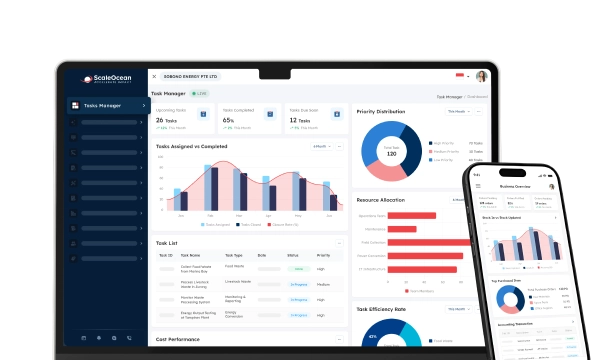

Catering management software refers to a digital program created for catering companies to manage a variety of crucial operations in a single integrated system, including event booking and customer billing. This software aims to provide greater cooperation and management among various operational processes, which allows a catering team to better manage daily operations.
Operating multiple events, suppliers, conducting kitchen operations, and catering to various customer needs all at once can make running a catering business in Singapore rather complex. If there’s no connected system, teams can experience poor data management, incorrect food costing, allocating staff in a way that isn’t efficient, and issues with changing the plan at the last minute.
Suitable catering management software helps businesses create a more structured operating environment by connecting customer orders, menus, recipes, inventory, purchasing, production planning, delivery activities, and financial information. With integrated workflows, catering companies can improve operational efficiency while gaining better visibility into business performance.
Data gathered by our team from IMDA reveals that 95.1% of Singapore’s SMEs have implemented at least one digital area in 2024, and 97% have implemented at least one sector-specific digital solution to address business needs in 2024. The growing digitization of this suggests that catering businesses need to equip themselves with tailored software solutions to optimize their operations.
Read this article to understand the most vital features, benefits, and the way to decide on the right catering management software in Singapore based on the dimensions of the business, its requirement for scalability, and long-term goals.
 Key Takeaways
- Catering management software is a digital solution that helps businesses manage orders, menus, inventory, staff, events, and financial processes on one platform.
- Catering businesses in Singapore need management software to handle strict food safety rules, high labor costs, and complex event logistics.
- The top catering management software in 2026 includes ScaleOcean Atlas for Industry, Tripleseat, Event Temple, CaterZen, Civica Catering Management, Total Party Planner, Connecteam, Caterease, Better Cater, and Infor Sales & Catering.
- ScaleOcean F&B Software connects catering operations with inventory, accounting, workforce management, and reporting workflows to help businesses improve visibility and manage complex food service operations through an integrated platform.
What Is Catering Management Software?
Catering management software is a specialized business solution that helps catering companies organize the processes involved in preparing, managing, and delivering catering services. Unlike basic scheduling tools, catering management platforms are designed to handle the complete workflow from customer inquiry and event planning to kitchen preparation and delivery coordination.
The software enables businesses to manage important catering activities such as menu creation, recipe costing, ingredient planning, inventory monitoring, staff scheduling, and event execution. By connecting these processes in one platform, catering teams can reduce operational gaps and improve coordination between sales, kitchen, procurement, and delivery teams.
For businesses managing multiple events or locations, catering management software provides better visibility into operational activities. Teams can monitor order requirements, production schedules, ingredient availability, and workforce allocation more efficiently, helping them deliver consistent service quality while managing increasing customer demands.
Why Catering Businesses in Singapore Need Management Software

Catering businesses in Singapore need management software to handle strict food safety rules, high labor costs, and complex event logistics. This technology automates menu costing, real-time inventory tracking, staff scheduling, and client billing to reduce costly mistakes and boost profit margins.
1. Rising Food and Ingredient Costs
With the fluctuation of food prices, it has become more important than ever for catering businesses to manage their costs. Inaccurate recipe costing and food visibility in inventory could cause companies to fall short of understanding real food costs and pricing strategies.
Catering management software enables businesses to track the use of ingredients, estimate the cost of recipes, and manage and compare expenses to budgeted figures. This enables teams to spot cost differences sooner and to make more informed decisions when modifying menus or procurement plans.
2. Managing Labour Costs and Staff Scheduling
For catering businesses, there is a need to coordinate a range of activities from the chefs and kitchen staff to the event team, delivery staff, and temporary staff. Depending on the size of an event, its location, and the services needed, manual scheduling can be challenging to match the proper number of employees.
A catering management system is designed to streamline the process of managing an organization’s staffing needs and schedules, ensuring that catering services are available when they are needed. This makes it more efficient to allocate resources and minimizes the scheduling problems or any redundant labour expenses.
3. Preventing Food Waste and Stock Expiry
One of the biggest challenges for catering companies is managing food waste, particularly if they have large menus and several events to cater. Inventory visibility can lead to over-ordering, unused ingredients, or expired inventory.
Catering management software integrates inventory data into the menu planning and procurement process, enabling businesses to track their inventory usage with greater accuracy. This helps to make better purchases and to maintain stock efficiently.
4. Coordinating Multiple Events and Last-Minute Changes
Catering companies are typically required to cater a number of events that have different menus, serving sizes, delivery times, and customer needs. When information isn’t shared between teams, the last-minute changes can cause operational problems.
A centralized catering platform enables teams to monitor event information, update catering needs, and coordinate among sales, kitchen, and delivery teams. This enables businesses to react much quicker and keep a consistent service.
5. Maintaining Consistent Food Quality Across Locations
Businesses operating multiple catering locations or branches need consistent processes to maintain food quality and service standards. Differences in preparation methods, ingredient usage, or operational procedures can affect customer experience.
Catering management software helps standardize recipes, production processes, and operational workflows across locations. This allows businesses to maintain consistency while scaling their catering operations.
6. Managing Food Safety and Operational Records
Documentation of ingredients, food preparation and storage activities, and operational procedures is crucial in food safety. Manual record-keeping can create administrative burdens and make it more difficult to keep track of the day-to-day information of the operation.
A digital catering management system can help businesses keep track of their catering activities in a structured way, ensuring traceability of all food preparation and service operations. This helps provide more operational control and access to critical business data.
Catering Management Software Comparison at a Glance
Catering Management Software enables food businesses to manage event booking, menu pricing, kitchen production, staff changes, and client billing. The best platforms range from basic online menus for small cafes to robust enterprise solutions for big banquet and corporate catering.
The following table gives a brief overview of the key differences between the various catering management software solutions, with regard to their operational focus, how they scale, and whether they fit the business needs.
| Vendor | Best For | Singapore Fit | Price |
|---|---|---|---|
| ScaleOcean | Medium- to large catering enterprises requiring integrated ERP workflows, central kitchen management, inventory, procurement, finance, and multi-location operations. | Suitable for Singapore catering businesses managing complex operations, multiple entities, large-scale events, and industry-specific workflows. | Pricing is customized based on business requirements, selected modules, integrations, and implementation scope, while supporting unlimited users with transparent costs and no hidden fees. |
| Tripleseat | Catering and hospitality businesses focused on event sales, booking management, and customer relationship management. | Suitable for businesses managing venue-based events and customer bookings in Singapore. | Subscription-based pricing depends on selected features and plan. |
| Event Temple | Hotels, venues, and catering providers managing event sales, contracts, and customer communication. | Suitable for hospitality groups and event-focused catering businesses. | Subscription pricing is based on features and business requirements. |
| CaterZen | Small to medium catering companies managing orders, customers, and delivery activities. | Suitable for growing catering businesses that need basic catering workflow management. | Subscription-based pricing depending on usage and features. |
| Civica Catering Management | Institutional catering organizations require menu planning, food production, and compliance management. | Suitable for schools, healthcare, and large-scale food service operations. | Pricing is available through vendor consultation. |
| Total Party Planner | Event caterers manage proposals, recipes, costing, and event planning. | Suitable for catering companies focused on event-based operations. | Subscription-based pricing depends on plan selection. |
| Connecteam | Businesses requiring workforce scheduling, communication, and employee management. | Suitable for catering businesses managing mobile teams and operational staff. | Subscription pricing is based on users and features. |
| Caterease | Banquet and event caterers need event planning, proposals, and customer management. | Suitable for small to medium event catering businesses. | Pricing varies based on package and features. |
| Better Cater | Small and growing caterers managing online orders and customer interactions. | Suitable for smaller catering businesses expanding their digital operations. | Subscription-based pricing. |
| Infor Sales & Catering | Hotels and hospitality groups managing catering sales and event operations. | Suitable for hospitality businesses requiring enterprise-level event management. | Enterprise pricing is based on implementation scope. |
12 Best Catering Management Software of 2026 in Singapore
Today’s menu management, recipe, inventory, staff scheduling, event needs, and customer order systems are no longer sufficient and are certainly not integrated for catering businesses in 2026. With the right catering management software, businesses can streamline kitchen operations, track employee activities, minimize operational gaps, and have a better overview of activity at various locations.
When deciding on a catering management software solution, it is important to consider it based on the size of the business, complexity of operations, menu planning needs, inventory management requirements, staff coordination, integration, customization options, and scalability.
1. ScaleOcean — Best for Integrated Enterprise Catering Operations
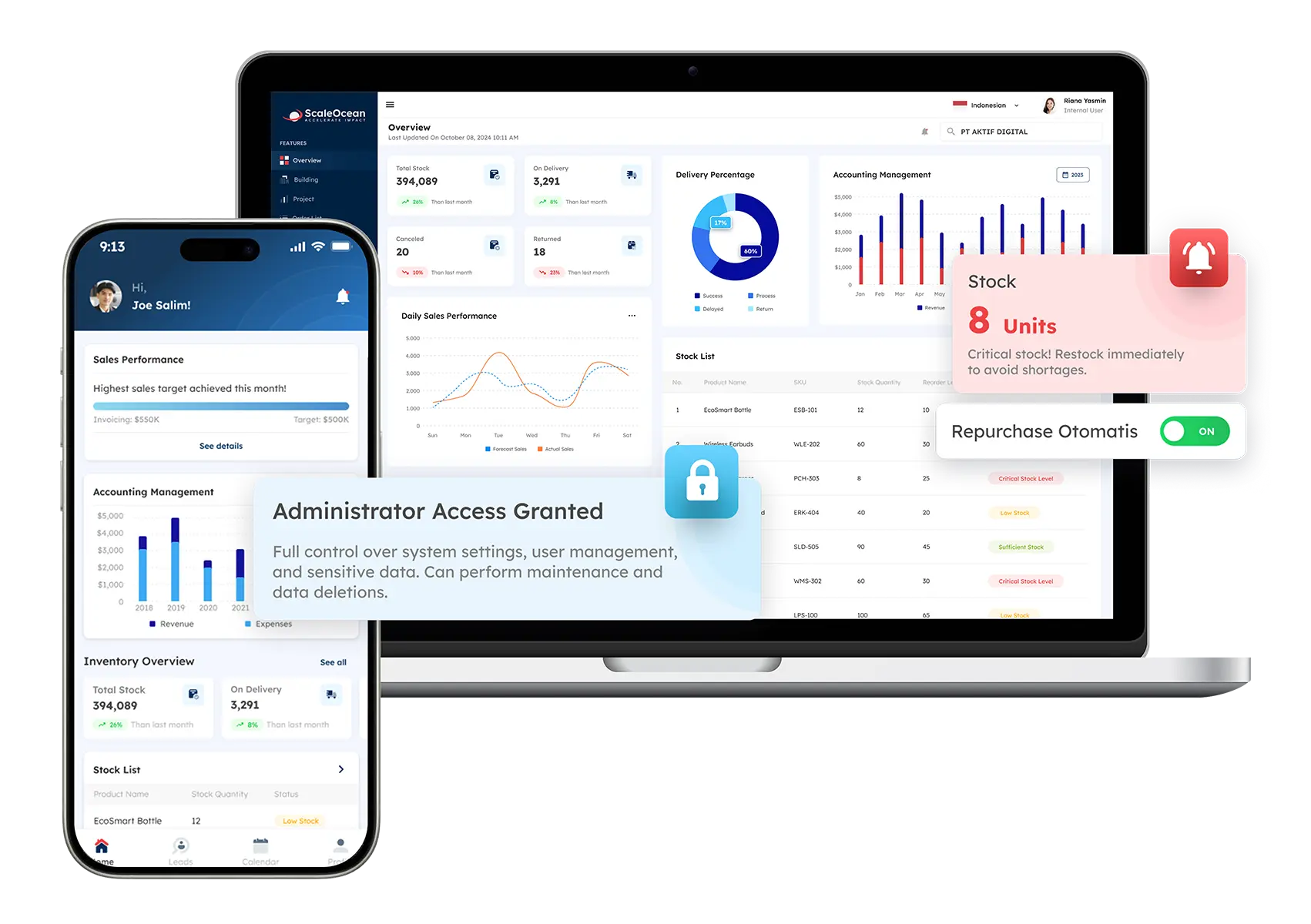
ScaleOcean is an ERP solution provider offering its flagship platform, ScaleOcean Atlas, designed to support medium and large catering businesses with complex operational requirements. Unlike standalone catering tools, ScaleOcean Atlas provides an industry-focused ERP ecosystem that can be configured based on business workflows, helping companies manage operations through a scalable and unified platform.
With flexible configurations, ScaleOcean Atlas adapts to different catering business structures, including companies with multiple locations, central kitchens, and complex operational processes. The platform supports connected workflows across catering operations, allowing businesses to improve visibility, streamline processes, and manage their growth through a centralized system with ScaleMind-powered insights.
A structured governance framework is also provided through access controls, approval workflows, and audit trails. The system has been optimized and complies with PDPA regulations and local financial reporting standards, including IRAS and GST requirements in Singapore. Additionally, it can be customized to support EDG and CTC requirements, subject to company eligibility and qualifying project costs. Schedule a consultation with ScaleOcean to explore how configurable ERP workflows can support your catering operations.
Key Features:
- Industry-specific catering workflows and configurable modules
- Recipe costing and ingredient planning
- Procurement and inventory management integration
- Workforce scheduling and operational coordination
- Financial and accounting workflow integration
- Role-based access and approval management
- Real-time operational reporting and dashboards
| Pros | Cons |
|---|---|
| Designed around enterprise catering complexity, including multi-location operations, centralized processes, and connected business functions. | May be more comprehensive than required for small catering businesses with simple ordering and scheduling needs. |
| Provides configurable workflows that allow businesses to align the system with existing operational processes instead of changing their business model. | Implementation scope requires business analysis to ensure modules and workflows are configured according to operational requirements. |
| Connects catering operations with inventory, procurement, accounting, and reporting within one integrated platform. | Pricing depends on business requirements, modules, integrations, and implementation scope rather than a fixed package. |
| Supports phased implementation, allowing companies to activate priority capabilities before expanding to additional workflows. |
Best for: Medium and large catering enterprises, multi-location catering providers, central kitchens, hospitality groups, F&B companies, and businesses managing complex food operations.
ℹ️Why choose ScaleOcean Atlas?
ScaleOcean Atlas helps catering businesses manage connected operations through ERP workflows configured based on their specific business requirements. Instead of adapting to a rigid system, businesses can implement workflows, modules, and configurations that align with their operational processes across catering, inventory, procurement, finance, workforce, and reporting.
2. Tripleseat — Best for Event-Focused Catering Management
Tripleseat is a hospitality and event management platform designed to help catering businesses manage event bookings, customer relationships, sales activities, and event coordination. The platform focuses on simplifying the process from initial inquiry and proposal creation to contract management and event execution.
For catering businesses that primarily manage private events, corporate functions, and venue-based catering services, Tripleseat provides tools to organize customer interactions, track booking details, and improve sales visibility. It helps teams coordinate event information across sales and operations departments.
Key Features:
- Event booking and inquiry management
- Proposal and contract creation
- Event calendar management
- Sales pipeline tracking
- Reporting and performance insights
| Pros | Cons |
|---|---|
| Provides dedicated event management capabilities that help catering teams organize bookings, proposals, and customer communication. | Businesses requiring deeper ERP functions such as production planning, procurement, or advanced inventory management may need additional systems. |
| Helps sales teams manage customer relationships and improve visibility into upcoming events. | May require integration with other platforms when businesses operate complex multi-department workflows. |
| Suitable for businesses that prioritize event coordination and customer-facing processes. | Large catering enterprises should evaluate whether the platform supports their full operational structure and scalability needs. |
Best for: Small to medium catering companies, event venues, hospitality businesses, and organizations focused on event-driven catering services.
ℹ️Why choose Tripleseat?
Tripleseat helps catering and hospitality businesses manage event sales, customer relationships, bookings, and event coordination through a centralized platform.
3. Event Temple — Best for Hospitality and Venue Catering Operations
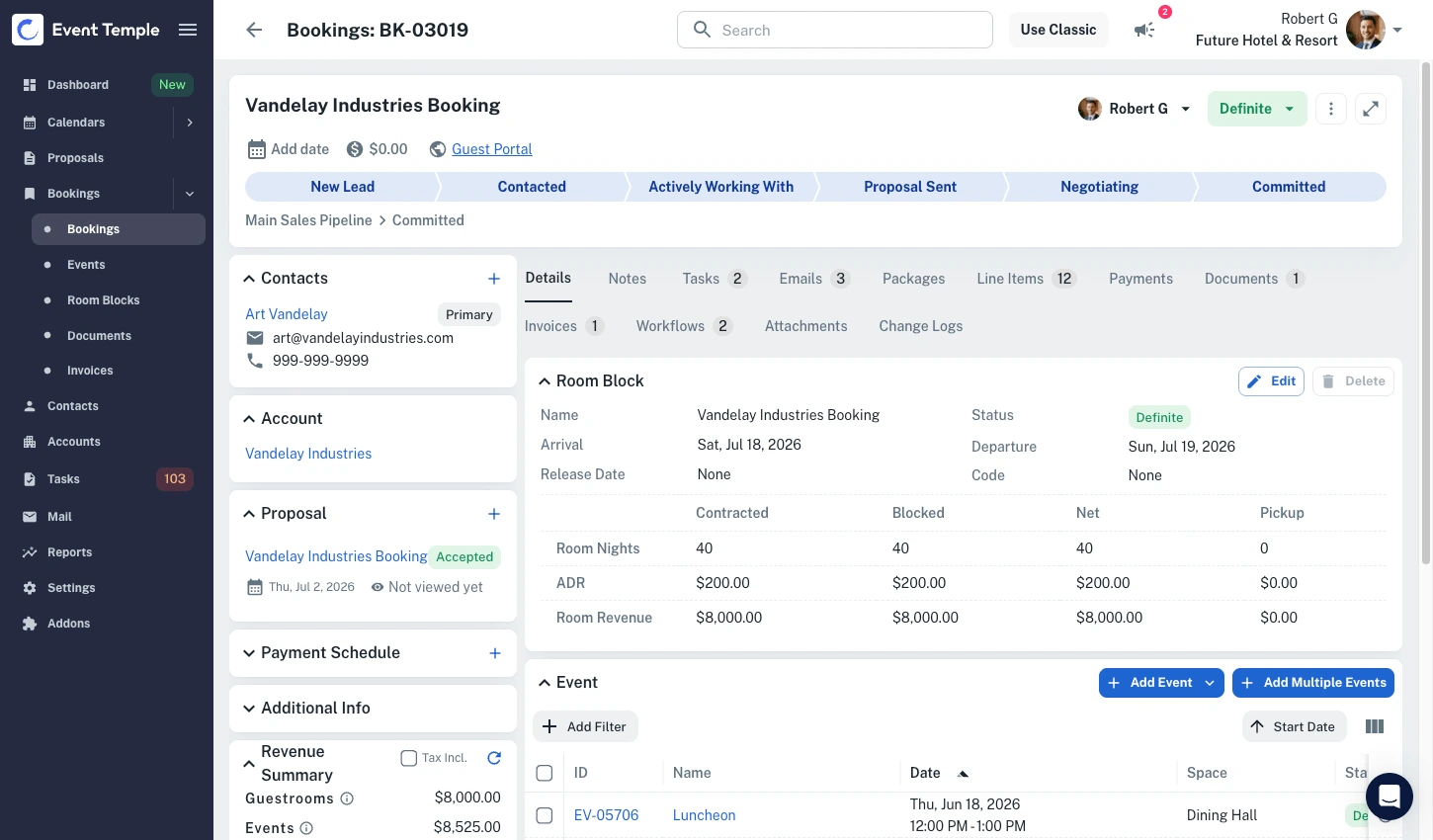
Event Temple is an event management platform designed for hotels, venues, and catering businesses that need to manage event sales, customer communication, contracts, and booking activities. The platform helps teams organize event-related workflows from initial lead management to final execution.
For hospitality businesses offering catering services, Event Temple provides tools to improve coordination between sales teams and operational departments. It helps businesses maintain visibility over event schedules, customer requirements, and revenue opportunities.
Key Features:
- Event booking management
- CRM and lead tracking
- Event calendar scheduling
- Payment tracking
- Sales reporting
- Integration with hospitality systems
| Pros | Cons |
|---|---|
| Provides structured event sales workflows for hospitality businesses managing frequent catering requests. | Companies requiring extensive supply chain, inventory, or manufacturing-style workflows may need complementary solutions. |
| Improves coordination between customer-facing teams and event operations. | The platform may require additional configuration for businesses with highly customized operational processes. |
| Suitable for hospitality groups that need better visibility over event pipelines and bookings. | Businesses outside hospitality-focused operations may need to assess whether its features match their workflow requirements. |
Best for: Small to medium hotels, event venues, hospitality groups, and catering businesses managing customer-focused event operations.
ℹ️Why choose Event Temple?
Event Temple helps hospitality and catering businesses manage event sales, customer relationships, proposals, contracts, and booking workflows in one platform.
4. CaterZen — Best for Growing Catering Businesses
CaterZen is a catering management platform designed to help small and medium catering businesses manage customer orders, event details, delivery coordination, and operational activities. The platform focuses on simplifying catering workflows by bringing customer information, order management, and event-related tasks into one system.
For catering companies that handle frequent orders and need better organization than manual spreadsheets, CaterZen helps teams manage daily activities more efficiently. The platform supports businesses in improving order visibility, coordinating customer requirements, and maintaining smoother communication between teams.
Key Features:
- Catering order management
- Customer database management
- Event scheduling and tracking
- Online ordering support
- Invoice and payment management
- Customer communication tools
| Pros | Cons |
|---|---|
| Provides catering-focused features that help businesses organize customer orders and event-related activities. | Businesses requiring advanced ERP capabilities such as procurement, financial integration, or complex inventory planning may need additional solutions. |
| Helps growing catering teams reduce dependency on manual order tracking and disconnected tools. | Large catering enterprises may need to evaluate whether the platform supports extensive operational structures. |
| Supports better visibility into customer requirements, event schedules, and delivery activities. | Businesses with multiple branches or complex workflows may require additional customization. |
Best for: Small to medium catering companies, corporate caterers, delivery-based catering businesses, and growing food service providers.
ℹ️Why choose CaterZen?
CaterZen helps catering businesses manage orders, customers, event details, deliveries, and operational activities through a dedicated catering management platform.
5. Civica Catering Management — Best for Institutional Catering Operations
Civica Catering Management is a catering solution designed for organizations managing large-scale food services, including education, healthcare, and institutional catering environments. The platform focuses on supporting structured meal planning, food production processes, and operational management.
For institutions serving large numbers of meals daily, the system helps teams coordinate menus, production activities, dietary requirements, and service processes. It provides better control over catering operations where consistency, planning accuracy, and operational records are important.
Key Features:
- Menu planning and meal management
- Food production planning
- Kitchen workflow management
- Reporting and analytics
- Multi-site catering support
| Pros | Cons |
|---|---|
| Designed for organizations managing structured catering environments with high meal volumes and operational requirements. | Small catering businesses may not require the depth of functionality designed for institutional operations. |
| Supports better control over menus, food preparation, and service processes. | Businesses with highly customized commercial catering workflows may require additional evaluation before implementation. |
| Helps improve consistency across large-scale catering environments. | Implementation requirements may vary depending on organizational structure and operational complexity. |
Best for: Medium to large institutions, schools, healthcare organizations, universities, and large-scale food service providers.
ℹ️Why choose Civica Catering Management?
Civica Catering Management supports institutional catering operations through structured meal planning, production management, inventory tracking, and operational reporting.
6. Total Party Planner — Best for Event Catering Planning
Total Party Planner is catering management software designed for event-based catering businesses that need tools for planning, proposals, recipes, costing, and event coordination. The platform helps catering teams organize the preparation process from initial client requests to event completion.
For businesses managing weddings, corporate events, and private functions, Total Party Planner provides features that help teams coordinate event details, estimate costs, and prepare operational requirements. It helps reduce manual planning efforts and improve organization across catering activities.
Key Features:
- Event planning management
- Food costing tools
- Inventory tracking
- Customer management
- Event calendar scheduling
- Reporting capabilities
| Pros | Cons |
|---|---|
| Provides catering-specific planning tools for managing menus, proposals, and event requirements. | Businesses looking for complete ERP capabilities may require additional platforms for broader operations. |
| Helps event caterers improve organization and visibility throughout the planning process. | Multi-entity businesses may need to assess integration and scalability requirements. |
| Supports better cost estimation through recipe and menu management features. | Advanced financial and operational reporting may require additional configuration. |
Best for: Small to medium event caterers, wedding caterers, corporate event providers, and businesses focused on customized catering services.
ℹ️Why choose Total Party Planner?
Deskripsi Jawaban untuk Title Headline
7. Connecteam — Best for Catering Workforce Management
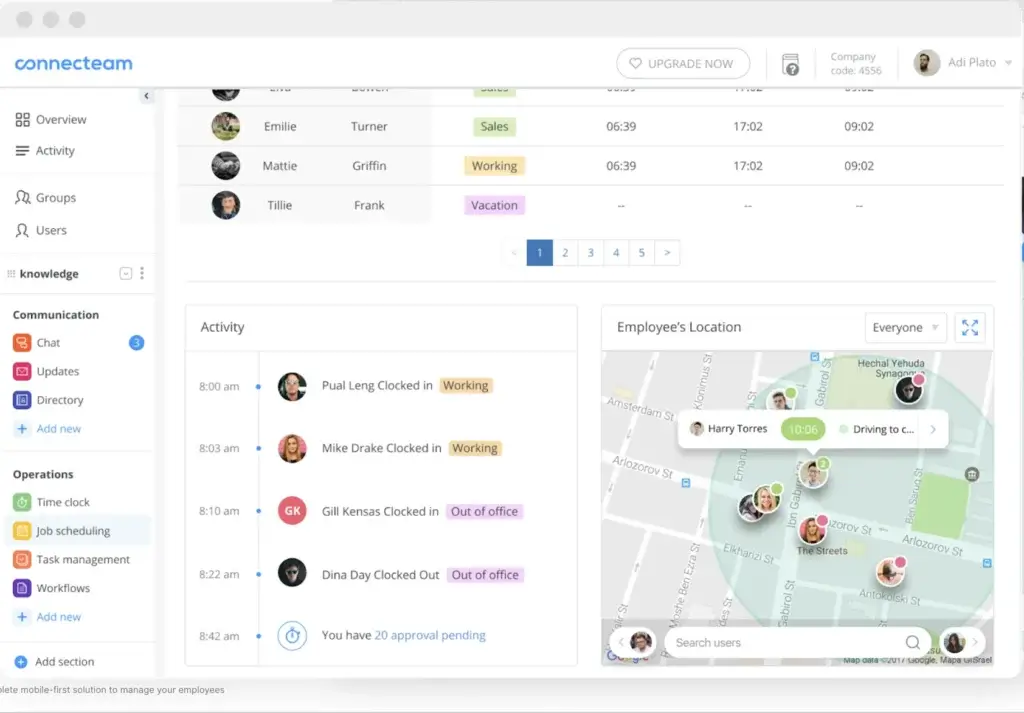
Connecteam is a workforce management platform that helps catering businesses coordinate employees, schedules, tasks, and internal communication. The platform focuses on improving workforce organization by providing tools for managing staff availability, shift planning, time tracking, and operational updates.
For catering businesses that rely on flexible teams, temporary staff, or mobile employees, Connecteam helps simplify workforce coordination. It enables managers to organize schedules, assign responsibilities, and maintain better communication between teams working across different locations or events.
Key Features:
- Employee scheduling and shift planning
- Time tracking and attendance management
- Team communication tools
- Mobile workforce management
- Performance tracking
| Pros | Cons |
|---|---|
| Provides practical workforce management tools for businesses that need better employee scheduling and communication. | Businesses requiring complete catering workflows such as recipe costing, procurement, or kitchen production may need additional solutions. |
| Helps catering teams coordinate mobile employees and temporary workers more efficiently. | Large catering enterprises may need to evaluate whether workforce features integrate sufficiently with broader operational systems. |
| Supports digital task management and operational communication across teams. | It is primarily focused on workforce management rather than end-to-end catering operations. |
Best for: Small to medium catering companies, event catering teams, businesses managing temporary workers, and organizations with mobile operational staff.
ℹ️Why choose Connecteam?
Connecteam helps catering businesses organize employee schedules, task assignments, communication, and workforce activities through a centralized workforce management platform.
8. Caterease — Best for Catering Event Administration
Caterease is catering management software designed to support event caterers with planning, customer management, proposals, contracts, and operational organization. The platform focuses on helping catering businesses manage event details from initial inquiry through completion.
For businesses handling multiple events, Caterease provides tools to organize customer information, menu details, pricing, and event schedules. It helps catering teams reduce administrative workload by bringing important event information into a structured system.
Key Features:
- Event booking management
- Customer database management
- Menu planning
- Event calendar scheduling
- Reporting tools
- Payment tracking
| Pros | Cons |
|---|---|
| Provides catering-specific tools for organizing events, customer details, and administrative workflows. | Businesses requiring deeper inventory, procurement, or financial integration may need complementary solutions. |
| Helps event caterers improve organization by centralizing booking and event information. | Large enterprises may require additional assessment for multi-entity and complex operational requirements. |
| Supports better preparation for customized catering events. | Businesses seeking broader business management capabilities may require an integrated ERP platform. |
Best for: small-to-medium event caterers, banquet providers, wedding catering companies, and businesses managing customized events.
ℹ️Why choose Caterease?
Caterease helps catering businesses organize event planning, customer information, proposals, contracts, and administrative activities within one platform.
9. Better Cater — Best for Online Catering Management
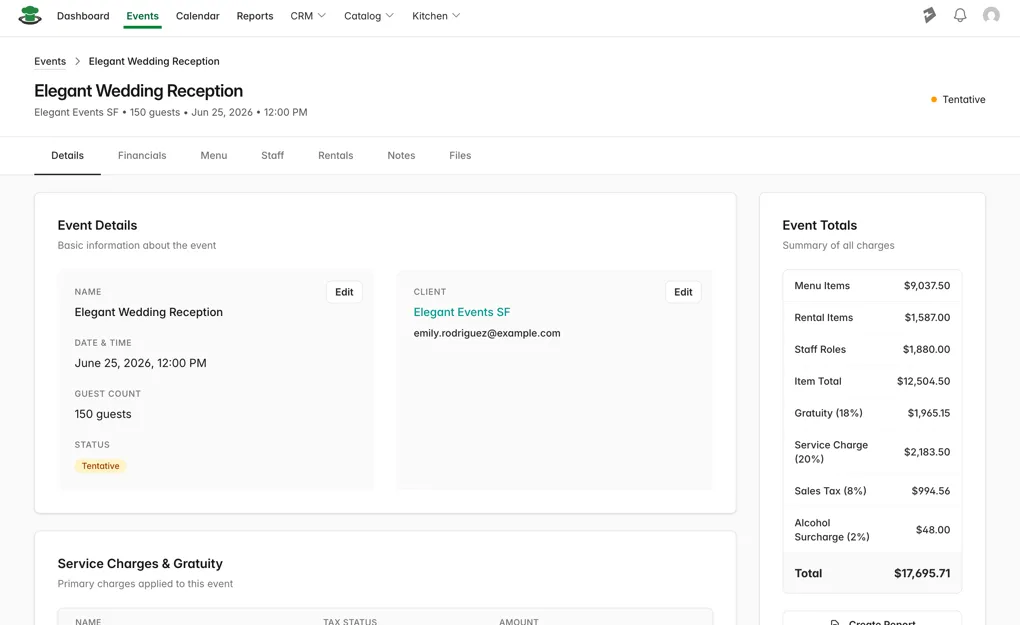
Better Cater is a catering management platform designed for businesses that want to simplify online ordering, customer management, and catering workflow organization. The platform helps caterers manage digital orders while improving visibility into customer requests and service activities.
For growing catering businesses transitioning from manual ordering processes, Better Cater provides tools to manage online interactions, customer details, and order-related activities. It helps businesses improve customer convenience while maintaining better operational organization.
Key Features:
- Online catering ordering
- Customer management
- Order tracking
- Menu management
- Payment processing
- Sales reporting
| Pros | Cons |
|---|---|
| Helps catering businesses improve digital ordering processes and customer interactions. | May not provide advanced operational management for businesses with complex kitchen and supply chain requirements. |
| Suitable for businesses looking to improve online ordering convenience. | Growing enterprises may require additional tools for inventory, procurement, and financial management. |
| Supports better organization of customer orders and catering requests. | Businesses with multiple branches should evaluate scalability and integration capabilities. |
Best for: Small catering businesses, online catering providers, corporate lunch providers, and growing food service companies.
ℹ️Why choose Better Cater?
Better Cater helps catering businesses manage online orders, customer information, menu activities, and digital catering workflows.
10. Infor Sales & Catering — Best for Hospitality and Large-Scale Catering Operations
Infor Sales & Catering is an event and catering management solution designed for hospitality businesses that manage banquet services, conferences, meetings, and large-scale catering activities. The platform helps hotels and hospitality groups coordinate event sales, customer requirements, and operational planning through a centralized system.
For organizations managing complex hospitality operations, Infor Sales & Catering provides tools to improve visibility across event bookings, sales activities, customer preferences, and revenue opportunities. It supports businesses that require structured event management processes and better coordination between sales and operational teams.
Key Features:
- Event sales management
- Banquet and catering booking management
- Customer relationship management
- Event scheduling and coordination
- Hospitality system integration
- Operational performance reporting
| Pros | Cons |
|---|---|
| Provides enterprise-level event and catering management capabilities for hospitality organizations. | Small catering businesses may not require the depth of features designed for large hospitality operations. |
| Helps hotels and hospitality groups improve coordination between event sales and service operations. | Businesses outside hospitality environments may need to evaluate whether the platform matches their operational needs. |
| Supports complex event workflows with structured processes and reporting capabilities. | Implementation requirements may vary depending on existing systems and organizational complexity. |
Best for: Medium to large hotels, hospitality groups, convention centers, and enterprise catering operations.
ℹ️Why choose Infor Sales & Catering?
Infor Sales & Catering helps hospitality businesses manage event sales, banquet operations, customer information, and catering workflows through an enterprise-focused platform.
How Does Catering Management Software Work?
Event management software for catering is an integrated automated solution for managing events. It automates data collection, menu tracking, staff scheduling, and billing, eliminating the need for manual spreadsheets and providing real-time updates. The next few steps will outline how catering management software aids the entire catering process.
1. Step 1: Capture Catering Orders and Event Requirements
The first step starts when companies get requests for catering requests from their customers. Catering management software enables teams to track essential information about the events, such as the number of guests, dietary and special requirements, menu choices, venue location, date of the event, and customer information.
Centralizing order information allows sales and operations teams to have access to the same data without having to use multiple spreadsheets or manually update information. This helps to ensure coordination and decrease the chances of overlooking vital customer needs before preparing for the event.
2. Step 2: Build Menus and Calculate Food Costs
Once event requirements are captured, catering staff can develop appropriate menus, depending on customer preferences, event size, and capacity. Catering management software enables businesses to manage their menu items, recipes, ingredient needs,s and pricing from a single place.
With these features of recipe costing, businesses can determine the cost of ingredients and estimate the profit of each catering order. This can assist teams in developing a more precise pricing policy and also help them to keep a more accurate control of food costs and margins.
3. Step 3: Plan Ingredients and Procurement
After menus have been agreed upon, businesses must make sure that there is enough food and supplies to produce. There is also catering management software that links the catering menu requirements to inventory data to determine the required quantity and organise purchasing activities.
This will provide greater transparency on stock availability, helping businesses to order less and avoid stock-outs of ingredients, as well as to coordinate orders more efficiently. This is particularly beneficial for companies that run several events or operate a central kitchen.
For businesses with extensive food preparation operations, like food chains, solutions like central kitchen management software can help enhance production planning and coordination across various sites.
4. Step 4: Schedule Kitchen Production and Staff
The coordination between chefs, the kitchen staff, event staff, and the delivery team is essential for catering operations. Catering management software is used to schedule the production, assign, and organise catering staff for upcoming events.
Having more accurate scheduling information can help teams plan meals more efficiently, assign staff by workload and minimize conflict in the workplace. This ensures that businesses can keep their kitchen functioning smoothly, even when dealing with multiple catering events.
5. Step 5: Coordinate Delivery and Event Execution
Once the food is prepared, catering teams have to arrange for the delivery of food, set up the event, and execute the service. Catering management software provides visibility of the need to deliver, event schedule, event location, and estimated teams.
This will facilitate communication among the kitchen staff, logistics staff and event staff. Real-time updates facilitate quick responses to changes and ensure that catering services are delivered according to the expectations of the customer.
6. Step 6: Invoice Customers and Analyse Event Profitability
The final step is the activities that occur subsequent to the event and involve money. Catering management software is a system that can help the business to manage the completed catering services, whether it’s the invoices or payment tracking.
Event data can then be combined with financial data, which can assist businesses in analyzing their profitability, food prices, operational efficiency, and growth opportunities. This helps to gain a better understanding of the value-creating catering activities and where efficiencies can be achieved.
With an integrated ERP system, catering companies can use ScaleOcean Atlas to link operational and financial data. Having all sales, inventory, procurement, and accounting information centralized in one system brings more insights to the business, improves the accuracy of reports, and helps make informed decisions for future business operations.
Key Features to Look for in Catering Management Software

The best catering management software comes with a number of features that include the automatic generation of BEO (Banquet Event Order), menu per person, client CRM, and real-time inventory management to streamline the execution of events. Look for platforms that connect your online ordering, scheduling, and accounting needs to cut back on manual data entry.
The right solution should enable the catering team to minimize manual coordination, enhance data visibility, and integrate across various activities in the operation within a single system.
1. Centralized CRM
This is a centralized CRM solution that will help catering companies maintain all the information, communication history, and customer questions, all in one place. Teams can access the same information when creating proposals, making bookings, and following up with clients, rather than having to access it from various spreadsheets and systems.
The feature is particularly beneficial for companies that need to organize frequent corporate activities, weddings, or large-scale catering contracts. Customer records that are organized can help sales staff better understand their customer’s needs, and give them a more customized service from the time the customer places their order until they are done with the customer.
2. BEO & Proposal Builders
Banquet Event Order (BEO) and proposal builder tools help catering companies create a well-organized event document that includes all of the event information, including the menu, the number of guests, the venue, the service requirements, the cost, and the timeline.
This digitalisation of the BEO and proposal process can simplify the creation of documents manually and improve communication between the various teams in the event business, such as the sales team, kitchen team, and event team. This way, operational teams are provided with the right information about events prior to their preparation.
3. Real-Time Inventory and Expiry Management
One of the most crucial features that catering businesses need to have is inventory management, given the short shelf life of food ingredients and the need to keep a close eye on them. A catering management system should provide stock level, ingredient usage, need to buy, and expiry dates visibility.
Having access to real-time inventory information can be beneficial to businesses looking to limit food waste, eliminate stock-outs of ingredients or other supplies, and enable superior purchasing decisions. This is particularly helpful in companies that have multiple events or big menus and central kitchen operations.
4. Catering Order and Booking Management
Catering order management supports businesses in receiving, managing, and tracking client orders from ordering to the completion of an event. The system should be able to easily handle details of the orders, such as dates of the event, customer needs, and food and beverages ordered.
A centralized booking system helps to reduce the chances of losing information and helps to align customer service and operations. This enables businesses to handle the different catering orders in a more efficient manner and maintain the accuracy of services.
5. Menu, Recipe, and Food Costing
Menu and recipe management software allows you to quickly create and organize food recipes and better control your food costs. The system helps teams to develop recipes, calculate quantities of ingredients, and calculate food charges for each menu item.
Food costing is crucial for businesses to determine appropriate pricing, run their operations efficiently, and ensure maximum profitability. This is especially important if the price of ingredients fluctuates or businesses cater for certain specific events.
6. Central Kitchen and Food Production Planning
Production planning can be used by caterers who have several kitchens to make sure food is prepared for several events and locations. The system connects with the menu requirements, the availability of ingredients, production schedules, and kitchen activities.
This increases the visibility of the production process so that enterprises can better allocate resources, ensure the consistency of food quality, and ensure food preparation is done on schedule for events. This is particularly useful for large catering hire companies or those who cater for big orders.
Companies interested in streamlining such processes can be interested in central kitchen management software that can help with coordination between food production, inventory, and distribution operations.
7. Workforce and Event Staff Scheduling
Catering operations rely on effective workforce coordination to manage chefs, kitchen staff, service teams, delivery personnel, and temporary event employees. Staff scheduling features help businesses allocate employees based on event requirements, availability, workload, and operational priorities, ensuring smoother coordination and more efficient resource management.
This helps smooth out the scheduling process, eliminates time conflicts, and ensures the proper resources are available for each event. This also allows managers to keep track of staffing requirements at several venues or at the same time at a number of different catering events.
8. Delivery and Dispatch Management
The delivery and dispatch management parts assist in the coordination of solid transportation exercises, delivery calendar, drivers assigned, and the area of the event. This is vital for businesses that make several deliveries or provide catering services on time.
A connected dispatch system provides visibility of deliveries and enables teams to be more responsive to changes to their schedules. Businesses can make the most of their kitchen completion times by aligning them with their delivery operations, ensuring greater punctuality and customer satisfaction.
9. Multi-Location and Centralized Operations
Catering companies that operate several branches, kitchens, or service points need software that can offer them a comprehensive operational view. Multi-location allows businesses to control data, workflows,s and reporting from various business locations.
This is a very useful function for enterprise catering companies to ensure they have uniform processes across all of their sites whilst being able to control their operational requirements. Multiple sites integrated within a single platform allow management staff to have a more comprehensive view of overall site performance and resource usage.
10. Integration and Reporting Capabilities
While not necessarily a key point, integration and reporting features are critical for companies looking to enhance operational transparency and facilitate future scalability. Catering management software should not be a standalone solution; it should integrate key areas like accounting, inventory management, procurement, customer management, and operational reporting.
Our team has analyzed the data we gathered from SBF and found that 73% of businesses have identified digital transformation as a priority that has helped them become more productive, efficient, and competitive in the business world. This underscores the growing demand in the business world for connected digital solutions that can connect various operations.
With integrated reporting capabilities, catering businesses can gain clearer insights into sales performance, food costs, inventory usage, event profitability, and operational efficiency. This enables management teams to make faster decisions based on centralized and accurate business data.
Catering Management Software vs POS vs Event Management Software
Catering Management Software (CMS), Point of Sale (POS) systems, and Event Management Software (EMS) solve different operational hurdles in hospitality.
Choosing the right platform depends on the complexity of catering operations, business size, and the specific challenges a company needs to solve.
| Comparison | Catering Management Software | POS Software | Event Management Software |
|---|---|---|---|
| Main Purpose | Manages complete catering workflows, including orders, menus, recipes, inventory, staffing, and event execution. | Processes sales transactions, payments, receipts, and customer purchases. | Supports event planning, scheduling, registration, and attendee coordination. |
| Primary Users | Catering managers, kitchen teams, sales teams, procurement teams, finance teams, and operations managers. | Cashiers, restaurant staff, and front-of-house teams. | Event planners, organizers, and customer relationship teams. |
| Key Functions | Catering orders, menu planning, recipe costing, inventory management, kitchen production, workforce scheduling, and reporting. | Sales transactions, payment processing, product management, and sales reporting. | Event registration, venue coordination, invitations, communication, and attendee management. |
| Best For | Catering companies managing complex operations, multiple events, large orders, or multiple locations. | Restaurants and food businesses that need efficient daily transaction management. | Businesses managing conferences, exhibitions, meetings, and large-scale events. |
| Operational Coverage | Covers the catering lifecycle from customer requests, preparation, inventory, delivery, and financial analysis. | Primarily supports customer transactions and sales activities. | Focuses on event coordination rather than food production or catering operations. |
| Scalability | Supports business growth through additional locations, larger teams, complex workflows, and operational expansion. | Scales are mainly based on transaction volume, products, and customer interactions. | Scales based on event volume, participants, and scheduling requirements. |
For businesses that only need payment processing or basic event scheduling, POS or event management software may be sufficient. However, catering companies managing complex workflows often require a more comprehensive solution that connects customer orders, kitchen operations, inventory, workforce, and financial processes within one platform.
How to Choose the Right Catering Management Software
If you’re only looking for payment processing or features like event management, you might be able to get by with a POS or event management software. But for catering companies that juggle multiple workflows, the need for an integrated one-stop solution extends to customer orders, kitchen management, inventory, staff management, and financial management.
1. Map Your Catering Workflow First
Before choosing software, businesses should understand their existing catering processes, including how orders are received, menus are prepared, ingredients are managed, staff are scheduled, and events are executed.
Mapping workflows helps companies identify operational gaps and determine which features are necessary. This ensures that the selected software supports actual business processes instead of forcing teams to adapt to a rigid system.
2. Evaluate Industry-Specific Capabilities
Catering businesses have unique requirements compared with general food service operations. The software should support catering-specific activities such as event planning, menu customization, recipe management, food preparation, and delivery coordination.
Industry-specific capabilities allow businesses to manage catering workflows more effectively while reducing the need for excessive customization or additional tools.
3. Check Inventory and Recipe Costing Depth
Accurate inventory and recipe costing are essential for controlling food expenses and maintaining profitability. Businesses should evaluate whether the software can track ingredient usage, calculate recipe costs, monitor stock availability, and support purchasing decisions.
A platform with deeper inventory and costing capabilities helps catering companies reduce food waste, improve pricing accuracy, and maintain better control over operational expenses.
4. Assess Scalability for Multiple Locations
As catering businesses grow, they may expand into additional branches, central kitchens, or new service areas. The chosen software should be able to support increasing operational complexity without requiring businesses to replace their system.
Scalable software allows companies to add locations, users, workflows, and reporting requirements while maintaining consistent operations across different sites.
5. Review Integration with Existing Systems
Catering businesses often rely on different systems for accounting, payments, inventory, customer management, and operational tracking. Without integration, teams may spend additional time transferring information manually.
Software with integration capabilities helps create a connected business environment by allowing data to flow between different functions. This improves accuracy and provides better visibility across operations.
6. Check Configuration and Workflow Flexibility
Every catering business has different processes depending on its service model, customer requirements, and operational structure. Flexible software should allow businesses to configure workflows, approval processes, reports, and system settings based on their needs.
This flexibility helps companies maintain their existing operational approach while using technology to improve efficiency.
7. Evaluate Security and User Permissions
Catering businesses manage sensitive information such as customer data, financial records, pricing details, and operational information. Software should provide proper security controls to ensure information is accessed only by authorized users.
Features such as role-based permissions and access management help businesses maintain better data governance while allowing teams to access the information needed for their responsibilities.
8. Consider Implementation and Data Migration
Successful software adoption depends on proper implementation and accurate data migration. Businesses should evaluate whether the provider offers support during system setup, data transfer, configuration, and employee training.
A structured implementation process helps reduce operational disruption and ensures that the software is properly aligned with business requirements.
9. Calculate the Total Cost of Ownership
Software costs should be evaluated beyond initial pricing. Businesses should consider implementation expenses, customization requirements, integrations, maintenance, training, and future expansion needs.
Understanding the total cost of ownership helps companies select solutions that provide long-term value rather than focusing only on short-term expenses.
10. Review Local Support and Long-Term Product Roadmap
Reliable support is important when businesses depend on software for daily operations. Companies should evaluate whether the provider offers ongoing assistance, system improvements, and future development plans.
A long-term partnership with a software provider helps businesses continue improving their digital operations as market requirements and business needs evolve.
ScaleOcean supports businesses through a consultative implementation approach that focuses on understanding operational requirements, industry workflows, and long-term business goals. This allows catering businesses to build a more adaptable digital foundation without relying on rigid systems that limit future development.
Conclusion
Catering management software is a digital solution that helps businesses manage catering operations, including customer orders, menu planning, inventory, workforce coordination, event execution, and financial processes within a structured platform. By connecting different operational activities, businesses can improve efficiency and gain better visibility into their catering workflows.
However, managing catering operations manually can become challenging as businesses handle more events, larger teams, multiple locations, and increasing customer expectations. Without an integrated system, companies may experience disconnected information, inefficient coordination, and difficulties controlling costs. Choosing software with the right capabilities helps businesses create more organized and scalable operations.
ScaleOcean F&B software is designed to support catering businesses through configurable workflows, connected business functions, and scalable operations. By integrating catering activities with inventory, procurement, finance, workforce, and reporting processes, ScaleOcean Atlas helps businesses manage complex operations more efficiently. Schedule a consultation with the ScaleOcean team to explore how an industry-focused ERP platform can support your catering business’s growth.
FAQ Catering Management Software:
1. What type of catering business needs catering management software?
Catering management software is suitable for businesses managing frequent events, large customer orders, multiple locations, central kitchens, or complex food preparation processes. It helps improve coordination between sales, kitchen, inventory, and operational teams.
2. What integrations should catering management software support?
Catering management software should support integrations with accounting systems, payment platforms, inventory tools, CRM solutions, procurement systems, and other operational applications to create connected workflows.
3. How much does catering management software cost?
The cost depends on factors such as business size, required features, number of users, integrations, customization needs, and implementation scope. Enterprise solutions usually require consultation to determine the appropriate configuration.
4. What is the difference between catering management software and ERP?
Catering management software focuses specifically on catering workflows such as orders, menus, events, and inventory. ERP systems provide broader business management capabilities by connecting catering operations with finance, HR, procurement, sales, and other business functions.


















.png)