

Sales forecasting software enables companies to predict sales revenue, demand, and performance using historical data, customer trends, and pipeline activity. In today’s highly competitive markets, having a reliable forecasting model is more important than ever.
Many Singaporean organizations still rely on Excel sheets across different departments for sales forecasts. As a result, sales, finance, inventory, and management are often working with inconsistent data, leading to ambiguity in decision-making.
Without a team sales forecast, business sales are rarely projected accurately. This results in underestimating operational risk and overselling sales. Inventory levels, workforce planning, and cash flow forecasts are, therefore, rarely accurate.
To overcome this, companies are using an integrated sales forecasting system that consolidates data from various sources to improve predictions. Connecting the sales pipeline, CRM system, financial records, and inventory information provides greater insight into a company’s potential.
 Key Takeaways
- Sales forecasting software is a platform that helps businesses predict future revenue, improve planning accuracy, and make informed operational decisions confidently.
- Comparing the best forecasting software including ScaleOcean, Pipedrive, Clari, and more helps businesses identify solutions that best match their forecasting and operational needs.
- Selecting the right forecasting software requires assessing data quality, integrations, forecasting capabilities, usability, and overall value.
- Key features of a forecasting software should provide automation, predictive analytics, scenario modeling, real-time visibility, and forecasting accuracy.
- ScaleOcean Sales System connects forecasting with sales, inventory, procurement, and finance, enabling more accurate business decisions.
What Is Sales Forecasting Software?
Sales forecasting software is a tool that predicts future sales performance based on historical sales, forecasted opportunities, and statistical analysis. It facilitates a better understanding of sales targets, stock management, and resource planning.
In contrast to physical forecasting tools, up-to-date software enables continuous monitoring of sales activity and market trends. In this way, companies can take prompt action, adapt quickly, and be confident in their financial forecasts.
Many of these solutions are also built to integrate directly with CRM, ERP, finance, and inventory systems. This enables enterprises to eliminate data silos and make forecasts based on validated, real-time operational data.
More sophisticated platforms may also utilize artificial intelligence/machine learning to enhance forecast accuracy. As the system receives additional data, it updates its forecasts and renders more accurate business intelligence.
 Also Read: How to Build a Sales Process: A Whole Step-by-Step Guide
What Makes Sales Forecasting Software the Best for Singapore Businesses?
As organizations, Singapore businesses operate in extremely competitive markets, and customer expectations are constantly changing amid ever-fluctuating regulatory policies and economic conditions. They need forecasts that deliver the right level of accuracy and information to enable speedy business decision-making.
The best sales forecasting software merges sales, financial, inventory, and operational data into a single system. As a result, managers and decision-makers can see the full picture of the business and adapt more quickly to fluctuating markets.
According to McKinsey, a global manufacturer struggled with demand forecasts that were regularly off by more than 30%. The company replaced manual forecasting processes with machine learning models that incorporated a broader range of sales, market, and operational data.
As a result, the organization reduced inventory and product obsolescence by 20–40%, depending on the product category. It also captured an additional 5% in sales because products were consistently available when customer demand occurred.
McKinsey also documented a leading enterprise equipment manufacturer that implemented predictive analytics to improve aftermarket and services sales. The company used forecasting algorithms to identify maintenance schedules, upselling opportunities, and the next-best sales actions.
After deploying the forecasting and analytics solution, the manufacturer increased its pipeline from new and existing customers by more than 20% of total revenue. The business also improved lead prioritization and sales productivity through data-driven forecasting insights.
Comparing the Best Sales Forecasting Software Tools in Singapore
Singapore businesses require sales management software that delivers accurate predictions while integrating seamlessly with CRM, finance, inventory, and operational systems. Therefore, the best solutions combine forecasting capabilities, automation, scalability, and local business compliance to support sustainable growth.
The following table shows some of the best sales forecasting software available in Singapore today. Each option offers unique strengths, ranging from AI-driven forecasting and revenue intelligence to integrated ERP capabilities and enterprise-scale planning.
| Software | Best For | Key Strengths |
|---|---|---|
| ScaleOcean | Mid to large-sized companies and enterprises seeking an integrated forecasting and business management platform | End-to-end sales, CRM, inventory, procurement, and finance integration, AI-powered forecasting and automation, and real-time reporting |
| Salesforce Sales Cloud | Large organizations with complex sales operations | CRM-based forecasting, pipeline visibility, sales analytics, and a broad integration ecosystem |
| HubSpot Sales Hub | Growing businesses that are adopting CRM and sales automation | Forecasting within CRM, pipeline management, sales reporting, and a user-friendly interface |
| Pipedrive | Small and medium-sized sales teams | Visual sales pipeline, forecasting dashboards, workflow automation, and activity tracking |
| Anaplan | Enterprises requiring advanced planning and forecasting | Scenario modeling, enterprise planning, revenue forecasting, and cross-functional planning capabilities |
| Avercast | Demand-driven businesses and supply chain environments | Demand forecasting, inventory planning, forecasting analytics, and operational planning |
| Clari | Revenue operations and sales leadership teams | Revenue forecasting, pipeline inspection, forecast management, risk visibility |
| Outreach | Sales teams focused on engagement and execution | Sales engagement tools, pipeline monitoring, workflow automation, performance insights |
| Gong Forecast | Organizations using conversation intelligence for revenue forecasting | Deal insights, pipeline analysis, forecasting visibility, sales conversation intelligence |
| Weflow | Companies using Salesforce that want additional forecasting capabilities | Salesforce-native forecasting, automated pipeline updates, revenue visibility, and forecast collaboration |
The 10 Best Sales Forecasting Software Tools
Businesses today need more than basic spreadsheets to predict revenue and sales management performance effectively. Therefore, many organizations adopt specialized forecasting software that combines automation, analytics, and real-time visibility.
The following best sales forecasting software solutions offer different strengths depending on business size, operational complexity, and forecasting requirements. However, companies should evaluate integration capabilities, scalability, and long-term value before making a final decision.
1. ScaleOcean
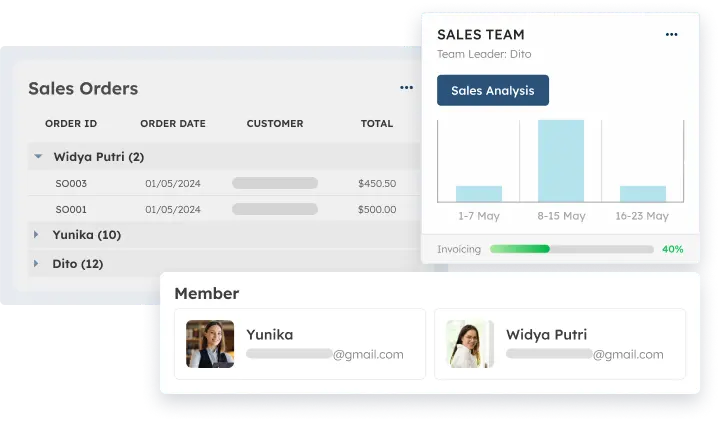
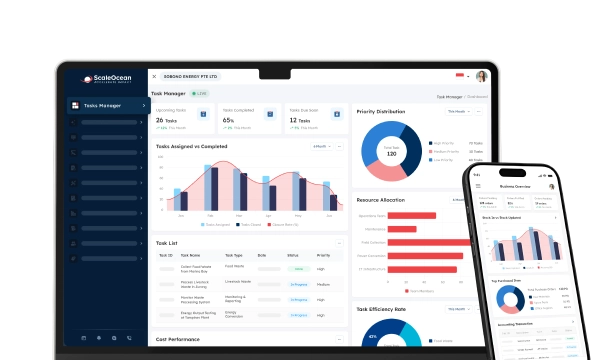
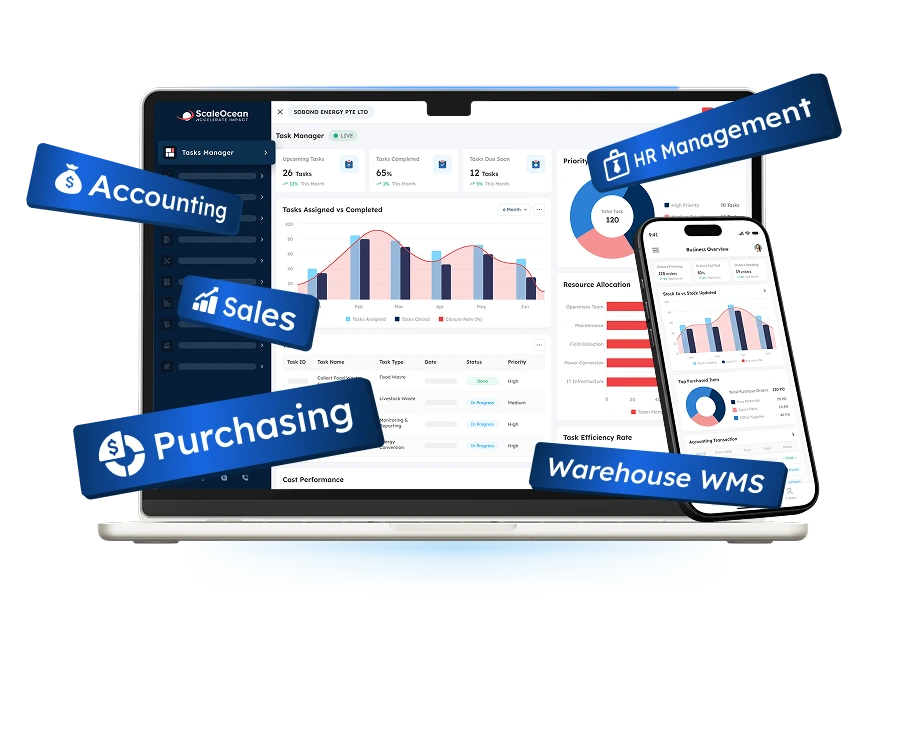
ScaleOcean Sales System is an integrated business platform that combines sales, CRM, inventory, procurement, finance, and invoicing within a single system. Consequently, businesses gain more accurate forecasts by connecting pipeline data with real-time revenue, stock availability, transaction history, and operational performance.
Beyond forecasting, ScaleOcean offers AI-powered analytics, workflow automation, real-time reporting, and flexible customization to match complex business processes. ScaleOcean is also fully optimized for Singapore tax compliance (GST), adheres to local financial reporting standards, and is fully compliant with the EDG and CTC grant requirements.
Book a free demo of ScaleOcean today and discover how an integrated platform can help your team make faster, data-driven decisions with confidence.
Key Features of ScaleOcean Sales Forecasting Software:
- AI-Driven Win Probability & Deal Scoring: Uses AI to score opportunities and predict which deals are most likely to close.
- Predictive Pipeline Intelligence & Risk Alerts: Detects stalled deals, pipeline risks, and declining engagement through automated alerts.
- Multi-Dimensional Scenario Modeling: Supports best-case, worst-case, and most-likely forecasting to improve planning.
- Deep CRM Integration (Bi-Directional Sync): Syncs forecasting data with CRM and business systems in real time.
- Conversation Intelligence: Analyzes customer interactions to identify buying signals and improve forecast accuracy.
| Pros | Cons |
|---|---|
|
|
Best For: ScaleOcean is ideal for medium to large-sized businesses and enterprises that require forecasting connected with broader operational processes. It particularly suits organizations managing complex workflows, multiple entities, or cross-department decision-making.
2. Salesforce Sales Cloud
Salesforce Sales Cloud forecasting software helps businesses forecast revenue using CRM data, pipeline activity, and sales opportunities. It provides forecasting tools that support sales planning and pipeline visibility within a unified platform.
The software also includes reporting and opportunity management capabilities for sales teams. Therefore, businesses can monitor forecast performance and track sales progress from a centralized system.
Key Features:
- Pipeline forecasting
- Opportunity management
- Sales dashboards
- CRM integration
| Pros | Cons |
|---|---|
|
|
Best For: Mid-sized and large enterprises that already rely on CRM-driven sales processes. It is suitable for organizations seeking forecasting capabilities alongside customer and pipeline management.
3. HubSpot Sales Hub
HubSpot Sales Hub forecasting software combines forecasting, pipeline management, and sales automation within a CRM environment. It helps businesses track opportunities and estimate future revenue using sales activity data.
The platform focuses on usability and centralized sales visibility for growing teams. As a result, businesses can manage forecasts and customer interactions from a single workspace.
Key Features:
- Sales forecasting
- Pipeline management
- Sales automation
- Reporting dashboards
| Pros | Cons |
|---|---|
|
|
Best For: Small and mid-sized businesses looking for forecasting tools within an easy-to-use CRM platform. It works well for companies prioritizing simplicity and quick user adoption.
4. Pipedrive
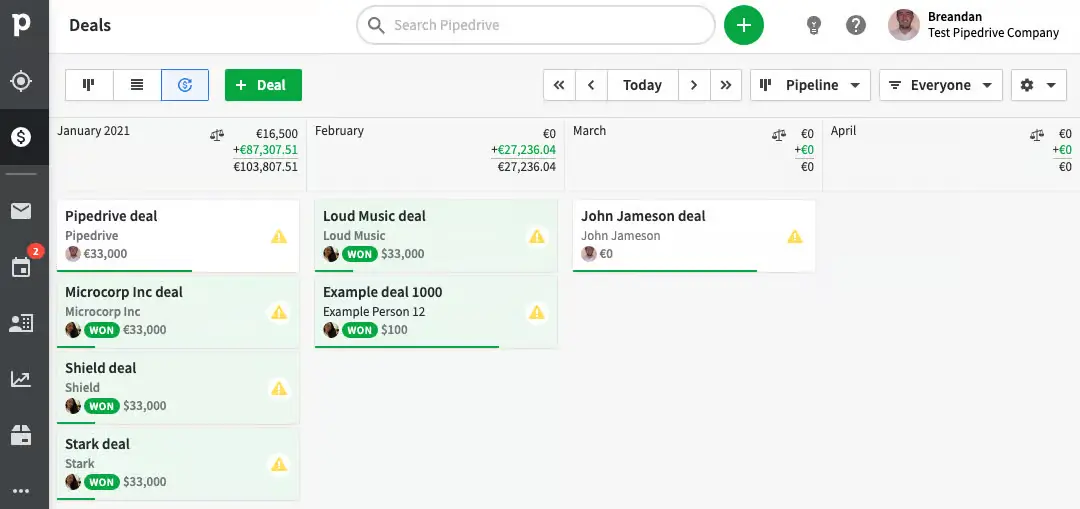
Pipedrive sales forecasting software helps businesses manage pipelines and estimate future sales performance. It provides forecasting functionality through visual pipeline tracking and opportunity management tools.
The software emphasizes simplicity and visibility into sales activity over advanced enterprise planning. Therefore, teams can review forecasts and pipeline status with minimal complexity.
Key Features:
- Visual pipelines
- Revenue forecasting
- Activity tracking
- Sales reports
| Pros | Cons |
|---|---|
|
|
Best For: Small businesses and growing sales teams that need straightforward forecasting and pipeline management. It is suitable for organizations seeking a simple solution with a shorter learning curve.
5. Anaplan
Anaplan sales forecasting software supports forecasting, planning, and scenario modeling across different business functions. It helps organizations evaluate future revenue outcomes using multiple planning assumptions.
The platform is often used for broader planning initiatives that extend beyond sales forecasting tools. Consequently, businesses can connect forecasting activities with financial and operational planning processes.
Key Features:
- Revenue forecasting
- Scenario modeling
- Business planning
- Forecast analysis
| Pros | Cons |
|---|---|
|
|
Best For: Large enterprises that require forecasting as part of broader planning and budgeting activities. It is most suitable for organizations managing complex operations across multiple departments and business units.
6. Avercast
Avercast sales forecasting tools helps businesses forecast demand, sales performance, and inventory requirements using historical business data. It supports planning activities that connect forecasting with purchasing and operational processes.
The software focuses on demand planning and forecasting accuracy for organizations managing inventory-driven operations. Therefore, businesses can improve visibility into future sales and stock requirements.
Key Features:
- Demand forecasting
- Inventory planning
- Forecast analytics
- Sales projections
| Pros | Cons |
|---|---|
|
|
Best For: Mid-sized businesses and supply chain-focused organizations that require forecasting alongside inventory planning. It is particularly suitable for companies managing demand fluctuations and stock availability.
7. Clari
Clari sales forecasting software focuses on revenue forecasting, pipeline visibility, and forecast management. It helps organizations monitor sales performance and improve the consistency of forecasting through centralized revenue insights.
The platform consolidates forecasting information from multiple sales activities and data sources. As a result, sales leaders can review pipeline performance and forecast updates more efficiently.
Key Features:
- Revenue forecasting
- Pipeline inspection
- Forecast management
- Revenue analytics
| Pros | Cons |
|---|---|
|
|
Best For: Mid-sized and large organizations that prioritize revenue forecasting and pipeline oversight. It works well for businesses with dedicated sales leadership and revenue operations teams.
8. Outreach
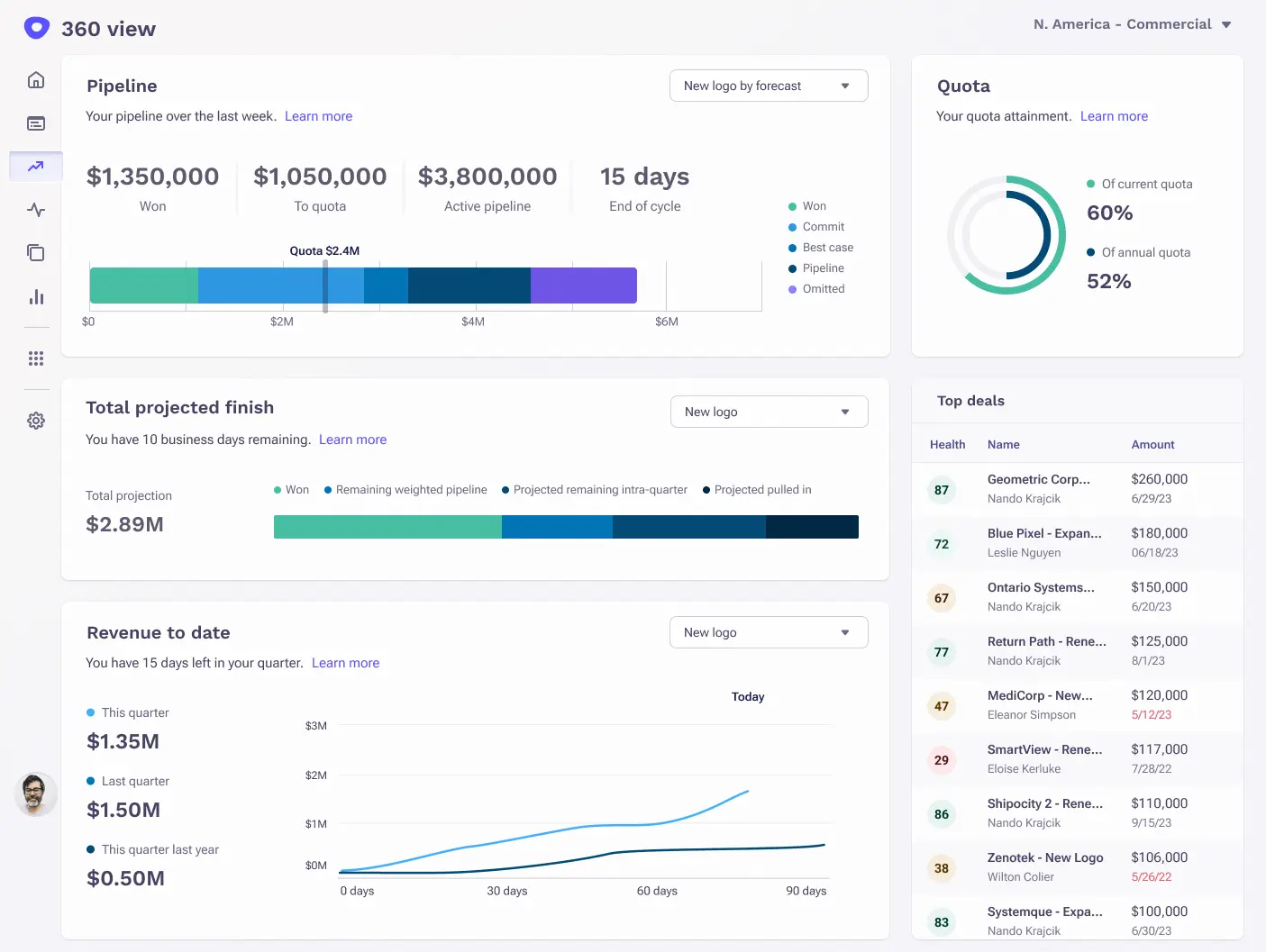
Outreach sales forecasting software combines forecasting functionality with sales engagement and activity management tools. It helps sales teams monitor opportunities while managing prospect interactions throughout the sales cycle.
The software places greater emphasis on sales execution and engagement workflows than broader business planning. Therefore, teams can review forecasts alongside sales activities and customer outreach efforts.
Key Features:
- Sales forecasting
- Activity tracking
- Pipeline visibility
- Sales engagement
| Pros | Cons |
|---|---|
|
|
Best For: Mid-sized and large sales teams seeking forecasting capabilities alongside sales engagement tools. It is suitable for organizations focused on improving sales execution and opportunity management.
9. Gong Forecast
Gong Forecast sales forecasting software uses sales activity and conversation data to support revenue forecasting. It helps organizations evaluate deal progress and forecast outcomes through sales interaction insights.
The platform provides visibility into pipeline health and opportunity performance across the sales process. Consequently, teams can review forecasting information together with deal activity indicators.
Key Features:
- Deal insights
- Revenue forecasting
- Pipeline analysis
- Conversation analytics
| Pros | Cons |
|---|---|
|
|
Best For: Mid-sized and large organizations that rely heavily on sales conversations and deal management. It is most suitable for businesses seeking additional visibility into opportunity performance and forecasting trends.
10. Weflow
Weflow sales forecasting software helps businesses improve forecasting and pipeline visibility within Salesforce environments. It supports forecast management through centralized sales data and pipeline updates.
The platform focuses on simplifying forecasting workflows and improving collaboration around forecast reviews. Therefore, sales teams can maintain greater consistency when managing projections and opportunities.
Key Features:
- Forecast management
- Pipeline tracking
- Revenue visibility
- Forecast collaboration
| Pros | Cons |
|---|---|
|
|
Best For: Mid-sized and large organizations already using Salesforce as their primary CRM platform. It works well for companies seeking additional forecasting functionality without replacing existing sales systems.
Key Selection Factors for Choosing Sales Forecasting Software According to Business Scale
Different-sized businesses have different needs for forecasting and day-to-day operations, so companies should consider how the software will fit these needs now and in the future.
| Business Size & Complexity | Primary Needs | Recommended Software |
|---|---|---|
| Small Business: Simple sales processes, limited users, and straightforward forecasting requirements | Easy implementation, basic forecasting, pipeline visibility, and affordability | HubSpot Sales Hub, Pipedrive |
| Growing Small-to-Mid-Sized Business: Increasing sales volume and expanding customer base | CRM integration, sales automation, forecasting accuracy, and reporting capabilities | HubSpot Sales Hub, Salesforce Sales Cloud |
| Mid-Sized Business: Multiple departments, higher transaction volumes, and cross-functional planning requirements | Integrated forecasting, operational visibility, workflow flexibility, scalable processes | ScaleOcean, Salesforce Sales Cloud, Clari |
| Large Enterprise Complex: organizational structures, multiple business units, and advanced forecasting requirements | Enterprise forecasting, cross-department integration, scenario planning, and governance controls | ScaleOcean, Anaplan, Clari |
| Enterprise with High Operational Complexity: Multi-company operations, multiple locations, complex workflows, and extensive data requirements | End-to-end business integration, customizable workflows, centralized forecasting, enterprise scalability | ScaleOcean |
| Supply Chain & Inventory-Driven Organizations: Demand fluctuations, inventory dependencies, and operational forecasting requirements | Demand forecasting, inventory planning, sales and operations alignment | Avercast, ScaleOcean |
How to Select the Right Sales Forecasting Software

Choosing the right sales forecasting tools is not just about comparing feature lists and pricing structures, but also about how well each solution meets operational objectives, the accuracy of sales forecasts, and business growth over time.
A systematic evaluation process enables businesses to understand whether their solutions can be integrated into current and future business systems. As a result, organizations can optimize investment in new technology while reducing the risks associated with deploying and accepting the new system.
1. Data Accuracy and Enrichment Capabilities
For prediction to be accurate, good-quality business data from various sources must be used. Given this, businesses need to focus on applications that automatically account for, cleanse, and enhance data before generating a forecast.
Further enhancing data improves forecast accuracy by incorporating customer profiles, transaction histories, and sales activities. As a result, demand patterns can be better identified, thereby enhancing forecast accuracy.
2. CRM Connectivity and System Compatibility
Any forecasting software should be able to communicate efficiently with business systems and CRM. Therefore, there is no duplication of data entry or reporting errors due to inconsistent data.
Compatibility with ERP, accounting, and inventory and analysis systems enhances efficiency even further. As a result, the business has a single view of performance, enabling more precise forecasting decisions.
3. AI-Powered Forecasting Accuracy
Artificial intelligence allows the forecasting system to analyze large amounts of data at speeds that are impossible with traditional methods. This way, companies will be able to pinpoint revenue opportunities, risks, and identify shifts in demand more accurately.
More sophisticated AI tools are constantly improving by expanding their knowledge bases and, in the long run, learning from past forecasts. This leads to more accurate predictions and less need for subjective hypotheses and complex manual calculations.
4. Scalability for Growing Teams
As a business grows, so does the complexity of forecasting through its departments, product lines, and geographical locations. Thus, a business must choose software and software features that are scalable to its growth.
Scalability reflects the system’s ability to handle growth in the number of users, transactions, and operations. This saves the company costly software replacements as the business expands.
5. User-Friendly Experience and Adoption
Even sophisticated forecasting applications are of little use when employees are unable to utilize them efficiently. Hence, user-friendly screens and easier-to-understand workflows will still be important selection factors.
Simpler-to-operate platforms enable employees and new users to adapt more easily and require less training when deploying new solutions, therefore forcing investments to deliver quicker results and enhancing organizational efficiency and accuracy.
6. Review Automation Capabilities
In fact, forecast reviews often take a long time when a manager uses manual reports. For this reason, a company should test software that automates the following activities: updating the forecast, approving the forecast, and performing a performance review.
Automation helps reduce administrative work, double the clarity of forecasts across teams, and ensure prompt action based on insights.
7. Assess Customization Flexibility
Each firm has its own sales process, reporting structure, and forecasting method. The software should therefore offer the options for adaptation to these.
Flexible configuration functions enable businesses to easily adapt workflows, data dashboards, and reports as forecast relevance changes in response to internal process adaptations. A flexible quoting system can further align pricing and quotation workflows with updated forecasts, business rules, and changing sales requirements.
8. Compare Pricing and Long-Term Value
Among these, software costs must be assessed alongside implementation, support, and future scalability needs. Hence, those offering the best value should be selected and not the cheapest.
A benefit that enhances forecast precision and efficiency usually results in higher long-term returns on technology investments. Consequently, a business case can be demonstrated based on tangible business gains.
Types of Sales Forecasting Software
There are a variety of forecasting methods suited to different business purposes and sales environments. Businesses should assess the key aspects of major forecasting methods before purchasing forecasting software tailored to their operations.
1. Based on the Sales Pipeline
Pipeline-based forecasting software estimates the future revenue based on open opportunities in the sales pipeline. It takes into account the deal stage, probability score, sales cycle duration, and conversion rates from the last 6 months.
It offers a clearer view of future revenue opportunities and risks. As a result, sales leaders can track pipeline health, identify bottlenecks, and improve forecasting accuracy throughout the sales cycle.
2. Based on Historical Sales
A historical sales forecasting program estimates the forecast based on historical sales data and recurring trends. For example, it determines periodic sales growth, seasonal trends, and demand swings.
This approach is especially effective where there are stable sales cycles and predictable customer purchasing patterns. In this way, the organization can make much more accurate forecasts and enhance the budgeting and planning process.
Key Features to Look for in Sales Forecasting Software

The performance of forecast software is influenced by its features. Organizations should assess capabilities that can increase forecast accuracy and insight, and support decision-making across the sales team.
1. Dynamic vs. Static Forecasts
Dynamic forecasts are real-time forecasts based on real business data and sales activities. Therefore, organizations can react rapidly to fluctuations in customer behavior or market conditions.
Whereas static forecasts rely on fixed assumptions and manual updates over specific periods. Hence, dynamic forecasting generally yields more accurate results and can be readily used to inform business decisions in growing organizations.
2. Automated Activity Capture
It logs everything like email, meetings, calls, and customer interactions automatically, so there is less administration for your sales team and more face-to-face time.
In addition, the data quality is improved by reducing human errors and missing information, enabling forecasting models to generate more accurate predictions from complete sales records. Sales pipeline management software can support this process by organising sales activities, tracking opportunities, and maintaining more reliable customer and transaction data.
3. Scenario Modeling (What-If Analysis)
Scenario modeling enables firms to compare multiple forecasting outcomes under a variety of assumptions. For instance, the revenue implications of changes in pricing decisions, labor levels, and market conditions can be anticipated.
Allows the business to plan more effectively for different situations and provides decision-makers with a tool to anticipate business variations. As a result, this reduces uncertainty in decision-making and builds more sustainable growth plans.
4. Predictive Deal Scoring
Predictive deal scoring processes data through artificial intelligence to forecast the probability of opportunities to close and thrive. It takes into account past performance, buying trends, degree of involvement, and the nature of selling activity.
By leveraging these predictive insights, sales teams will be able to focus on the most lucrative opportunities. As such, this leads to better resource utilization, enhanced forecast accuracy, and improved conversion rates. With AI for sales capabilities, businesses can analyze customer data, prioritize high-potential leads, and make more informed decisions throughout the sales process.
5. Real-Time Alerts
Instantaneous alerts inform traders as soon as there are any changes in forecasts or risks. Consequently, managers can resolve problems before they impact sales targets or revenues.
These alerts enable processes to become more responsive. It helps develop attentive teams when making decisions, leading to faster control over forecasting.
What Happens If You Use the Right Sales Forecasting Software?
The right forecasting software offers benefits beyond just better revenue forecasts. Hence, companies experience greater operational alignment, efficiency, and strategic insight across all departments.
1. Predictable Revenue and Strategic Growth
More accurate forecasting allows greater confidence in revenue planning and business investment decisions. This enables organizations to set realistic goals and achieve sustainable, measurable growth.
Leaders additionally have better foresight into future performance trends and possible obstacles, so that they can make strategic choices with accurate information rather than speculation
2. Radical Sales Pipeline Clarity
Sales managers have total clarity on the forecast pipeline and deals. Consequently, opportunities, risks, and hurdles can be pinpointed earlier.
This transparency enhances accountability throughout the sales organization and facilitates enhanced coaching. As a result, teams will maintain stronger pipeline health and improve forecasting confidence and accuracy.
3. Unlocked Rep Productivity
Sales reps frequently spend a lot of time updating spreadsheets and preparing manual reports. Automated forecasting software allows sales reps to spend a lot more time actually selling.
Enhancing productivity improves sales and revenue over time without burdening managers with additional administrative information.
4. Seamless Inventory and Operations Sync
Providing a more accurate sales forecast is likely to enhance the efficiency of the inventory and operations departments in understanding future demand for the company’s product. This, in turn, allows the organization to shield itself from stockouts, excess inventory, and unnecessary resource misallocations.
Links between forecasting, inventory, and operational systems greatly enhance cross-functional collaboration. As a result, businesses develop more effective processes without compromising service levels and profitability.
Conclusion
Sales forecasting software helps businesses improve revenue predictability, strengthen planning accuracy, and make better decisions using real-time data. By selecting a solution that aligns with their business size, operational complexity, and growth objectives, organizations can reduce uncertainty and improve overall business performance.
ScaleOcean Sales System offers a fully integrated platform that connects sales forecasting with CRM, inventory, procurement, finance, and broader business operations. This unified approach helps organizations produce more accurate forecasts, enhance departmental visibility, and support scalability.
Schedule a free demo with ScaleOcean today and discover how an integrated sales system can help your business make faster, data-driven decisions with confidence.
FAQ:
1. Does sales forecasting software need to integrate with my CRM?
Yes. CRM integration is crucial because it syncs live customer data, removes manual data entry, and ensures your revenue forecasts are accurate.
2. Is sales forecasting software suitable for every company size?
Yes. Small teams can track basic pipelines, while large enterprises use advanced predictive analytics to scale complex operations.
3. Which industries benefit most from sales forecasting software?
SaaS, retail, manufacturing, and wholesale distribution benefit most due to their fast sales cycles, recurring revenue, or heavy supply chains.
4. Should I choose AI deal scoring or basic visual reporting?
Choose basic reporting if your data is limited. Choose AI deal scoring if you have large datasets and want to predict close probabilities automatically.



















.png)