

An accounting information System (AIS) is an organized system that allows organizations to capture, store, manage, and report accounting information. In essence, it transforms raw accounting and financial transaction data into meaningful insights and information for decision-makers, stakeholders, investors, auditors, and regulators.
As companies’ business activities grow more complex, the accounting matters typically become more complicated for many companies across Singapore. In such cases, finance departments face issues such as slow multi-entity consolidation, inaccurate GST Recon, inconsistent multi-currency reporting, manual tax adjustments, overdue AP approvals, and a lack of real-time AR collection data.
All of these can negatively affect compliance, cash flow, reporting, and management decision-making. Fortunately, these issues can be overcome by a reliable accounting information system that can automate GST workflows, integrate financial data from various sources, enable e-invoicing, and generate the required reports in audit-ready formats according to Singapore regulations.
According to the data collected by our team concerning Singapore’s Digital Economy, 82% of Singapore SMEs have implemented at least one digital tool to improve various aspects of their business operations, like accounting and digital marketing. It is precisely because of this that financial digitalization is becoming increasingly significant for organizations demanding quick reporting and improved financial management.
This article would explain what an accounting information system is, how it works, and what the main components of an Accounting Information System would include. It also describes typical business problems and how to select an AIS suitable for your organization. You will be able to understand the significance of an AIS in the strictly regulated Singapore financial sector.
 Key Takeaways
- An accounting information system is a structured framework that businesses use to capture, store, manage, and process accounting and financial information.
- There are six critical components, such as people, procedures, data, software, IT infrastructure, and internal controls, working together.
- There are three types of AIS, such as manual systems, legacy systems, and modern/integrated systems.
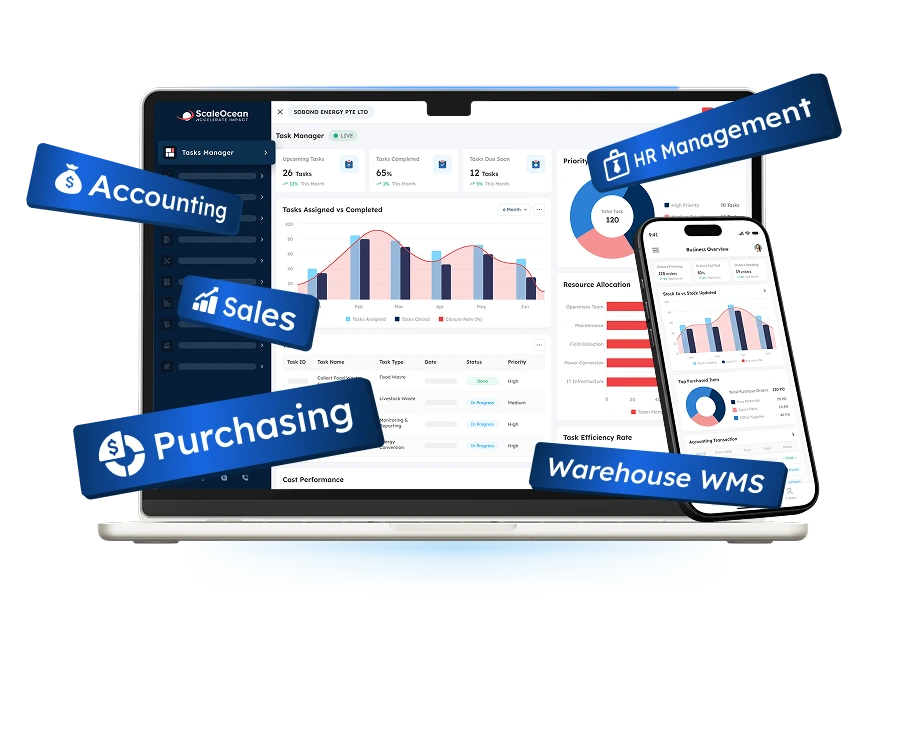
- ScaleOcean’s accounting management software can help automate all the accounting processes, eliminate manual errors, improve reporting efficiency, and integrate its operations, such as payroll, inventory, sales, and purchases, along with its finance.
What is an Accounting Information System?
An accounting information system (AIS) is an organized collection of procedures, software, hardware, personnel, and controls to capture, store, manage, and process accounting and financial information. It helps to transform everyday business transactions on a daily basis into precise data for various uses, including decision making, auditing, reporting, and compliance.
In practice, an accounting information system serves as the central hub for financial operations. It records sales, expenses, purchases, payroll, assets, liabilities, and other transactions, then generates reports such as income statements, cash flow, balance sheets, tax reports, and dashboards. For businesses evaluating accounting software in Singapore, this capability helps simplify reporting and improve financial visibility.
The overall purpose of an accounting information system is to assist organizations in producing exact, in-time, organized financial information. By using a proper AIS, finance officers would be able to minimize human error, track company transactions, improve internal controls, and ensure that stakeholders have precise data.
Without a well-managed accounting information system, companies may struggle to track revenue, expenses, assets, liabilities, and compliance obligations accurately. This can affect financial reporting quality, slow down decision-making, and increase operational risks. For that reason, AIS plays an important role not only in record keeping but also in supporting sustainable business growth.
Six Critical Components of an AIS (Accounting Information System)
An accounting information system (AIS) refers to a system that is designed to capture, store, manipulate, and produce financial data in the form of financial reports to address various requirements, such as decision making, auditing, and complying with the rules. It is made up of six main components, such as people, procedures, data, software, IT infrastructure, and internal controls.
1. People
Users are employees who make use of an accounting information system, which could be accountants, finance departments, managers, auditors, consultants, or executives. They input transaction information into the system, check for transactions posted, create financial statements, review the cash flow, research the information, and make business decisions.
The accuracy of financial reports depends heavily on how diligent, accurate, and knowledgeable users are when entering data into the system. That is why training plays an important role in helping users follow operating procedures, reduce data entry errors, and maximize the benefits of AIS in daily work. To support this, ScaleOcean offers customizable workflows that can be adjusted to each company’s accounting process, making it easier for teams to work accurately and consistently.
2. Procedures and Instructions
Procedures and instructions are the protocols for entering, processing, storing, verifying, and reporting financial data into an accounting information system. It will guide users on the correct procedures to follow when conducting financial transactions, accounting entries for closing business, approving purchase orders, and preparing reports.
Depending on the organization’s workflow, procedures may be manual, automated, or a combination of both. Documented processes within church accounting software help standardize operations across departments, support employee training, and maintain data accuracy.
3. Data
Data are accounting and financial information that are input into an accounting information system as part of the normal processes of conducting business. The data could be sales invoices, supplier purchase orders, customer payments, payroll information, tax reports, assets information, and so on.
To ensure that the information in an AIS is well presented, it should be accurate, complete, and relevant to the needs and filed correctly. In the case of data quality concerns, it is imperative to keep data control and validation to ensure that the business can make correct decisions, analyze, and make financial statements.
4. Software
Accounting Software is a component of an accounting information system. It’s a part that is used to automate journal entries, ledger bookings, generating invoices, reconciliation processes, budgeting, tax reporting, and financial statement preparation.
The software is influenced by the complexity of the activities in the organization and the type of software application being used. Smaller businesses can use a simple accounting information system, while a bigger enterprise can choose accounting software with inventory management, purchase, sales, and payroll software in an ERP.
5. Information Technology Infrastructure
The hardware, network, server systems, data storage, and cloud environment on which an AIS runs. This infrastructure layer is the foundation needed to run accounting software applications, store financial data securely, and provide easy access to the financial data for users.
A robust IT infrastructure ensures that the system is consistently available, has high processing speed, and a secure network to prevent data theft. The infrastructure also plays a significant role in accessing the system, scaling the system, ensuring effective data back-up and business continuity, especially since businesses are constantly moving to cloud solutions.
6. Internal Controls
The main purpose of internal controls is to protect the accounting information system, primarily for fraud prevention and to safeguard financial data within an organization. These controls may be user access privilege settings, workflow approval, robust password protection policies, separation of duties between different jobs, audit trails, and periodic data backups.
Good internal control can prevent unauthorized access, identify fraudulent transactions, and keep financial records accurate. These control measures help strengthen the reliability of financial reporting for managers, auditors, regulators, and stakeholders. To see how automated controls can support your business, try ScaleOcean’s free demo and explore how the system helps improve financial visibility, accuracy, and compliance.
Why Do Businesses Use AIS? Function & Role Accounting Information System
An Accounting Information System is a collection, storage, and processing system of financial data, which is then converted into a series of reports. The reports that are produced are used by businesses in making business decisions, for efficient working, and to meet various regulations required by businesses.
In addition to bookkeeping, it is also possible for an accounting information system to improve the controls and speed up financial processes. An AIS would make it easier to process accounts, streamline accounting procedures, ensure better collection of data, prevent inaccuracies from human error, resulting in accurate compliance with reporting standards and long-term financial planning.
1. Collecting Financial Data
It is the responsibility of an accounting information system to collect all the financial data that comes in from the day-to-day operations of the business, which could include sales invoices, purchase orders, bills from vendors, customer payments, data regarding the employees, payments related to expenses, taxes, and transactions concerning the inventory.
The system collects this data and stores it in a format that can be managed and evaluated more easily. An accounting information system must gather as much accurate data as possible, as the whole aspect of finance will depend on the data that gets into the accounting information system.
2. Creating Financial Reports
Accounting information system is the way in which accounting transaction data is transformed into useful financial reports used either by internal or external stakeholders and for financial reporting such as income statements, balance sheets, cash flow statements, tax reports, age reports, budget reports, and Management dashboards.
These reports help businesses monitor performance, control expenses, evaluate profitability, and operate more efficiently. Financial reports are also important for external stakeholders during financial statement reviews and audits. To simplify this process, ScaleOcean’s automated financial reporting helps generate key reports such as P&L, balance sheet, cash flow, general ledger, and tax reports more accurately and on time.
3. Compliance with Regulatory Requirements
An accounting information system is required for storing records in an organized way, preparing tax reports, ensuring the recording of GST-related transactions is maintained properly, and maintaining easily accessible audit trails that are needed for the regulatory authorities and audits.
Compliance issues can also be addressed more efficiently with all documents stored digitally, so they can be accessed at any time, and this reduces the chances of missed reports and information, so business owners can respond more quickly to issues such as auditing.
4. Managing Financial Data Storage & Processing
An accounting information system is a tool that enables large volumes of business financial data to be stored. The data can be accessed easily from historical transactions, checked against current balances, and adjusted accordingly if needed.
It removes the need for spreadsheets or written records, so finance personnel can get on with the accounting, processing the information, and displaying it. Balancing transactions is automatically processed in an accounting information system, so it ensures that all transactions are processed.
5. Business Financial Data Security & Control
Accounting information systems should be of a high standard in information security and control, especially for sensitive information like financial data. To ensure this, there are specific controls, such as a high-level of access restriction to data, security measures regarding approval processes, protection of the system against intrusion using passwords, controls on access, accounting for all audit trails, and allocation of tasks according to roles.
These controls provide an appropriate safeguard against unauthorized access, theft, potential loss of financial data, and inaccuracies, as well as building trust in the financial statements and increasing employee accountability between departments.
Types of Accounting Information Systems

There are three types of accounting information systems, such as manual systems, legacy systems, and modern/integrated systems. Two ways that financial information is collected, processed, and reported may vary from each other.
The correct accounting information system for the business depends on the volume of transactions and the nature of operation of the business, the available budget, and the reporting needs of the business. The type of system required will depend on the size and complexity of the business, with a small business potentially having a much simpler system compared to an organization or large enterprise.
1. Manual Systems
This is the simplest type of accounting information system, where financial data is recorded manually, account books are maintained by hand, and income and expenses are tracked without automation. Reports are also prepared and stored as hard copies, making the process less efficient compared to cloud accounting systems that support faster access, automation, and digital record management.
These systems are often used by small businesses with low transaction volume. However, as the business grows, manual accounting and reporting processes can become slow, inaccurate, and time-consuming. To support scalable operations, ScaleOcean offers an all-in-one ERP platform that connects finance, procurement, sales, inventory, and payroll data, making financial information easier to manage in real time.
2. Legacy Systems
Legacy systems refer to old computerized systems that may have been either developed or adapted for the specific requirements of a business. They help manage areas such as billing, paying salaries, managing expenses, and balancing the books of accounts.
Managing and operating them may prove to be very costly, and it can be difficult for businesses to make specific adaptations based on changing business needs and needs for real-time data, as they do not readily offer a solution for business needs related to cloud-based work or the demands of large enterprises.
3. Modern Systems
Currently, modern accounting information systems consist of highly advanced software, cloud-based systems, multi-currency accounting software, and automation that are aimed at improving financial efficiency. Systems that integrate accounting procedures with the company’s purchasing systems, sales, stores, payroll, and tax procedures are available.
Modern systems are more scalable, much faster when it comes to processing data, more visible, and internal controls can be put in place more easily to assist in managing an expanding business. Accounting procedures based on ERP-based systems are highly suitable due to the ability to cut through the boundaries between departments.
Standalone Accounting Software vs. Integrated Modern Accounting Information System (AIS)
Standalone accounting software and integrated modern Accounting Information Systems (AIS) represent different stages of business maturity in a part of broader Enterprise Resource Planning (ERP) systems. Standalone software is usually built for specific financial tasks, such as invoicing, payroll, expense tracking, and basic reporting, making it easier and more affordable for smaller firms to start digitizing their accounting processes.
As companies grow, an integrated modern AIS becomes more suitable because it connects finance with inventory, HR, sales, purchasing, and other operational data in one system. This allows transactions to flow automatically across departments, reduces duplicate data entry, improves reporting accuracy, and gives management a real-time view of business performance.
| Feature | Standalone Accounting Software | Integrated Modern Accounting Information System |
|---|---|---|
| Main Purpose | Handles specific accounting tasks such as invoicing, expense tracking, payroll, and basic financial reporting | Connects accounting with wider business functions such as inventory, sales, purchasing, HR, and operations |
| System Scope | Focuses mainly on finance and accounting activities within a limited operational area | Covers end-to-end business processes and centralizes financial data from multiple departments. |
| Data Flow | Often requires manual data transfer between accounting, inventory, sales, and other business tools. | Enables automated data flow across departments, reducing duplicate entry and improving data consistency |
| Integration | May need third-party connectors or manual uploads to exchange data with other systems | Built to integrate finance with operational modules in one connected platform |
| Scalability | Suitable for smaller companies with simpler transaction volume and limited process complexity | Suitable for growing and enterprise companies that need multi-entity, multi-department, or multi-location control |
| Reporting Capability | Provides financial reports based mainly on accounting data entered into the software | Provides broader reports using real-time data from finance, inventory, sales, purchasing, and operations |
| Internal Control | Supports basic user access, transaction records, and approval features, depending on the software | Supports stronger controls through role-based access, approval workflows, audit trails, and standardized processes |
| Business Value | Helps small businesses digitize core accounting tasks with lower setup effort | Helps growing businesses improve efficiency, accuracy, visibility, and strategic decision-making across the enterprise |
How AIS Meets IRAS, ACRA (XBRL), and PDPA Standards?
AIS in Singapore can be a combination of two types of compliance context, which are the accounting information system (to help the business manage the financial data, reports, tax computation, and internal control) and the Auto Inclusion Scheme (to allow employers to report the employment income directly to IRAS and for IRAS to compute tax).
With a modern accounting information system, it will be a system where business able to comply with the requirements of the IRAS, ACRA XBRL filing, and PDPA. A modern accounting information system will enable the company to automate tax data preparation, organize the financial data, and keep business-sensitive data secure.
- IRAS compliance: A company can maintain records of revenues, expenses, taxes, GST, and transaction details in a centralized platform, helping ensure accurate tax reporting and smoother IRAS inspections. With multi entity accounting software, businesses can consolidate financial data across entities while improving compliance and reporting efficiency.
- GST calculation and reporting: By utilizing the AIS system, it will allow the system to compute the GST of every transactions occurred throughout the business. This system would reduce the chances of human error in calculations during the preparation of the GST report, and this will ease the company in managing and submitting the GST reports more efficiently, as the details required for the report are all captured in the system.
- ACRA XBRL filing: By the use of AIS, the tedious and repetitive data processing to convert the account balances into XBRL format would be lessened significantly, as the information recorded in the system is readily available to be extracted into the XBRL format, which could be more timely and accurate when filing the financial statements to ACRA regularly.
- Audit trail readiness: An effective AIS would ensure that an adequate record of transaction date, transaction occurred, who took the actions, approvals on the transaction, and supporting documents, as well as changes made, were kept in one record so that it could ease the company to conduct its respective audit, internal reviews, and regulatory inspections.
- PDPA data protection: Through AIS, businesses will be able to implement data protection under PDPA by having user role assignment and password, secured data storage, and back-up to prevent data theft or usage by unauthorized parties.
- Internal control support: Approval process, access control, segregation of duties, and activity log. These features support strengthening control of business activities for reduced risk of non-compliance.
With integrated accounting, tax, audit trail, and data security features, ScaleOcean AIS helps businesses in Singapore manage compliance processes more efficiently. The system enables easier integration of accounting data with IRAS-related reporting needs, while supporting organized financial records for ACRA requirements and secure data management aligned with PDPA standards. Request a free demo to see how this software can support your accounting and financial reporting processes.
How to Choose the Right AIS for Your Singapore Business?

As businesses increasingly shift toward digital HR and payroll solutions, selecting the ideal Auto Inclusion Scheme (AIS) payroll software in Singapore for 2026 is gaining significance. According to data from Grand View Research, Singapore’s human resource software market is projected to increase at a CAGR of 15% between 2025 and 2030, driven by increased demand for cloud-based human resource and payroll automation solutions.
Hence, companies should prioritize IRAS-compliant solutions that can streamline the submission of employment income, such as preparing IR8A forms and filing directly with IRAS. It should also enable companies to handle CPF rates updates, calculate payroll, manage employee records, and handle data securely, which in turn will help them cut down on manual mistakes, hasten year-end reporting, and comply with local tax requirements in a better manner.
- Assess business size and complexity: Simple businesses can handle basic accounting, invoicing, and expense tracking, while larger businesses can benefit from multi-entity accounting, approval workflows, integration with inventory, payroll integration, and advanced reporting.
- Check Singapore compliance support: There are many types of systems with different purposes. Having a clear picture of their features, it will reduce the likelihood of purchasing a system that doesn’t fully cater to the business’s needs or not being able to optimize the system.
- Review integration capabilities: A strong AIS should connect with inventory, sales, purchasing, HR, payroll, CRM, banking, and e-commerce systems. Integration helps reduce duplicate data entry and improves financial data consistency across departments.
- Evaluate scalability: The business should look for a system that is flexible enough to adapt to changing needs and grow in terms of its capability to handle more transactions, users, branches, new entities, and more complex reporting requirements. This helps to reduce the need for constant changes and further investments over time.
- Prioritize security and access control: Check for role-based access, approvals, user logs, backups, data encryption, and audit trails. These attributes assist in keeping financial information secure and enhance accountability.
- Consider reporting and analytics: Real-time dashboards, profit and loss reports, balance sheets, cash flow reports, GST reports, and management insights should be part of the reporting and analytics. Good reporting aids in timely and effective decision-making.
- Calculate total cost of ownership: This should not be limited to the upfront cost of implementation and annual subscription fees, but should also take into account the cost related to customization, training, maintenance, and support, as well as the cost of additional modules if and when required in the future.
- Evaluate vendor support: A company needs to work with a reputable vendor that offers satisfactory implementation, training, and post-sales support; especially for a Singapore-based business, partnering with a vendor with a deep understanding of local tax regulations and operational needs in Singapore is an added advantage.
For businesses that need a more complete and scalable AIS solution, ScaleOcean can be considered one of the best options for Singapore companies. Its flexible modules also make it easier for growing businesses to connect payroll, accounting, inventory, purchasing, sales, and HR data without relying on separate systems.
Conclusion
An accounting information system is an organized structure consisting of people, procedures, data, software, IT infrastructure, and internal controls that provide the management of financial data. It gathers, stores, computes, and reports accounting information, which enables businesses to generate accurate financial statements, ensure compliance with accounting frameworks, assist in the audit process, and make informed financial choices.
Having the right accounting information system solution, it can help automate all the accounting processes for a business, eliminate manual errors, provide improved internal controls and reporting efficiency, and integrate its operations like payroll, inventory, sales, and purchases, along with its finance.
For businesses that want stronger financial visibility and scalable compliance support, ScaleOcean Accounting Software can help simplify these processes in one integrated system. Try a free demo to see how this software can support more accurate, efficient, and compliant financial operations.
FAQ:
1. What is the accounting information system?
An accounting information system (AIS) is a framework used to collect, store, and process financial and accounting data for decision-making. It is typically a computer-based system that tracks accounting activities with the support of information technology.
2. What is an example of an AIS?
A practical example of an accounting information system (AIS) is QuickBooks Online, a cloud-based system commonly used by small and medium-sized businesses.
3. What are the 5 fundamental principles of accounting information systems?
Accounting information systems are built around five key principles, such as control, relevance, compatibility, flexibility, and cost-benefit balance.
4. Is an accounting information system hard?
Accounting Information Systems (AIS) are generally seen as moderately challenging. They are often considered easier than calculation-heavy courses like Intermediate Accounting, but the difficulty depends on how comfortable you are with technology and your understanding of business processes and IT concepts.



















.png)