




Property tax is a yearly tax on the ownership of property in Singapore that is paid and collected by the Inland Revenue Authority of Singapore (IRAS). It is used when the property is owned, rented, or vacant. IRAS determines the amount payable by multiplying the annual value of the property by the property tax rate. The annual value is the yearly rental value estimated by IRAS.
This may seem like a fairly simple calculation for someone who owns just one home. But the challenge is different for property developers, REITs, property investment groups, landlords, retail groups, warehouse owners, and businesses that have a vast property portfolio. They must ensure that the AV records, classifications, ownership data, payment schedules, and accounting transactions for many units are accurate.
That’s why property tax management should be more than just an annual percentage calculation. There should be a formalized system in place for enterprises to centralize property records, review the new IRAS notices, identify AV changes and effective dates, review expected liabilities, manage approvals, and reconcile payments with accounting records.
Our team has been able to obtain data from the Singapore Ministry of Finance (MOF), Annual Value (AV) is calculated taking into account market rentals of similar or comparable properties as well as other factors like property size and condition. Residential properties pay progressive tax on their AV depending on their occupancy status, while commercial properties and other non-residential properties pay a single flat rate.
Explore this article to familiarize yourself with the property tax rules in Singapore 2026, annual value, current tax rates, payment timeline, modes of payment, objections, and enterprise real estate implications. We will also discuss how businesses can systemize and organize property tax information without software being a substitute for IRAS assessment or professional tax advice.
 Key Takeaways
- Business budgeting software helps companies plan budgets, allocate resources, compare actual results, update forecasts, and evaluate financial scenarios more consistently.
- Property tax applies to three main property categories, each with different tax treatment depending on the property type and use.
- Evaluate Residential Property Tax Rates in Singapore to understand how property-related obligations may affect budgeting, cash-flow planning, and long-term financial forecasts.
- ScaleOcean Business Budgeting Software connects budgets, actual and committed costs, workforce, projects, procurement, cash flow, and operational data within one configurable platform.

What is Property Tax?
In Singapore, property tax is a tax on the ownership of immovable property. Things like this imposed on the basis that a person or organization owns the property, whereas income tax applies to rental income. Thus, a house could still be taxed if it is not being used, and a business building could still be taxed if the owner uses the building as a place of business.
The value payable will mainly depend on two factors: the value of the property (Annual Value or AV) and the tax rate applicable to the property’s category. Residential properties can have either an owner-occupied treatment or a non-owner-occupied treatment, and most non-residential properties are subject to a flat rate treatment. This separation is particularly significant in the context of businesses with diverse property portfolios.
In the context of asset and portfolio management, real estate businesses should also take property tax into account. Changes in the AV may impact operating costs, profitability at the property level, and anticipated cash needs. Finance teams are then able to link the latest IRAS assessment to the relevant property, entity, cost center, and accounting period.
How is Singapore Property Tax Calculated?
IRAS uses a straightforward underlying formula:
Property Tax to be Paid = Annual Value (AV) × Applicable Property Tax Rate
The challenge is finding out which AV and tax rate are applicable to each property. Progressive rates are used for residential properties, with various percentages applied to various parts of the AV. All other non-residential properties (industrial buildings) are typically assigned a flat 10% rate on their AV.
On average, an office that has a property value of S$200,000 will pay S$20,000 in annual property tax. The calculation for a residential property with the same AV would be different, as the amount payable would depend on the occupancy status and the progressive tax bands. Therefore, businesses should always check the most recent AV and property classification before estimating tax liability.
Understand Your Property’s Annual Value (AV)
Annual Value is the initial basis for the calculation of property tax in Singapore. It is important for businesses not to think of AV as a passive figure that is added in when a property is initially purchased. The current AV, the most recent effective date, its classification, entity of ownership, and the relevant IRAS notice should all be part of its current property master record.
This is important at the enterprise level. Even if it’s just a few out-of-date records in a company with hundreds of properties, that can throw off the expected portfolio tax liability. Having historical AV information also helps finance teams to understand their current liabilities compared to the prior year, analyze significant differences in their expenditures, and determine the anticipated tax expenditure and budget it into their property.
What is Annual Value (AV)?
The term Annual Value (AV) as used in Singapore is the estimated gross annual rent that a property would generate if it were to be let out without the furniture and maintenance costs. The AV is calculated by the Inland Revenue Authority of Singapore (IRAS) based on the rental transaction of a similar or comparable property, as well as other factors like size, location, condition, and other property characteristics.
If similar ones suggest a property can reasonably be rented at about S$5,000 per month, then the chances are that it will achieve that figure. If similar ones suggest that a property can be rented at about S$5,000 per month, then the chances of it achieving that number are good.
Assuming the property is rented out at S$60,000 per annum, its value would be taxed at the appropriate rate before being added to the indicative annual rental value of S$60,000. The amount assessed by IRAS is still considered the official AV used for property tax even if an internal estimate is prepared by the property owner.
There are other methods of valuing specific assets, too. IRAS explains that the general guideline for AV for land and development sites is at 5% of estimated freehold market value, or as determined by a statutory or other valuation method for specialized properties. The difference is significant for developers and real estate companies that have land and industrial facilities.
Latest Assessment from IRAS
The latest IRAS Annual Value guidance states that IRAS reviews property AVs yearly to reflect changes in market rental values of comparable properties. An AV may be amended when current rental evidence no longer supports the existing amount. Physical changes that materially affect a property’s rental value can also lead to an AV revision from the relevant effective date.
Therefore, saying that IRAS automatically changes every property’s AV each year would be inaccurate. A better interpretation is that IRAS reviews AV yearly and revises assessments where market or property evidence warrants a change. For enterprise property owners, the practical task is to identify which properties received revised valuation notices and quantify the impact from each effective date.
For 2026 planning, this creates an important connection between leasing data and taxation. Rising comparable market rentals can influence AV even when a particular property has not been sold or renovated. A finance team should therefore investigate significant property tax movements by comparing AV history, rather than assuming that an increase necessarily came from a change in tax rates.
How to Check Your Property AV?
Owners can check the AV of their properties through the IRAS myTax Portal using the View Property Summary digital service. IRAS states that property owners can review their current AV and historical AV information online, allowing businesses to verify whether their internal property records agree with the latest government assessment.
For large portfolios, teams should reconcile downloaded or reviewed IRAS data against an internal property register. Useful fields include property reference number, address, owning entity, usage category, latest AV, effective date, tax treatment, tax amount, payment status, and associated notice. This provides a stronger audit trail than storing only the final tax amount.
3 Categories Required to Pay Property Tax in Singapore

In Singapore, there are three types of categories required to pay property tax. There are 3 categories that are required to pay property tax in Singapore.
Property tax is a tax on owning property in Singapore, collected and paid yearly by the Inland Revenue Authority of Singapore (IRAS). It is applied when the property is owned, rented, or vacant at the time. IRAS will take into account the value of the property and multiply it by the property tax rate to determine the amount payable. The annual value is IRAS’s estimate of the value of the rental for a year.
This classification is particularly significant if there are a variety of types of assets in an enterprise portfolio. A condominium that is an investment is not treated like a qualifying owner-occupied home, while an office or industrial warehouse is subject to the 10% rate.
1. For Owner-Occupied Residential Properties
For Owner-Occupied Residential Properties, please refer to this link for more information:
Owner-occupied residential rates apply to residential properties owned by an individual owner who meets IRAS’s eligibility criteria and who occupies the property as his/her own residence. Starting from 1 January 2025, the first S$12,000 of AV will be taxed at 0%, while additional tax brackets will be imposed on the remaining AV amounts.
It does not generally apply to a body of persons, trust, association or company owning a residential property or commercial or industrial property. IRAS also rules that a married couple with two properties can usually benefit from owner-occupier tax rates for just one property.
An enterprise point of view is that a property should not be defined as owner-occupied because the enterprise itself is using or managing the property. The eligibility rules applicable to IRAS should be matched against the actual ownership and occupancy structure to determine eligibility.
2. For Non-Owner-Occupied Residential Properties
Non-owner-occupier residential rates apply to residential properties not being used as a residence by the owner. Typically, this category will involve fully leased investment apartments and houses. Where the owner does not live in an empty dwelling, the properties could still be subject to non-owner-occupier rates.
The new non-owner-occupier rates that came into effect on 1 January 2024 start at 12% for the first S$30,000 of AV, and increase gradually for the amount exceeding S$60,000 up to 36%. This makes the taxation very different from owner-occupied property.
Occupancy status is thus crucial for landlords and property investment groups to be in sync with the leasing records. If moving in, moving out, a lease has been terminated, or the asset has been sold, the accountant needs to understand the tax treatment that has been entered for the asset.
3. For Non-Residential Properties (Commercial and Industrial Properties)
Non-residential properties such as commercial buildings, offices, retail premises, industrial buildings, warehouses, and land are generally taxed at a flat rate of 10% of Annual Value. The progressive owner-occupier rates do not apply even when the property owner uses the building for its own business activities.
For example, IRAS illustrates that a commercial property with an AV of S$54,000 produces property tax of S$5,400 at the 10% rate. This flat rate makes individual calculations simpler, although enterprise management can still become complicated when hundreds of properties, changing AVs, different entities, and multiple payment records are involved.
Property companies should also distinguish property tax from GST treatment. IRAS states that when a GST-registered business sells or leases non-residential property, GST may apply to the transaction. Residential sale and lease supplies generally receive different GST treatment. Property tax and GST should therefore be recorded separately rather than combined into one tax category.
What are the Property Tax Rates in Singapore?
When enquired, the answer to “how much is property tax in Singapore” is a range of percentages, not a single fixed amount, as there is no universal percentage to apply across all properties. The answer is very much dependent on the property’s AV and, if it is a residential property, if it’s owner occupier treatment.
For 2026, the owner-occupier residential property rate bands apply the same as they did from 1 January 2025. The non-owner-occupier residential property rates are still in place from 1 January 2024; the commercial and industrial property rates are still 10% AV.
Before finalizing the budgets or statutory payments, businesses should always check for the updated rates on the official IRAS Property Tax Rates page.
Evaluate Residential Property Tax Rates in Singapore
Singapore’s progressive residential structure means teams should calculate tax by AV band rather than multiply the entire AV by the highest applicable rate. This distinction becomes particularly important for higher value properties, where several bands may apply before the top marginal percentage is reached.
The following tables use the latest rate structures published by IRAS and are formatted as HTML so they can be inserted into the article CMS.
1. Owner-Occupied Tax Rates (Residential Property)
For qualifying owner-occupied residential properties, rates effective from 1 January 2025 range from 0% on the first S$12,000 of AV to 32% on the portion above S$140,000. The percentage shown for the highest band is a marginal rate and does not mean the entire AV is taxed at 32%.
For 2026 specifically, the Government also provides a one-off property tax rebate of 15% for owner-occupied HDB flats and 10% for owner-occupied private residential properties, capped at S$500. The rebate is automatically reflected for eligible properties and does not change the underlying tax rate bands.
| Annual Value (AV) Band Tax | x Rate From 1 Jan 2025 | Tax Payable for Band |
|---|---|---|
| First S$12,000 | 0% | S$0 |
| Next S$28,000 (S$12,001 to S$40,000) | 4% | S$1,120 |
| Next S$10,000 (S$40,001 to S$50,000) | 6% | S$600 |
| Next S$25,000 (S$50,001 to S$75,000) | 10% | S$2,500 |
| Next S$10,000 (S$75,001 to S$85,000) | 14% | S$1,400 |
| Next S$15,000 (S$85,001 to S$100,000) | 20% | S$3,000 |
| Next S$40,000 (S$100,001 to S$140,000) | 26% | S$10,400 |
| Above S$140,000 | 32% | 32% of AV above S$140,000 |
2. Non-Owner-Occupier Residential Rates
Non-owner-occupied residential properties currently use the rates effective from 1 January 2024. The first S$30,000 of AV is taxed at 12%, followed by rates of 20%, 28%, and 36% for higher portions of AV.
For investment portfolios, this structure means properties with higher AV can produce considerably larger tax liabilities. Portfolio managers should therefore model tax based on each asset’s actual AV rather than applying one average percentage to the entire residential portfolio.
| Annual Value (AV) Band Tax | x Rate From 1 Jan 2024 | Tax Payable for Band |
|---|---|---|
| First S$30,000 | 12% | S$3,600 |
| Next S$15,000 (S$30,001 to S$45,000) | 20% | S$3,000 |
| Next S$15,000 (S$45,001 to S$60,000) | 28% | S$4,200 |
| Above S$60,000 | 36% | 36% of AV above S$60,000 |
3. Non-Residential Property Rates
Commercial and industrial property follows a significantly simpler rate structure. IRAS currently taxes non-residential properties at 10% of Annual Value, regardless of whether the property is rented out, vacant, or used by the owner for its own operations.
However, simple rates do not necessarily mean simple administration. A REIT or enterprise may still need to manage hundreds of AV updates, payment references, legal entities, cost allocations, notices, and accounting entries. The operational challenge therefore shifts from rate calculation to portfolio-wide data accuracy.
| Property Category | Tax Rate | Property Tax Payable |
|---|---|---|
| Commercial, Industrial Buildings, and Land | 10% of Annual Value | Annual Value × 10% |
Track Payment Deadlines and Methods
The calculation of the correct tax amount is just one of the tasks of property tax administration. Other aspects for businesses to consider include the prompt receipt of bills, timely approvals, the correct property tax reference for payment, and the reconciliation of all settlements with the property and legal entity involved.
A central deadline register may be useful for companies that have extensive properties, to help the finance teams keep track of the annual property tax cycle and separate out other notices that are sent throughout the year.
1. Bill Issuance
The property tax bill is sent by IRAS towards the end of the year for the subsequent year. For instance, if a property owner has an annual property tax bill that will come due in December 2025, the property owner is usually expected to pay the bill by the required January 2026 due date.
Companies should receive each bill and record it on the property it relates to, rather than send it to disconnected e-mail groups. The bill date, assessment year, AV, tax rate, tax amount, property reference, entity, and approval status are details recorded to assist in the subsequent bill reconciliation.
IRAS also delivers e-property tax bills and e-notices via myTax Portal. Any corporate owner can request property information electronically, and owners holding multiple properties can leverage consolidated property information available to them to enhance portfolio visibility.
2. Payment Due Date
Property tax is normally payable by 31 January every year or by the due date on the property tax bill. IRAS has confirmed that the 2026 property tax bill was due on 31st January 2026. The other property tax notices sent out during the year usually contain one month from the notice payment date.
This is important because not all property tax obligations occur on the January cycle. If the AV is revised, there is another assessment or adjustment; another notice may be issued in the calendar year, due to a different deadline. Therefore, the tax calendar should be based upon the individual notices as well as the annual calendar.
In addition, finance teams can tie each due date with internal lead times for approval to further minimize risk. If more than one level of authorization is needed within the treasury, the approval process should start early enough, instead of waiting until the IRAS due date.
3. How to Pay Property Tax
IRAS offers several electronic payment methods for businesses looking at how to pay property tax in Singapore. Payments can be made using PayNow QR, AXS payments (via myTax Portal), and Internet Banking Bill Payment (via the appropriate IRAS property tax billing option and IRAS-provided property tax reference number).
They are achieved primarily by the following approaches:
- GIRO: One-time payment or monthly instalments, subject to the applicable arrangement.
- PayNow QR: Generate the QR securely through myTax Portal or the IRAS payment function.
- AXS: Pay through supported AXS channels using the relevant property tax information.
- Internet Banking: Select IRAS PROPERTY TAX and enter the correct property tax reference number.
There is one important operational note to highlight for multi-property businesses. IRAS notes that different properties have their own property tax reference numbers. Payment master data and the verification of the payment are particularly crucial when referrals are used incorrectly, since it can cause delays or misallocation of payment, especially in larger portfolios.
4. Instalments
IRAS allows property tax to be paid through GIRO either as a one-time yearly deduction or through up to 12 monthly interest-free instalments. IRAS also states that e-GIRO can support up to 200 property tax accounts within a single submission, which can be useful for organizations managing multiple properties.
An extended GIRO scheme of up to 24 months is available for qualifying residential property owners under specific criteria. From 1 January 2026, the eligibility conditions include all owners being aged 65 or older, residing in the property, meeting the applicable assessable income threshold, and having outstanding property tax payable.
For corporate property portfolios, the standard GIRO arrangement is generally the more relevant mechanism. Businesses should still reconcile scheduled deductions with the correct entity, bank account, property, and accounting period.
What Happens When You Miss the Property Tax Payment Deadline?
IRAS imposes a 5% late payment penalty on unpaid property tax when full payment is not received by the due date, and the taxpayer is not covered by an approved instalment plan. Filing an objection does not suspend the requirement to pay the amount assessed on the bill. If the assessment is subsequently revised, excess payment can be refunded.
The consequences can extend beyond the initial penalty. IRAS states that it may appoint parties such as a bank, employer, tenant, or lawyer handling a property sale as agents to recover overdue tax. In more serious cases, IRAS may initiate the sale of the property through public auction to settle outstanding amounts.
For an enterprise, late property tax therefore creates both direct financial costs and unnecessary operational escalation. A central tax calendar should identify upcoming deadlines, unresolved approvals, failed payments, and outstanding balances before the due date. Finance teams should also distinguish a disputed assessment from a payment hold because IRAS requires payment even while an objection or appeal remains outstanding.
Manage Tax Check and Appeals

Property tax administration does not end after a payment is submitted. Organizations should verify that payments have been applied correctly, identify remaining balances, retain assessment notices, and establish a review process when an AV appears inconsistent with relevant market evidence.
This is especially useful when a real estate business has multiple finance teams, property managers, and legal entities. One central record helps separate genuine assessment disputes from internal data or payment errors.
1. Check Outstanding Balance via IRAS
Property owners can check outstanding property tax through IRAS digital services. The Check Property Tax Balance service can be used with relevant property information, while myTax Portal provides account details, historical payment transactions, statements of account, and payment information.
For portfolio management, the external IRAS balance should be reconciled with internal accounting records rather than assumed to match automatically. A payment may have been initiated but not yet posted, allocated to an incorrect reference, or recorded internally against the wrong property.
Large enterprises can therefore use a reconciliation process that connects each tax bill to its payment transaction and general ledger posting. Exceptions such as a bill without a payment, a payment without a bill, or an internal amount that differs from the IRAS balance can then be investigated before reporting periods close.
2. File an Objection
A property owner may object to the proposed AV or its effective date within 30 days from the date of the Valuation Notice. IRAS also permits objections to AV shown in the Valuation List during the year, subject to the applicable deadline. An objection must be supported by valid grounds rather than simply dissatisfaction with the resulting tax amount.
IRAS specifically notes that high tax rates, financial difficulties, or the absence of rental income because a property is vacant or owner-occupied are not valid grounds for objecting to AV. According to IRAS, 98% of residential AV objections in its records were unsuccessful, reinforcing the importance of reviewing comparable market evidence before filing.
If IRAS disallows or only partially allows an objection, a further appeal may be made to the Valuation Review Board within 30 days of IRAS’s decision. However, property tax remains payable while the objection or appeal is outstanding. Businesses should therefore manage the dispute workflow separately from the payment workflow.
Can Property Tax Be Managed and Calculated Automatically?
Yes, businesses can automate a fair amount of the management of property taxes in Singapore, but automation should be placed at the right position. Software can be used to compute expected liability based on the recorded AV and applied rate, set up property master data, and schedule deadlines, route approvals, keep track of payments, reconcile accounting entries, and alert to unusual changes.
It is important for property developers, REITs, landlords, industrial operators, and companies with a substantial owned property portfolio. For instance, if IRAS changes the AV of a commercial property from $180,000 to $215,000, and an enterprise system records the new AV and the new date of availability, calculates the new expected liability at 10%, compares it with the previous year, and sends the updated AV for finance review.
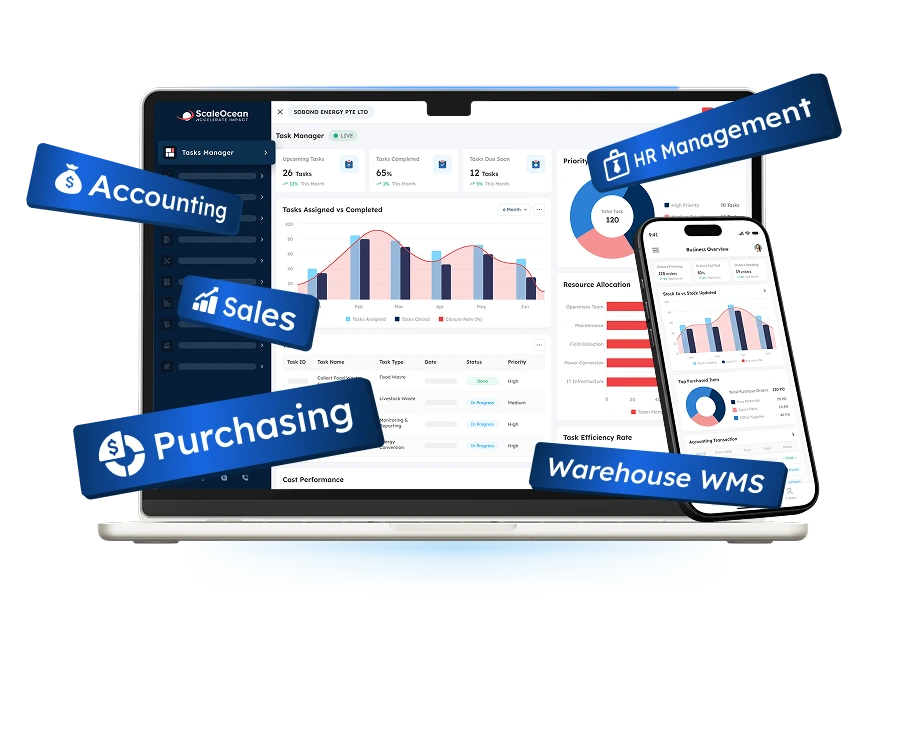
If companies desire these workflows in the context of larger property operations, ScaleOcean property real estate software integrates property records with accounting, contracts, leasing, assets, and other property operations data. ScaleOcean’s real estate platform aims to bring together property and financial data, while its accounting features enable automated calculations, Singapore financial reporting workflows, and reconciliation.
ScaleOcean property real estate software connects property, leasing, finance, accounting, asset, and compliance data in one configurable platform. This helps enterprises maintain a more consistent property tax workflow, from recording annual value changes and tax notices to tracking approvals, payment schedules, and portfolio-level liabilities.
Within ScaleOcean Atlas, embedded ScaleMind can analyze authorized cross-functional data to highlight material AV movements, incomplete tax records, unusual year-on-year liability changes, and upcoming obligations that still require approval. These insights help finance teams identify exceptions earlier and focus their review on properties that contribute most significantly to overall tax exposure.
For instance, a company with 350 residential, commercial, and industrial properties would be able to centralize all AV information for all properties, connect the current and historical AV to the respective property record, and automatically update the expected tax exposure when the recorded AV changes. Instead of manually recalculating hundreds of properties, Finance could then look at exceptions.
The same information can also flow into budgeting. If total portfolio tax liability increases by 22% year on year, management can trace which assets contributed to the variance, compare it with AV movements, and update forecast expenses accordingly. This turns property tax from a year-end compliance exercise into a visible component of property-level and portfolio financial planning.
ScaleOcean also places its Singapore ERP environment to provide local financial reporting standards and workflows that are in line with IRAS and GST requirements. However, property tax must not be confused with the GST treatment. For instance, IRAS has announced that transactions of non-residential property may be liable to GST, while the sale and lease of residential property is treated as exempt.
For enterprises comparing wider systems for property operations, our guide to the best property management software can also help evaluate how property, leasing, financial, asset, and compliance workflows can be connected within a broader technology architecture.
Ultimately, automation is most valuable when it helps the business maintain one reliable property record, identify exceptions earlier, and preserve a clear audit trail. IRAS remains the authority for AV assessments and statutory tax obligations, while software supports the enterprise process around those obligations.
Conclusion
The Singaporean property tax is an annual tax on property ownership and is based on the property’s Annual Value and applicable tax rate. Owners may be liable to progressive residential rates, or a flat rate for non-residential properties, depending on the type of property and the occupancy status of the property, and IRAS will determine the official AV for assessment purposes.
The challenge happens when businesses operate more than one property location and must maintain accurate AV records, classifications, tax notices, and accounting entries for a variety of assets and entities. Having these records centralized and automating calculations, approvals, reminders, and reconciliations can save a lot of manual effort, detect discrepancies at an earlier stage, and therefore provide increased visibility of property tax obligations.
ScaleOcean property real estate software connects property, leasing, finance, accounting, asset, and compliance data in one configurable platform. With unlimited-user options, multi-property management, AI-assisted analytics through ScaleMind, API integration, and cloud or on-premises deployment, it supports complex real estate operations while aligning financial workflows with Singapore requirements, including IRAS and GST-related processes. Schedule a consultation to assess how ScaleOcean can help simplify property tax administration, portfolio reporting, and financial planning.
FAQ: Property Tax in Singapore:
1. How much is property tax for a 4-room HDB?
There is no single fixed property tax amount for every 4-room HDB flat because IRAS calculates tax from the property’s actual AV. If the flat qualifies for owner-occupier treatment, the current progressive rates apply, and eligible owner-occupied HDB flats receive a 15% property tax rebate for 2026.
2. Is property tax different for HDB flats and private properties?
Both HDB flats and private residential properties use residential property tax rules based on AV and occupancy status. However, their AVs can differ significantly, which affects the final tax payable. The 2026 rebate also differs, with eligible owner-occupied HDB flats receiving 15%, while owner-occupied private residential properties receive 10% capped at S$500.
3. Do I pay lower property tax if I live in my own property?
Generally, yes. Qualifying residential owners who live in their property may receive the lower progressive owner-occupier tax rates. Eligibility depends on IRAS requirements, and the concession does not apply simply because a company uses a property for its own operations.
4. Why did my property tax increase even though I did not sell or renovate my property?
Your property tax can increase if IRAS revises the property’s Annual Value based on changes in market rents of comparable properties. IRAS reviews AVs yearly and may amend them where current rental evidence no longer supports the existing AV, so a sale or renovation is not required for the assessment to change.
5. Can I claim owner-occupier property tax rates for more than one property?
Generally, an individual or married couple cannot claim owner-occupier rates for two homes simply because they own both. IRAS states that a married couple owning two homes may enjoy the concession on only one home, subject to specific ownership and occupancy situations described in its guidance.





















.png)