
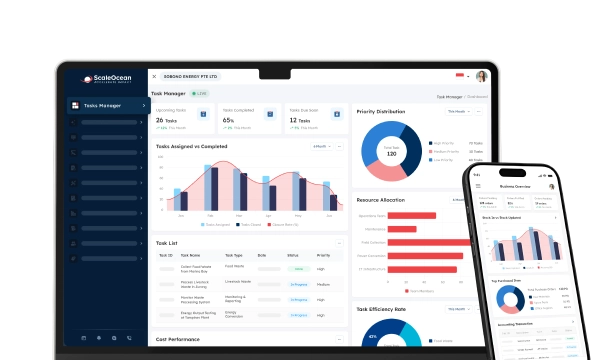

In the rapidly changing market we live in today, businesses are choosing to leverage the benefits of an ERP system in order to gain improved efficiency and drive growth into the future. Each industry has a specific ERP designed to provide businesses with a fully integrated system, where technology is mapped to the business’s industry and can remain flexible enough for business needs.
However, most of our businesses do not run an ERP, due to it not being designed for the industry in which it is being used. Businesses that are using disparate systems with no interdepartmental visibility or workflows that have undergone excessive customization often find effective operations management difficult.
According to the data our team collected from EDB, Singapore continues to strengthen its position as a leading hub for advanced manufacturing, logistics, and digital transformation, encouraging businesses to adopt technologies that improve productivity and competitiveness. This highlights the increasing demand for flexible business systems that can support different industry requirements.
Therefore, companies require ERP solutions that can deal with more than just transactions. They need platforms that understand the complexities of operations, can support their specific operational business models, and offer flexibility to address challenges and future opportunities in the industry.
This article explores how ScaleOcean Atlas for Industry, the flagship ERP platform by ScaleOcean, provides a unified ERP solution that supports businesses across multiple industries in Singapore. It covers the challenges of traditional ERP systems, key factors in selecting an industry-specific ERP, and how ScaleOcean Atlas helps businesses build more connected, scalable, and efficient operations.
 Key Takeaways
- ScaleOcean offers ScaleOcean Atlas, an enterprise ERP platform designed to support complex and industry-specific business operations.
- ScaleOcean Atlas is designed for growing enterprises that require scalable ERP capabilities to manage complex operations, multiple entities, and evolving business needs.
- ScaleOcean Atlas supports diverse industries by adapting ERP workflows and modules to match specific operational requirements across logistics, manufacturing, retail, construction, education, and more.
- ScaleOcean Atlas provides a unified ERP platform that connects business functions, supports industry-specific workflows, and helps enterprises manage complex operations through scalable and configurable solutions.
Why Do Companies Need an Industry-Specific ERP Solution?
There is a need for an industry-specific Enterprise Resource Planning (ERP) solution to address industry-specific operational workflows, regulatory requirements, reporting measures, and other specific criteria that cannot be addressed without costly customizations by generic software.
Unlike general ERP solutions that provide broad business functions, an industry-specific ERP approach focuses on aligning technology with the way each industry operates.
1. Different Industries, Different Business Processes
The needs of various industries are unique, whether it’s production planning, inventory and stock management in manufacturing, logistics coordination in the logistics industry, construction project management, or retail operations. However, a single, standard ERP might not be adequate to handle such differences on its own.
Different industries can tailor a business ERP system by using various modules, workflows, and reporting features. This allows the system to support business processes, but does not require major changes in the operating practices of companies.
2. Overcoming General ERP Limitations
There are various companies that rely on general ERP systems because they have the essential features such as accounting, inventory management, sales, and purchasing. But when these systems are not equipped to support the needs of the industry or need significant changes to meet the industry’s workflows, the business may have challenges.
Manufacturers might need production scheduling and quality control measures, for instance, or logistics firms could need tracking of shipments and coordinating warehouse operations. An industry-focused ERP will lessen these gaps with functions that better suit industry needs.
3. Connecting All Operational Data in One Platform
Growing enterprises often rely on multiple systems to manage different departments, including finance, HR, inventory, sales, and operations. When data is separated across different platforms, businesses may struggle to maintain accurate information and gain complete operational visibility.
An integrated ERP platform connects these functions within one ecosystem, allowing teams to access consistent data and improve collaboration. This helps management teams make faster decisions based on a more complete view of business performance.
4. Supporting Growth with a Scalable ERP
As businesses expand, their ERP requirements also change. Businesses might require more branches, new business units, a higher volume of transactions, or more intricate structures.
Scalable ERP software will enable companies to expand their capabilities and features within their system without the need to purchase a new system. This provides flexibility for long-term growth and meets changes in business needs with technology.
5. Faster Decisions with Real-Time Insights
Historical reports are just not enough for the operations of modern enterprises. They have to have timely information about inventory, financial performance, customer activities, and operational efficiency.
An ERP that is industry-specific and offers real-time reporting features enables businesses to track industry metrics and identify areas for improvement in real time. Data can be used to make decisions and adjust to market changes more effectively by turning the operational data into insights.
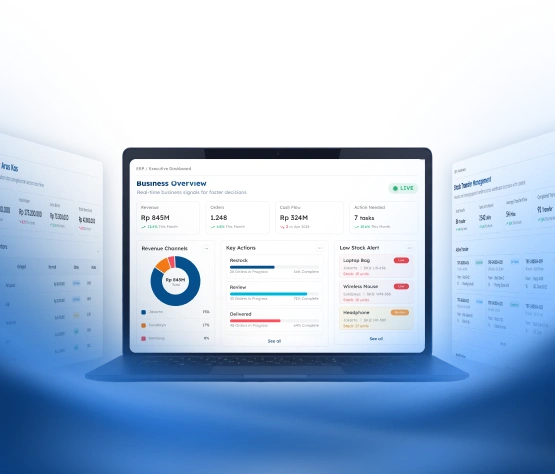
ScaleOcean Atlas supports this need by bringing operational and business data into one integrated platform. With real-time visibility across key processes, enterprises can monitor performance more clearly, identify issues earlier, and make informed decisions based on up-to-date information.

Common Challenges When Using General ERP Systems

There are a number of major issues that can arise when using a generic Enterprise Resource Planning (ERP) solution that can impact operations and delay value to the business. In more complex operations, companies require ERP systems that can be customized to fit their processes and integrate the data they need for operations, while also providing the flexibility to accommodate the business’s growth.
1. Workflows Misaligned with Industry Needs
General ERP can offer standard workflows for general business activities. There may be industry-specific processes, however, that will need industry-specific configuration, approval, and operational requirements.
For instance, manufacturing firms can benefit from production organizing and quality control procedures, while logistics firms can benefit from shipment tracking and warehouse organization. If ERP workflows don’t align with industry requirements, businesses might resort to manual adjustments or extra tools to satisfy everyday requirements.
2. Fragmented and Disconnected Data Across Operations
Numerous businesses operate various business processes in various systems, including an accounting system, inventory management system, customer relationship management (CRM) system, and operational applications. These systems can help with single processes, but isolated data can lead to departments working in silos.
There is no central information, which can lead to more time being spent by teams on collating reports, checking data, and coordinating between functions. This can lead to inefficiency and less clarity for management teams of the overall business.
3. Limited Real-Time Operational Insights
For businesses, the need for accurate and timely information is crucial, particularly when operating across various departments or locations with complex operations. But conventional ERP systems can lack visibility in situations of delayed, fragmented, or hard-to-analyze data.
This is a failure to get immediate ‘snapshot’ awareness of their operations, which can restrict their ability to make rapid decisions, optimize resources, and react to market shifts.
4. Systems Struggle with Business Growth
As companies expand, their operational requirements become more complex. Additional branches, business units, users, transactions, and industry-specific processes require an ERP system that can scale alongside the organization.
Rigid ERP platforms may create challenges when businesses need to add new capabilities or modify existing workflows. Without sufficient flexibility, companies may face higher costs, longer implementation cycles, and limitations in supporting future growth.
Based on the data our team gathered from IMDA, 95.1% of SMEs in Singapore have adopted at least one digital technology area in 2024, while 97% have adopted at least one sector-specific digital solution to support business needs. This increasing digital adoption highlights the importance of scalable ERP platforms that can adapt to evolving industry requirements and help businesses manage growth more effectively.
How Does ScaleOcean Atlas Address Industry-Specific Business Challenges?
ScaleOcean Atlas addresses industry-specific business challenges by rejecting “one-size-fits-all” software logic, instead offering an integrated ecosystem that adapts directly to actual business complexities.
Rather than overloading enterprises with a complex array of unused modules, ScaleOcean Atlas serves as a singular operational platform that consolidates branch management, process flows, and approval systems while tailoring its modules to specific vertical bottlenecks.
1. ERP Modules Adapted to Industry Workflows
Unlike conventional ERP systems that often rely on standardized modules, ScaleOcean Atlas allows businesses to configure ERP capabilities based on their industry processes. This enables companies to manage workflows that are more aligned with their operational requirements, whether in manufacturing, logistics, distribution, construction, retail, or other sectors.
By supporting industry-specific modules and flexible workflows, businesses can reduce unnecessary system adjustments and create processes that better match their daily operations. This approach helps enterprises improve efficiency while maintaining the flexibility to adapt as business needs evolve.
2. Integrated Data in One Unified Platform
Many enterprises manage operations across multiple systems, creating disconnected information between departments. ScaleOcean Atlas addresses this challenge by bringing core business functions into one unified platform, allowing teams to access more consistent and centralized operational data.
With connected information across finance, inventory, sales, procurement, HR, and operations, businesses can reduce data silos and improve collaboration between departments. This provides management teams with clearer visibility to support faster and more accurate decisions.
3. Supporting Growth with a Scalable ERP
As businesses expand, their ERP requirements also become more complex. Companies may need additional modules, users, locations, or workflows to support increasing operational demands.
ScaleOcean Atlas provides a scalable ERP foundation that grows alongside business requirements. With flexible module activation and enterprise-level capabilities, businesses can expand their system without replacing their existing ERP infrastructure, helping them maintain operational continuity during growth.
4. ScaleMind as an Embedded AI Business Assistant
Modern enterprises need more than operational data; they require intelligent insights to improve planning and decision-making. ScaleMind is embedded within ScaleOcean Atlas as an AI Business Assistant that helps users analyze business information and gain more actionable insights from their ERP data.
Through AI-assisted capabilities, businesses can improve operational analysis, identify potential issues faster, and support more informed decisions across different departments. This helps companies move beyond traditional reporting by using ERP data as a foundation for smarter business management.
5. Seamless Integration with Existing Business Systems
Enterprises often rely on existing applications for specific operational needs, such as marketplaces, logistics platforms, banking systems, or other business tools. Without proper integration, these systems can create additional manual work and fragmented data.
ScaleOcean Atlas supports integration capabilities that help businesses connect existing systems with their ERP environment. This allows companies to maintain smoother data flows, reduce repetitive tasks, and create a more connected digital ecosystem.
6. Centralized Management Across Multiple Entities and Locations
Businesses operating across multiple branches, subsidiaries, or locations require greater visibility and control over their operations. Managing different entities separately can create challenges in reporting consistency, approval processes, and operational coordination.
ScaleOcean Atlas enables centralized management by providing visibility across different business units and locations. This allows enterprises to standardize processes while maintaining flexibility for specific operational requirements in each entity.
7. Personalized ERP Solutions for Enterprise Requirements
Every enterprise has different operational structures, challenges, and priorities. A successful ERP implementation requires more than software deployment; it requires understanding business processes and configuring the system accordingly.
ScaleOcean Atlas follows a consultative approach by helping businesses identify their requirements, map workflows, and determine suitable ERP configurations. This ensures the platform aligns with business objectives while supporting long-term digital transformation.
Why Is ScaleOcean Atlas Different from Conventional ERP Systems?
As ScaleOcean’s flagship ERP product, ScaleOcean Atlas for Industry is designed to help enterprises manage complex operations across different industries through flexible modules, AI-powered capabilities, and a consultative implementation approach.
Unlike conventional ERP systems that often require businesses to modify their processes to match the software, ScaleOcean Atlas adapts to existing business workflows while providing the scalability needed for future growth.
| Comparison Aspect | Conventional ERP System | ScaleOcean Atlas for Industry |
|---|---|---|
| Industry Adaptation | Provides standardized modules that may require additional customization to support specific industry workflows. | Offers industry-focused modules and configurable workflows designed to align with different business processes and operational requirements. |
| Workflow Flexibility | Businesses may need to adjust existing processes to match system limitations or available features. | Allows businesses to configure workflows, approval processes, and operational structures based on their requirements. |
| Data Management | Data may remain distributed across different systems, requiring additional integrations or manual consolidation. | Centralizes business information across departments to improve data visibility and operational coordination. |
| Scalability | Growth may require additional customization, upgrades, or system restructuring. | Supports business expansion through scalable modules, unlimited users, and flexible configurations. |
| AI Capability | Generally focuses on transaction processing and standard reporting capabilities. | Includes ScaleMind as an embedded AI Business Assistant to support data analysis and smarter operational decisions. |
| Multi-Entity Management | Managing multiple branches, locations, or entities may require additional configurations. | Enables centralized management across multiple entities, locations, and operational structures. |
| Implementation Approach | Often follows standardized implementation methods based on existing software capabilities. | Uses a consultative approach to understand business requirements and configure the ERP based on operational needs. |
Who Is ScaleOcean Atlas Suitable For?
The industry-specific business challenges ScaleOcean Atlas aims to solve are different and can’t be solved by using “one-size-fits-all” software logic. The software is an integrated ecosystem that evolves in real time to meet the complexity of actual business.
1. Growing Companies Needing a Scalable ERP
Growing businesses often experience increasing operational complexity as they expand into new markets, add employees, open new locations, or introduce additional products and services. At this stage, businesses need an ERP system that can support growth without creating unnecessary limitations.
Unlike rigid ERP solutions that may require businesses to replace systems as requirements change, ScaleOcean Atlas provides scalable capabilities that allow companies to expand modules, users, and workflows based on their operational needs. This enables businesses to build their ERP environment gradually while maintaining process consistency.
With configurable modules, unlimited-user options, and flexible deployment choices, ScaleOcean Atlas helps growing companies prepare for future expansion while keeping their operations connected within one platform.
2. Companies Relying on Multiple Business Systems for Complex Operations
Many enterprises use different applications to manage finance, inventory, sales, procurement, customer management, and operational activities. While these systems may support individual departments, disconnected platforms can create challenges when businesses need accurate and unified information.
ScaleOcean Atlas helps businesses reduce dependency on fragmented systems by connecting essential business functions within one ERP ecosystem. This allows teams to access more consistent information, improve collaboration, and reduce manual data consolidation between departments.
3. Businesses Managing Multiple Departments, Locations, Branches, or Entities
Enterprises operating across multiple branches, subsidiaries, or locations often require stronger control over their operational processes. Managing each entity separately can make reporting, approvals, and performance monitoring more challenging.
ScaleOcean Atlas supports centralized management across different business units while maintaining flexibility for specific operational requirements. Businesses can improve visibility across locations, standardize important processes, and maintain better coordination between teams.
4. Companies Accelerating Digital Transformation with AI ERP
As digital transformation progresses, businesses are looking beyond traditional ERP functions and seeking systems that can support smarter decision-making. AI-enabled ERP solutions help organizations analyze operational data, automate repetitive processes, and improve business responsiveness.
ScaleOcean Atlas integrates ScaleMind as an embedded AI Business Assistant, allowing businesses to gain additional insights from their ERP data. This supports teams in identifying trends, improving operational analysis, and making more informed decisions across different departments.
5. Businesses Facing Data Silos Across Multiple Systems
Data silos remain a common challenge for enterprises that rely on disconnected applications, spreadsheets, and manual reporting processes. When information is separated across different systems, teams may struggle to maintain data accuracy and obtain a complete view of business performance.
According to the data our team gathered from TechRadar, 34% of businesses reported revenue loss due to disconnected customer data, while only 31% believed their data was sufficiently accessible for AI systems. This highlights the importance of unified data management to support accurate reporting, automation, and better business decisions.
ScaleOcean Atlas helps businesses overcome data silos by creating a centralized ERP environment where operational information can be accessed across departments. This improves data consistency, strengthens collaboration, and provides a stronger foundation for digital transformation.
ScaleOcean Atlas Across Various Industries in Singapore

Singaporean businesses face diverse operational complexities, with each industry requiring different processes, workflows, and management priorities. A manufacturer may focus on production efficiency and inventory optimization, while a logistics provider requires greater visibility over fleet operations, warehouse activities, and shipment coordination.
To address these varying requirements, ScaleOcean provides industry-focused ERP solutions, with ScaleOcean Atlas for Industry as its flagship platform designed to support businesses through configurable modules and workflows tailored to specific operational needs.
1. ScaleOcean Atlas for Logistics
Businesses engaged in the logistics business involve complex process flows, planning and execution of transport, warehouse operations, goods management and tracking, and delivery to end customers, and fulfill the needs of customers. This application will be suitable for all the process flows in logistics, such as managing all transportation until delivery, in a single integrated framework.
ScaleOcean Atlas equips logistics organizations with a wide range of logistics functions that include warehouse management functions, logistics workflow, delivery tracking, active stock management, logistics reporting, and such. Companies may gain a full picture of shipment operations, coordinate warehouse and transportation staff perfectly, or keep their logistics data with high accuracy.
ScaleOcean Atlas allows the setting of configurable and scalable work streams that support complex, mixed-use logistics networks that often include a number of warehouses, widespread branches, or a dense delivery network.
2. ScaleOcean Atlas for Courier Expedition
Courier service providers always confront problems that deal with intensive volumes of orders, a vast range of delivery routes, and growing demand from customers to have their goods delivered on time without fail. ScaleOcean Atlas streamlines the full range of operations, from managing orders to fully monitoring the status of shipments for courier service providers.
The platform fully supports the process of coordination between the sorting center and managers in courier logistics by having the service to automatically allocate tasks efficiently. The service further provides such as real time update of delivery status, logistics performance monitoring, and uncompromised visibility over all first-mile and last-mile delivery movements.
As a rapid-growth courier business, ScaleOcean Atlas needs scalable workflows are essential to manage an increasing volume of shipments and expanded geographic service areas. Centralizing courier operations eliminates manual efforts in coordination and enables efficient delivery processes, resulting in consistently superior customer service.
3. ScaleOcean Atlas for Freight Forwarding
Freight forwarding companies manage complex international logistics processes involving shipments, documentation, carriers, customers, and customs requirements. ScaleOcean Atlas helps freight forwarders organize these activities through connected workflows that improve visibility across the entire shipment lifecycle.
The platform supports freight operations by connecting shipment management, customer information, financial processes, and operational reporting. This enables teams to monitor shipment progress, manage documentation more effectively, and improve coordination between internal teams and external logistics partners.
For businesses handling multiple routes, suppliers, and international shipments, ScaleOcean Atlas provides a centralized platform that supports complex logistics structures. With configurable workflows and integrated operational data, freight forwarders can improve efficiency while maintaining better control over global supply chain activities.
4. ScaleOcean Atlas for Transportation
Transportation companies require effective fleet coordination, route planning, vehicle management, and cost monitoring to maintain efficient operations. ScaleOcean Atlas helps transportation businesses manage these activities by connecting fleet-related workflows with broader operational processes.
The platform supports vehicle tracking, scheduling, maintenance management, transportation planning, and performance monitoring. By centralizing transportation data, businesses can improve resource allocation, monitor fleet utilization, and identify opportunities to optimize daily operations.
For companies managing large fleets or multiple transportation networks, ScaleOcean Atlas provides flexible workflows that can adapt to different operational requirements. This enables businesses to manage transportation activities more effectively while maintaining visibility across fleet performance and logistics processes.
5. ScaleOcean Atlas for Manufacturing
Manufacturing companies require precise coordination between production planning, procurement, inventory management, quality control, and financial processes. ScaleOcean Atlas helps manufacturers integrate these functions into one ERP platform to improve production visibility and operational efficiency.
The platform supports manufacturing workflows such as production planning, material requirements planning, inventory monitoring, costing, and quality management. By connecting production data with procurement and finance processes, businesses can improve resource planning and maintain better control over manufacturing activities.
For manufacturers managing multiple production lines, facilities, or complex product structures, ScaleOcean Atlas provides configurable workflows that adapt to specific manufacturing requirements. Businesses can manage operations more effectively while maintaining flexibility to scale production processes as demand changes.
6. ScaleOcean Atlas for Distribution
Distribution businesses manage a high volume of products, numerous suppliers, complex warehouse operations, and a large number of customer orders. ScaleOcean Atlas empowers distributors by integrating purchasing, inventory, sales, warehouse management, and financial processes into a unified, user-friendly platform.
The platform allows distributors to precisely track their inventory, efficiently fulfill customer orders, streamline purchasing processes, and gain unprecedented visibility into distribution activities, thereby minimizing inventory discrepancies and enhancing supplier, warehouse, and customer coordination.
ScaleOcean Atlas provides scalable features and adaptable workflows designed for complex distribution networks, particularly for distributors with multiple warehouses or geographically dispersed regional networks. Businesses can customize workflows to meet their unique operational needs and significantly boost supply chain efficiency.
7. ScaleOcean Atlas for Wholesale
The high volume of transactions of businesses such as retail, coupled with numerous suppliers, product catalogs, varied prices, and customer purchases, makes wholesale business operations very complex. The ScaleOcean Atlas assists wholesale business practices by integrating all sales, purchase, inventory, and finance-related workflows on a single integrated system.
By centralizing wholesale data, businesses can improve visibility into stock levels, customer orders, supplier activities, and transaction performance. This allows teams to make better purchasing decisions and manage inventory more efficiently.
For wholesalers managing expanding product ranges or multiple sales channels, ScaleOcean Atlas provides flexible configurations that support changing business needs. Companies can improve operational consistency while maintaining the scalability required for growth.
8. ScaleOcean Atlas for Trading
Trading businesses demand a strong sense of co-ordination concerning purchasing practices, supplier interaction, managing movement of goods, tracking inventory, transaction documentation, and reporting of financial records. The ScaleOcean Atlas aids trading businesses in bringing uniformity and effective management to all these processes through a unified ERP approach.
By integrating purchasing, inventory, financial transactions, and sales-related workflows, trading businesses maintain efficient business monitoring, gain full control over the various trading practices, and minimize manual workload and interpersonal communication gaps among employees/departments concerned.
The flexible work configuration ability of the ScaleOcean Atlas assists businesses of trading activities that maintain multi-variety product suppliers and operate within several market domains at a globally standardized scale.
9. ScaleOcean Atlas for Construction
Construction companies manage complex projects involving budgeting, procurement, materials, subcontractors, resources, and project timelines. ScaleOcean Atlas helps construction businesses organize these processes through an integrated ERP platform that connects project operations with financial and administrative workflows.
The platform supports project costing, procurement management, resource planning, inventory tracking, and financial reporting. By connecting project data with accounting and operational activities, businesses can improve cost visibility, monitor project performance, and reduce inefficiencies caused by disconnected systems.
For construction companies handling multiple projects, locations, or contractors, ScaleOcean Atlas provides configurable workflows that adapt to different project structures. Teams can manage approvals, track project-related expenses, and maintain better coordination between project managers, finance teams, and operational departments.
10. ScaleOcean Atlas for Food & Beverage
Food and beverage businesses require accurate management of ingredients, recipes, purchasing, inventory, production processes, and financial activities. ScaleOcean Atlas helps F&B companies integrate these workflows to improve operational consistency and reduce manual management.
The platform supports inventory monitoring, procurement planning, recipe-related processes, cost tracking, and financial reporting. This allows businesses to maintain better visibility over ingredient usage, operational expenses, and product performance.
For F&B companies managing multiple outlets or production facilities, ScaleOcean Atlas provides centralized data visibility across locations. Businesses can standardize processes, improve inventory control, and make more informed decisions based on accurate operational information.
11. ScaleOcean Atlas for Restaurants
Restaurant businesses manage fast-moving operations involving menu management, purchasing, inventory usage, employee scheduling, sales transactions, and financial reporting. ScaleOcean Atlas helps restaurants organize these activities through connected business workflows.
The platform enables restaurants to improve control over ingredient inventory, purchasing activities, operational expenses, and sales information. By connecting different business functions, teams can reduce manual administrative work and improve daily operational efficiency.
For restaurant groups operating multiple branches, ScaleOcean Atlas supports centralized management while allowing flexibility for individual locations. This helps businesses maintain consistent processes, monitor performance, and support expansion into new outlets.
12. ScaleOcean Atlas for Food Retail
Food retail businesses require accurate inventory management, supplier coordination, replenishment planning, and sales monitoring to maintain product availability. ScaleOcean Atlas helps food retailers connect purchasing, inventory, sales, and financial processes within one ERP environment.
The platform supports stock monitoring, procurement workflows, inventory movement tracking, and operational reporting. This enables businesses to reduce stock discrepancies, improve replenishment decisions, and maintain better control over product availability.
For food retailers managing multiple stores or distribution points, ScaleOcean Atlas provides scalable capabilities to support expansion. Businesses can improve coordination between locations while maintaining centralized visibility over retail operations.
13. ScaleOcean Atlas for Education
Student administration is complicated since the details include financial data, staff profiles, and work-related matters, as well as resource allocation at different times, together with other business operational information such as purchasing records for items or services required on demand.
The ScaleOcean Atlas helps each educational institution bring such administrative complexities under a single, centrally managed entity on an ERP platform. With its system features covering all such workflow, financial, and administrative needs of educational institutes and schools, in its reporting feature.
Flexible configuration within the ScaleOcean Atlas ensures it adapts well to complex administrative structures of any educational institution that requires more oversight.
14. ScaleOcean Atlas for K–12 Education
K–12 schools require efficient management of student administration, fee collection, staff information, purchasing, and daily operational activities. ScaleOcean Atlas helps schools organize these processes through a centralized ERP environment.
The platform supports administrative workflows, financial processes, HR management, and operational reporting. This enables school administrators to maintain more accurate information and improve coordination between different departments.
For schools managing multiple campuses or growing student populations, ScaleOcean Atlas provides scalable capabilities that support future expansion. Institutions can configure workflows based on their administrative requirements while maintaining operational consistency.
15. ScaleOcean Atlas for Higher Education
Higher education institutions manage more complex operations involving faculties, departments, research activities, finance, human resources, and facility management. ScaleOcean Atlas helps universities connect these functions within a single ERP ecosystem.
The platform supports financial management, procurement, HR processes, reporting, and administrative workflows. By centralizing institutional data, universities can improve collaboration between departments and gain better visibility into operational performance.
For universities managing multiple faculties or campuses, ScaleOcean Atlas enables centralized control with flexible configurations. This helps institutions manage complexity while supporting long-term organizational growth.
16. ScaleOcean Atlas for Educational Institutions
Educational institutions with multiple operational units require systems that can support different administrative processes while maintaining centralized visibility. ScaleOcean Atlas helps these organizations manage finance, HR, procurement, and operational workflows in one platform.
By connecting information across departments, institutions can reduce manual reporting processes and improve data accuracy. This allows management teams to make better decisions based on consistent operational information.
ScaleOcean Atlas provides flexible ERP configurations that can adapt to different institutional structures. This enables education organizations to improve efficiency while maintaining the ability to expand their operational capabilities.
17. ScaleOcean Atlas for Rental Services
Rental businesses are responsible for managing assets, schedules, contracts, maintenance, billing, and customer relationships. ScaleOcean Atlas assists rental companies by streamlining the management of the entire asset lifecycle through integrated ERP workflows.
The ScaleOcean Atlas platform provides asset tracking, rental management, inventory control, customer service, and financial operations. By leveraging these capabilities, rental businesses can optimize asset utilization, track available stock, and minimize administrative burdens.
When dealing with a large number of assets, ScaleOcean Atlas offers central visibility across operations, helping companies to forecast their asset schedules, maintain detailed records, and ensure a smooth rental process.
18. ScaleOcean Atlas for Hospitality
Hospitality businesses are in constant need of streamlined management of customer service, financials, inventory, procurement, employee, and operational processes. ScaleOcean Atlas helps hospitality firms achieve unification across these areas by integrating them within an ERP solution.
This platform accommodates financial workflows, inventory management, employee processing, and operations reporting capabilities. Linking the various business units will enhance the company’s efficiency and the control it can maintain over its day-to-day operations.
ScaleOcean Atlas provides scalable solutions to manage these processes across a chain of individual hotels, providing a centralized control system for hospitality firms managing multiple locations. Their workflows can be customized for use at different branches or in varying types of establishments.
19. ScaleOcean Atlas for Real Estate
Real estate companies work with a wide range of property, booking, financial, and transaction management, client care, and maintenance workflows. ScaleOcean Atlas assists real estate businesses in managing these activities effectively using ERP solutions that link various business functions.
The system integrates financial activities, asset-specific processes, customer data, and reports on transactions. These features can be beneficial for maintaining real estate firms’ visibility on all property activities and transactions managed, and for controlling all elements related to property services effectively.
ScaleOcean Atlas comes with flexible solutions adaptable to complex organizational structures common in real estate. Business can work on increasing coordination between various departments with this solution, while maintaining central reporting and visibility of all business operations.
20. ScaleOcean Atlas for Retail
Retail companies operate with various business processes such as customer service, inventory, order fulfillment, finances, and purchasing management. The platform, ScaleOcean Atlas, helps retailers enhance the visibility and efficiency of these businesses.
Manage and oversee inventory, purchasing, customer management, accounting, and operations through various reports and analytics features provided by the system. Retail firms can manage inventory and enhance decision-making from information gathered on all their current business data.
With the rise in scale and reach of retail businesses today, ScaleOcean Atlas caters to businesses that may need additional modules as well as expansion to other stores. The adaptable business configuration supports businesses as they grow and may expand their retail networks globally.
21. ScaleOcean Atlas for Salons
In a salon, businesses manage a wide variety of processes, including employee and client appointments, sales, service administration, and financial operations. ScaleOcean Atlas helps salons manage these functions efficiently from a single online environment.
The ScaleOcean Atlas system handles various functions such as customer details management, employee scheduling, and inventory and sales reports. This system will help salon services run more efficiently by helping organize the many operational details and providing you with improved control and a view of your entire business.
With a connected, centralized system that ScaleOcean Atlas provides for salons with several branches, you can develop and enforce standardized procedures throughout your business while also allowing customized options based on the requirements of individual sites.
22. ScaleOcean Atlas for Professional Services
Professional services companies operate within business environments concerned with resources and project management, customer satisfaction and client delivery of services, billing and employee costs, as well as overall business financial performance. ScaleOcean Atlas links the project-driven side of a professional services organization with its operational, financial, and administrative processes.
By linking many components of their business into the ScaleOcean Atlas platform, this professional services business will know what their project completion status and actual project costs are. Customer and supplier data can also be held securely in one place with added user privileges set according to the roles given within the team.
ScaleOcean Atlas can cover and handle various flexible processes in professional services. Clients might demand specific reporting of business activities, with custom workflows, and the firm might have teams scattered across different cities; these are all areas that are easily handled and supported with this ERP solution.
Key Factors to Consider When Choosing an ERP Solution for Specific Industries
Choosing an ERP platform solely based on the array of available functionalities may not be sufficient. It is essential to identify whether the ERP solution’s functionality will adapt to the industry you operate in, changes within your business and operations, and whether the tool offers sufficient return on investment over the course of its lifespan as your organization develops.
The ERP solution must correlate with the organization’s overall business objectives while allowing sufficient adaptability required for navigating the intricate specifics of particular business sectors. Prior to implementing the ERP system, it is imperative to explore each of the critical factors in detail to guarantee that it is compatible with existing operations.
1. Industry Fit and Business Process Alignment
An ERP solution should match the way a business operates rather than forcing teams to significantly change existing workflows. Different industries have different operational requirements, such as production planning in manufacturing, shipment management in logistics, project costing in construction, or inventory control in retail.
Businesses should evaluate whether the ERP platform provides suitable modules, workflows, and configurations for their industry. A system that understands industry processes can reduce implementation challenges and help teams manage daily operations more effectively.
2. Scalability for Future Business Growth
As a company grows, so does the need to handle more complex information and procedures. This might entail dealing with more sites, additional employees, different locations, extended inventory and product lines, and an increased customer base while making sure current business functions remain aligned to these changes.
A scalable ERP solution will enable businesses to grow and expand operations without the need to swap their entire systems. Options for modular upgrades, adaptable configuration settings, and support for increased transactional volume can ensure that your chosen system remains the correct choice as your business needs evolve.
3. Integration Across Business Functions
Large organizations often have multiple business sectors that interact on a daily basis: finance, sales, HR, and operations, etc. It is vital for companies to use business software that integrates all sectors and business processes together, thus preventing the data fragmentation of separate systems that might create inaccuracies.
Businesses would benefit from integrating all functions using an ERP application where the required information can flow securely across departments and reduce the potential for manual entry mistakes, thereby enabling interdepartmental synergy.
4. Workflow Flexibility and Customization
A workflow approval process, unique structural elements, or management controls that are specific to your business are part of the unique working configuration of each individual company. A rigid ERP framework might hinder some of your business processes to the point that costly alterations are a necessity.
With a truly flexible workflow functionality, the business is able to reconfigure process controls and modifications based on operational exigencies, which will permit the company to maintain its current operational layout while advancing through operational efficiencies thanks to digital intervention.
5. Real-Time Data Visibility and Reporting
The provision of real-time information allows the business to make well-informed and faster operational decisions. Businesses would expect to have access to consolidated dashboard views, customized reporting formats, and always up-to-date information that reflects the current situation for all of their departments.
Based on the data our team gathered from TDWI, 86% of organizations reported that their businesses need access to real-time ERP data to make smarter decisions, while only 23% had systems capable of providing that level of access. This highlights the importance of selecting ERP platforms that can deliver timely insights and improve decision-making across enterprise operations.
With better data visibility, businesses can monitor performance, identify operational issues earlier, and make more informed decisions based on current business conditions.
6. Enterprise Security and Governance
Enterprise ERP systems manage critical business information, including financial records, employee data, customer information, and operational processes. Therefore, businesses need to evaluate security capabilities before selecting an ERP platform.
Important considerations include user access control, permission management, data protection, audit trails, and compliance support. A secure ERP environment helps businesses protect sensitive information while maintaining better governance across operations.
7. Implementation Support and Industry Expertise
ERP implementation involves not just the installation of software but a well-thought-out plan, mapping of processes, configuration tailored to the specific business, and an effective training regime, all of which lead to successful adoption by staff.
A truly experienced ERP vendor that has a strong understanding of business industries, which possesses in-house knowledge of software implementation strategies, can make a substantial difference during deployment. A strong consultative approach will guide the business in selecting suitable software modules to extract maximum benefit from its ERP system.
ScaleOcean Atlas: One Unified System for All Industry Business Operations
Businesses across different industries require more than a standard ERP system to manage their growing operational complexity. From manufacturing and logistics to retail, education, construction, and professional services, each industry has unique workflows, compliance requirements, and management priorities that require a more adaptable approach.
ScaleOcean Atlas for Industry is the flagship ERP platform by ScaleOcean, designed to support businesses across various industries through a unified and adaptable system. It provides configurable modules, connected workflows, and centralized data management that allow businesses to manage different industry requirements while maintaining a consistent enterprise platform.
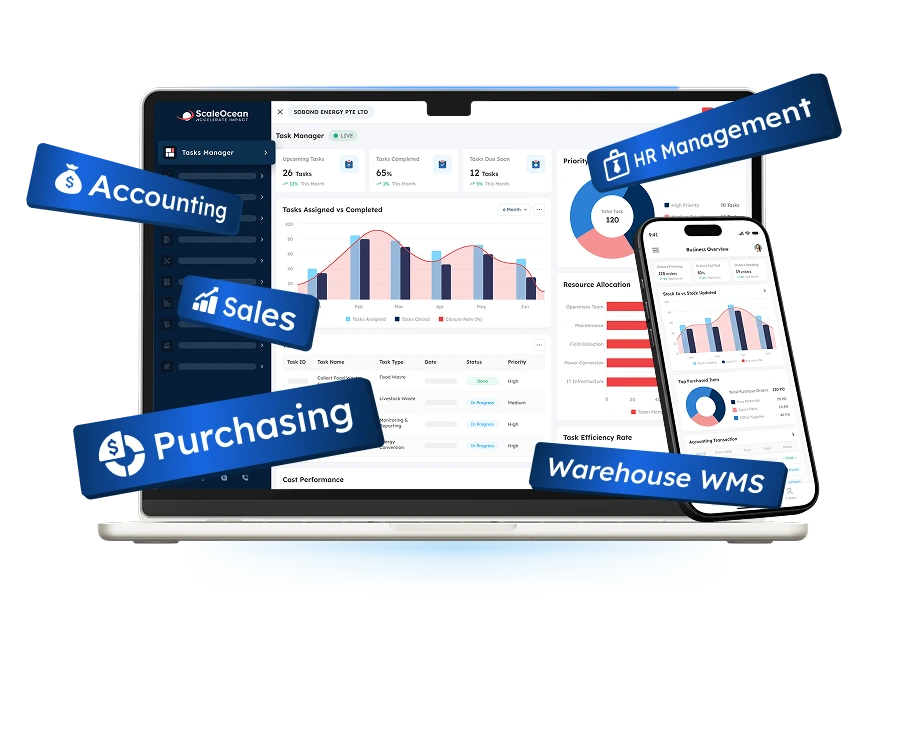
The platform helps businesses manage core operations such as finance, inventory, procurement, sales, HR, asset management, project management, warehouse, and industry-specific processes within one ecosystem. By connecting different business functions, companies can reduce operational gaps, improve collaboration, and gain better visibility across their organization.
For enterprises managing multiple branches, entities, or complex operational structures, ScaleOcean Atlas provides flexible configurations, scalable modules, and customizable workflows. This allows businesses to implement the capabilities they need while maintaining the flexibility to expand as their requirements change.
This system has been optimized and complies with PDPA regulations and local financial reporting standards, including GST and IRAS-related reporting requirements in Singapore. ScaleOcean Atlas can support businesses through configurable ERP workflows and scalable deployment options that align with their operational goals. Schedule a consultation with the ScaleOcean team to evaluate your ERP requirements and discover how a unified industry ERP platform can support your business growth.
Conclusion
ScaleOcean Atlas for Industry is a unified ERP platform designed to help businesses manage different operational requirements through configurable workflows, integrated business functions, and industry-focused capabilities. By adapting to the unique processes of various industries, the platform helps companies improve operational efficiency and create a more connected business environment.
As enterprises continue to expand, many businesses face challenges such as disconnected systems, limited operational visibility, and ERP workflows that do not fully match their industry requirements. ScaleOcean Atlas helps address these challenges by providing a flexible ERP ecosystem that connects departments, streamlines processes, and supports businesses as their operational needs evolve.
With support for industries such as logistics, manufacturing, construction, retail, education, hospitality, and professional services, ScaleOcean Atlas enables businesses to manage their operations through one scalable platform. Through centralized data, customizable workflows, and enterprise-focused capabilities, businesses can improve collaboration and prepare for sustainable growth. Schedule a consultation with the ScaleOcean team to explore how an industry-specific ERP approach can support your business objectives.
FAQ ScaleOcean Atlas for Industry:
1. How can businesses start implementing ScaleOcean Atlas for Industry?
Businesses can start by evaluating their current operational challenges, identifying required ERP capabilities, and discussing their requirements with the ScaleOcean team. Through a consultation process, companies can explore suitable modules, workflow configurations, and implementation approaches that align with their industry needs and business objectives.
2. How does ScaleOcean Atlas support different industries?
ScaleOcean Atlas supports various industries by providing configurable ERP capabilities that adapt to different business processes. Whether for logistics, manufacturing, construction, retail, education, hospitality, or professional services, the platform helps businesses manage industry-specific workflows while maintaining centralized data, integrated operations, and scalable system configurations.
3. Can ScaleOcean Atlas be customized based on business requirements?
Yes. ScaleOcean Atlas provides flexible configurations that allow businesses to adjust workflows, modules, approval processes, and operational structures based on their specific requirements. This enables enterprises to implement an ERP solution that aligns with their existing processes rather than changing their operations to fit a fixed system.
4. How does ScaleOcean Atlas help businesses manage multiple locations or entities?
ScaleOcean Atlas helps businesses manage multiple branches, locations, or entities by providing centralized operational visibility and connected workflows. Companies can maintain consistent processes across different business units while still allowing flexibility for specific operational requirements in each location.



















.png)