




Maintenance bond is a financial guarantee to ensure that the completed work is free of defects after the construction project has been finished. Furthermore, the bond helps to shield the owner of the project from the contractor’s obligation to rectify any flaws during warranty.
This type of construction bond is commonly required in construction projects to ensure quality standards are maintained. For either infrastructure or government projects, knowing bonds can aid contractors and owners in effective risk management.
 Key Takeaways
- A maintenance bond is a type of surety bond that guarantees contractors will repair defects discovered after project completion during the specified maintenance period.
- A maintenance bonds worked by ensuring that the project owner is compensated if the contractor fails to repair defects after project completion.
- Maintenance bonds are important because they protect owners from financial losses, promote high-quality construction, and support effective risk management.
- ScaleOcean Construction ERP Software helps construction companies streamline project management, contract administration, and business operations.

1. What is a Maintenance Bond?
A maintenance bond is a type of surety bond that guarantees a contractor will repair or correct defects that appear after a construction project has been completed and accepted by the project owner.
The bond is activated when the project is completed and will be in effect during the warranty period of the contract. If a defect occurs during this time and the contractor does not take care of it, the project owner can claim on the bond for the repair costs.
Maintenance bonds are one of several construction bond types used throughout a construction project’s lifecycle. Each bond serves a different purpose, from the bidding phase to post-completion warranty obligations.
2. How Does a Maintenance Bond Work?
It is crucial to learn about how a maintenance bond works to ensure that construction contracts can be managed easily. Typically there are three parties to a maintenance bond; the project owner, the contractor, and the surety company. The general process goes as follows:
- The contractor completes the construction project in line with the terms of the contract.
- The project owner accepts completed work formally and maintenance period starts.
- The owner monitors the project for defects of workmanship, materials, or installation during the maintenance period.
- When defects are found, the owner asks the contractor to fix or correct the defects.
- If defects are not corrected by the contractor, the owner could raise a claim against the maintenance bond.
- The surety company saves the owner from the cost of the repairs if it is found to be a valid claim and pays the owner according to the amounts in the terms of the bond.
There are also many project owners who ask for a bid bond in construction at the tender phase to make sure that a contractor will comply with its bidding and enter into the contract in case of selection.
3. Why are Maintenance Bonds Important?

Maintenance bonds are important to protecting both project owners and contractors. They ensure that construction defects are resolved during the warranty period, and reduce financial risks post-construction. Below are some reasons why maintenance bonds are important:
- Protect from Financial Loss: Construction defects may result in large repair bills. A maintenance bond will help project owners not have to pay these costs if the contractor fails to pay for the necessary repairs.
- Promote High-Quality Construction: Contractors will carry on the responsibility of the defects, so they can be encouraged to maintain high standards in workmanship, materials and overall project quality during the maintenance period.
- Strengthen Trust: Maintenance bonds give project owners, lenders, investors and government agencies the peace of mind that the contractor is committed to meeting the post-completion obligations and guarantees the quality of the project.
- Support Risk Management: Maintenance bonds can help lessen disputes, financial uncertainty, and enhance project risk management by establishing the responsibilities for defects following project completion.
When it comes to the costs of a project, research in the Journal of Construction Engineering and Management has revealed that quality failures and construction nonconformances can be a cause of extra project costs. This emphasises the need for quality assurance procedures like maintenance bonds.
 Also Read: Understanding Payment Bonds: How They Work
4. How Much Do Maintenance Bonds Cost?
Several factors will affect the cost of a maintenance bond, such as the contract value, the amount of bond required, the credit history and financial condition of the contractor, the complexity of the project and any claim history.
In addition, the premium for maintaining a bond can be anywhere from about 0.5% of the bond’s value up to 3%. The rate is not guaranteed however, and may be influenced by the surety provider and the contractors risk profile.
For example, if the contractor requires a maintenance bond of PHP 10 million, the premium may be in the range of PHP 50,000 to PHP 300,000. A contractor that has great finances and a history of success would be more likely to be on the lower end of this range.
Contractors should have strong financial statements, a favorable credit history, and a proven track record of successful project completion and timeliness of delivery in order to be able to negotiate for lower maintenance bond costs.

5. Performance vs Maintenance Bond
There are two types of bonds, each providing protection against financial losses for project owners, but for different reasons. A performance bond will guarantee that the project is completed on time and in line with the contract. The difference of this type of bonds is:
| Aspect | Performance Bond | Maintenance Bond |
|---|---|---|
| Purpose | Guarantees contract completion according to agreed specifications | Guarantees correction of defects after project completion |
| Coverage Period | During project execution | After project completion |
| Claim Trigger | Contractor fails to perform contractual obligations | Contractor fails to repair defects during the maintenance period |
| Main Objective | Ensure project completion | Ensure quality and workmanship |
Knowing the difference between a performance bond and a maintenance bond allows project owners to include full risk coverage throughout the project’s life. Together, these bonds minimize financial risks, ensure project quality, and provide coverage.
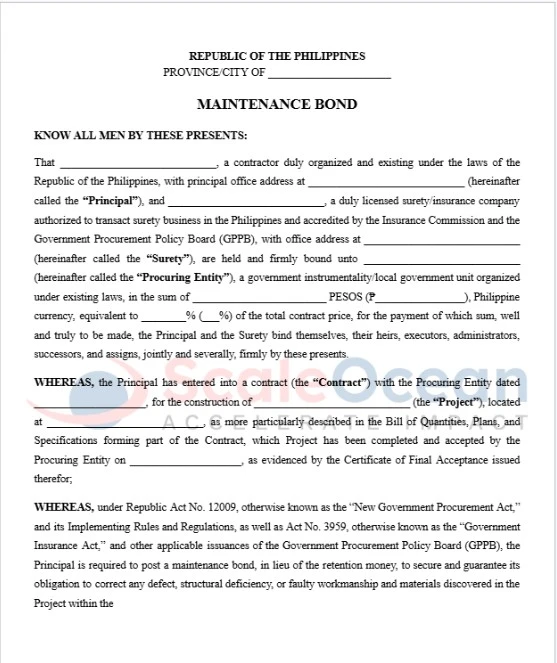
6. Maintenance Bond Example in the Philippines
To better understand how a maintenance bond works in practice, consider the following example from a construction project in the Philippines. The following example shows the bond’s protection to project owners when defects are discovered:
7. In Conclusion
A maintenance bond is a risk management tool adopted to safeguard project owners against defects after project completion. By ensuring that defects are corrected, maintenance bonds help minimize financial risks, and improve project quality.
As construction companies grow, the management of bonds, contracts, budgets, procurement, and project execution can become more and more complex. ScaleOcean Construction ERP Software integrates project management and contract administration.
If your business wants to expand and need systems to manage every business flow, you can request a free demo and discover how ScaleOcean can support your business growth.
FAQ:
1. What is the purpose of a maintenance bond?
A maintenance bond, also known as a warranty bond, ensures that a contractor will correct defects in workmanship or materials that arise after a project is completed. It provides financial protection to project owners during the agreed maintenance period.
2. What is the difference between a performance bond and a maintenance bond?
A performance bond guarantees that a contractor will complete the project according to the contract. A maintenance bond, on the other hand, ensures the contractor repairs defects found after project completion during the maintenance period.
3. What is the maintenance period on a bond?
The maintenance period refers to the timeframe during which the contractor remains responsible for repairing defects in the completed work. This period typically lasts one to two years after project completion, depending on the contract requirements.


















.png)