




Warehouse receiving is the first step in ensuring products enter your warehouse accurately. All items received should be checked, documented, inspected, and stored properly prior to being made available for inventory and/or order fulfillment.
Any errors at receiving in the warehouse can result in stock discrepancies, late deliveries, and wasted resources. As businesses in the Philippines continue to grow, warehouse operations are becoming increasingly complex.
The receiving process is an integral part of the warehouse operation that can be improved to help businesses maintain inventory accuracy. In this article, you’ll get to know what warehouse receiving is, the receiving processes, and some practical tips.
 Key Takeaways
- Warehouse receiving is the process of accepting, verifying,, documenting, and storing incoming goods to maintain accurate inventory records.
- Improving warehouse receiving involves implementing SOPs, optimizing layouts, using ASNs, barcode and a Warehouse Management System (WMS).
- ScaleOcean Warehouse ERP Software streamlines warehouse receiving with AI-powered automation and integrated warehouse management.

1. What is Receiving in Warehouse?
Warehouse receiving is the process of receiving goods from the supplier, checking the accuracy, inspecting the condition of the goods, recording the information of the goods received, and storing them in the suitable storage room.
Unloading goods is just a part of the first stages of the acceptance process. It ensures that every shipment is consistent with purchase orders, that stock is up-to-date, and gets pulled from stock when it is damaged or wrong.
According to a research study published on International Journal Innovative Science and Research Technology, found that offices relying on manual receiving and record-keeping consistently cited inaccurate inventory data.
The study also identified slow receiving processes and difficulty tracking item locations as recurring challenges, highlighting the importance of maintaining accuracy from the receiving stage onward.
Therefore, implementing warehouse management software helps address these issues by automating inventory tracking and providing real-time visibility. It reveals that implementing a WMS can have a significant impact on the warehouse efficiency.
2. The Key Processes in Warehouse Receiving

Warehouse receiving refers to a series of interdependent processes that ensures incoming deliveries are received correctly and go into the warehouse stores. Below here are some of the processes during warehouse receiving:
a. Pre-Receiving & Scheduling
Pre-receiving and scheduling prepare warehouses before shipments arrive. Teams can track delivery schedules, purchase orders, and ASNs, which can help to minimize delays and increase receiving efficiency by assigning docks, labour, storage space, and the appropriate warehouse racking system for incoming goods.
b. Unloading
Products are unloaded from the shipments with the appropriate equipment including forklifts or pallet jacks. By using the proper handling procedures, damage to the product, employee safety, and an efficient reception process are avoided.
c. Inventory Verification & Counting
The warehouse personnel verify the contents with the purchase order, packing list and delivery receipts, and count each item. This step ensures shipment accuracy and ensures reliable inventory records.
d. Quality Inspection
Quality inspection is conducted for the incoming product to verify any damage, quantity, and specification before acceptance. Early detection means that faulty products don’t make it into the inventory and into production.
e. Documentation
They were documented with delivery receipts, Goods Receiving Notes (GRNs), and inspection reports. Accurate records mean inventory is easily monitored, traceable and future audits are handled easily.
f. Labelling
The products have barcodes or RFID tags that carry product information, including SKU, batch number or storage location. Clear labeling improves inventory tracking, order picking and stock identification, and decreases error rates.
g. Putaway
Putaway moves picked up items into the warehouse storage areas according to layout and storage requirements. Correct warehouse putaway can lead to better space utilisation, reduced travel time, and to faster order fulfillment.
3. How to Improve Receiving in a Warehouse?
Optimizing the warehouse receiving process can significantly minimize errors, accelerate inbound, and ensure accurate inventory management for businesses. Standardized procedures and digital tools help in receiving goods, here are some tips:
a. Implement Proper SOPs
Standard Operating Procedures (SOPs) guarantee that each receiving task is conducted the same way. Standardized processes help minimize mistakes, ease employee training, and enhance materials management in warehouse operations.
b. Optimize Warehouse Routes & Layouts
An organized warehouse layout reduces unnecessary travel during receiving. Applying practical warehouse organization ideas, such as zoning high-demand products and optimizing storage locations, improves space utilization, & speeds up putaway activities.
c. Enforce Advanced Shipping Notices (ASNs)
Advance Shipping Notices (ASNs) are notices that inform shippers of the contents of a shipment before it is delivered. This enables warehouse staff to set up the dock, labor and storage areas, minimizing delays, and congestion on the dock.
d. Utilize Digital Scanners (RFID / Barcode)
Product identification at receiving is automated using barcode and/or RFID scanners. Moreover, it is to ensure that inventory is accurate, minimize data entry, and offer up to the moment inventory updates.
e. Implement A Warehouse Management System
Warehouse management system automates receipt, inventory up-dates, documentation, and putaway. It enhances visibility of inventory and lessens manual effort and errors in operation.
 Also Read: 25 Warehouse Management Tips for Growing Businesses
4. What is a Warehouse Receiver’s Role in Receiving?
A warehouse receiver is very important to the accurate processing of incoming shipments to be added to inventory. They are accountable for the integrity of the inventory and quality of the products. Common responsibilities include:
- Receive Incoming Deliveries: Collect goods from suppliers, and confirm that the goods are delivered right on the schedule with orders.
- Verify Shipment Quantities: Check delivered products to ensure correct items and quantities are received, packing lists, and delivery receipts.
- Inspect Product Quality: It is the checking stage before accepting the product to inventory for damage, defect, incorrect specifications, and/or expired products.
- Record Inventory Information: Accurately record inventory information via warehouse systems or electronic devices to ensure real-time visibility of inventory.
- Label Received Products: Use the barcode or RFID labels with product information, including SKU, batch number or storage location, for easier tracking.
- Report Receiving Issues: This is to record and report any damaged or lost items, wrong products, and to resolve this issue (if happened) as soon as possible.
- Coordinate Product Putaway: Coordinate the movement of accepted products to designated storage areas in the warehouse according to warehouse procedures.
- Maintain Receiving Documentation: Ensure that receiving documentation is accurate, such as Goods Receiving Notes, inspection reports, delivery documentation, for inventory tracking and audit.

5. What are the Challenges in Warehouse Receiving?
Many warehouses experience issues with receiving that impact workflow and inventory accuracy. Solving these problems can enhance and ensure the stock is reliable in the businesses. Some of the challenges while receiving at the Warehouse:
a. Manual Data Entry & Human Error
The manual process is prone to human errors like wrong quantities, duplicate records, and inventory not updated. Digital systems reduce such errors and enhance the accuracy of data.
b. Station Congestion
When several deliveries arrive at the receiving stations at the same time, you may end up with a congestion problem. Therefore, it causes poor scheduling which increases unloading times, delays receiving activities, and reduces warehouse productivity.
c. Incorrect Paper Documentations
There is a higher risk of paper records being lost, damaged, or recorded incorrectly. Digital documentation helps to enhance traceability, streamline audits, and maintain inventory accuracy.
d. Poor Slotting Decisions
Having products stored in improper locations reduces travel time and slows warehouse management. Good slotting techniques can improve space utilisation, facilitate quicker replenishment, and picking process.
6. Oversee Every Shipment Easily with ScaleOcean AI WMS
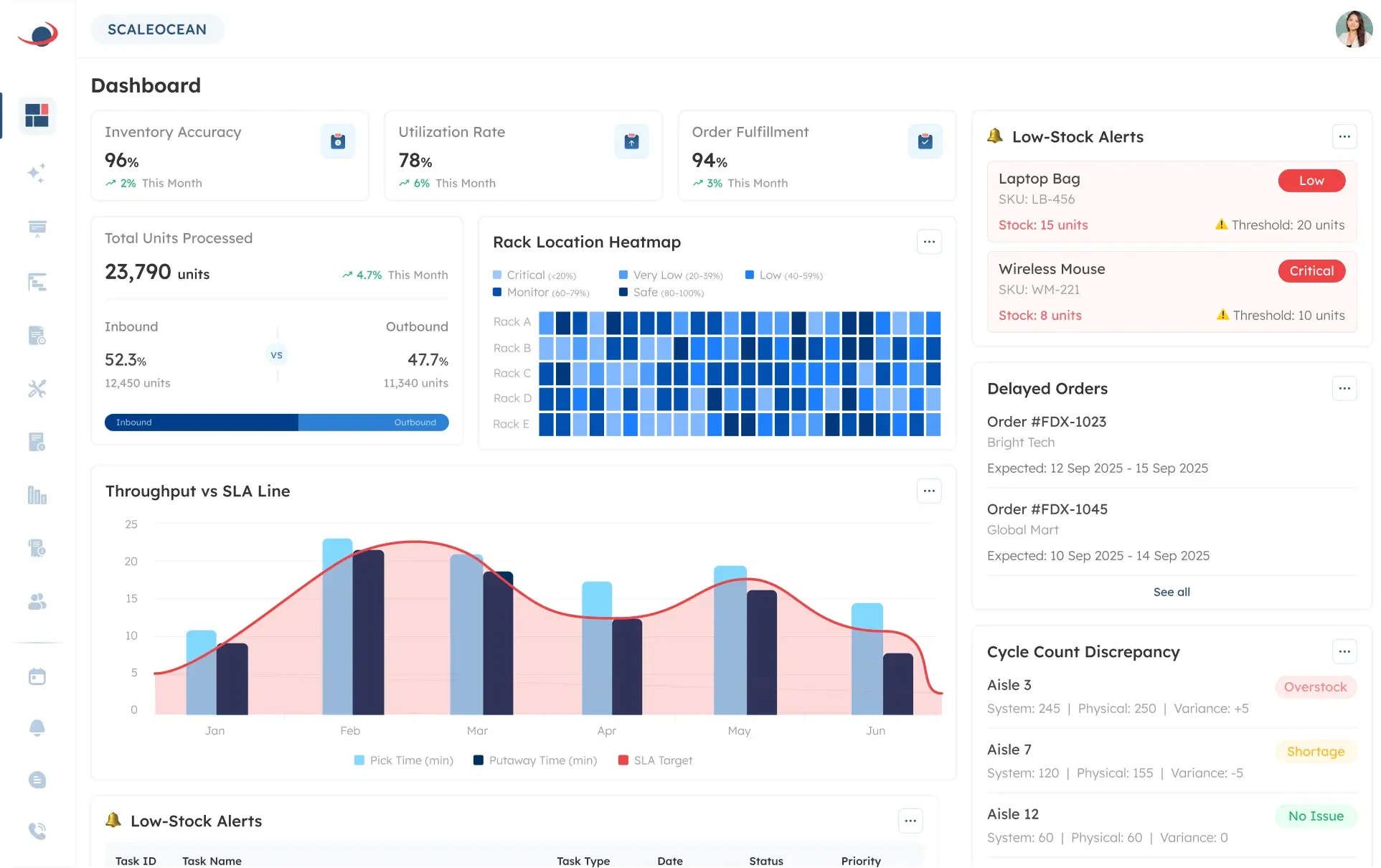
As warehouse operations become more complex, manually managing the warehouse receiving process can result in inventory discrepancies, delayed putaway, and slower order fulfillment.
To address these challenges, ScaleOcean’s AI-powered Warehouse Management System automates warehouse receiving, from verifying incoming goods to updating inventory records and recommending optimal storage locations.
In addition, ScaleOcean Warehouse ERP Software combines all the aspects of a warehouse receiving, purchasing, and logistical functions onto one platform. This allows businesses to keep track of all their shipments from the time they arrive.
Not only this, ScaleOcean also integrates easily with other business processes throughout every department. Get a free demo and see how ScaleOcean can help with your warehouse receiving processes. Here are features include:
- Real-Time Receiving Visibility: Monitor incoming shipments and inventory updates instantly, helping warehouse teams track every delivery with greater accuracy.
- Barcode & RFID Integration: Allows scanning products during receiving to reduce manual data entry, to speed up verification, and to improve the inventory accuracy.
- Automated Inventory Verification: Ensure that the quantity of purchased goods matches with the delivery document and purchase order before inventory is added.
- Smart Putaway Recommendations: Automatically suggest the best storage areas based on space, product type, and warehouse rules.
- Digital Receiving Documentation: Replace paper-based records with digital receiving notes and inspection reports for better traceability and easier audits.
- Lot, Batch & Serial Number Tracking: Real-time viewing of receiving performance, status of inbound shipments, and warehouse productivity.
- Warehouse Performance Dashboard: Monitor receiving performance, inbound shipment status, and warehouse productivity through real-time dashboards.
- AI-Powered Analytics: Analyze receiving trends, identify operational bottlenecks, and gain insights to enhance warehouse planning, and inbound efficiency.
7. In Conclusion
Warehouse receiving is an essential process that verifies, inspects and records received goods to ensure the goods are accurate, and ready to be used for daily activities.
An optimized warehouse setup, the implementation of standardized procedures, the adoption of barcode or RFID technology, and the use of a modern wms are all ways to improve inventory accuracy, decrease receiving time, and operation costs.
If your business is looking to streamline warehouse receiving and improve warehouse efficiency, ScaleOcean Warehouse ERP Software provides an AI-powered solution that integrates receiving, and warehouse operations into one platform.
Sign up for a free demo with ScaleOcean and see how it can benefit and streamline your warehouse operations and contribute to your success in the Philippines.
FAQ:
1. What are the 5 steps in the receiving process?
The warehouse receiving process typically includes verifying documents, unloading goods, counting inventory, inspecting product quality, and storing items in their designated locations to maintain inventory accuracy.
2. What is warehouse receiving duties?
Warehouse receiving staff inspect incoming shipments, verify quantities, check for damage, record inventory, and prepare goods for storage. Their role helps ensure accurate inventory records and efficient warehouse operations.
3. What is a warehouse SOP for receiving goods?
A warehouse receiving SOP is a standardized procedure for checking deliveries, verifying purchase orders, inspecting goods, updating inventory in the WMS, and storing products correctly to ensure consistent and accurate receiving.

















.png)