

Bigger manufacturers and distributors, whose business volume may be increasing at a faster rate than the administration that backs them, are not alone in finding themselves in this situation. It’s a matter of teams having to review an increasing number of stock requests, approve transactions across multiple locations, and handle a growing volume of attendance and payroll activities.
This was a situation that Dekkson had to face as its product range, geographical operations, inventory needs, and manpower bases continued to grow. The staff at its locations had to handle more than 150 request orders daily, prioritize where orders go, reconcile finances, and manage hours and payroll for more than 1,000 workers.
If these activities were recorded separately, other checks had to be done for each approval or calculation. Inventory staff were forced to check stock availability before shipping to the branches, finance staff were forced to cross-check the branch transactions with data in the head office, and HR staff had to create attendance before processing payroll.
Dekkson therefore decided to have the ingredients of inventory, accounting, digital attendance, and payrolls integrated within one operating base, with the help of ScaleOcean ERP. In this implementation case study, Dekkson tells us about their initial challenges, why they chose ScaleOcean, how implementation was structured around priority workflows, and what they have been able to do to measure their transformation.
 Key Takeaways
- Dekkson is an architectural hardware manufacturer and supplier that has operated in Indonesia since 1994 and serves a growing network of branches and warehouses.
- Before using ScaleOcean, Dekkson faced difficulties prioritizing inter-branch stock requests, reconciling financial data, and managing attendance and payroll for over 1,000 employees.
- ScaleOcean was implemented across Dekkson’s priority workflows by connecting stock approvals, warehouse information, transaction recording, digital attendance, and payroll within one system.
- After implementing ScaleOcean, Dekkson improved process efficiency by 85%, handled over 150 daily requests, generated reports in 10 seconds, and processed more than 1,000 payslips in 10 minutes.
Get to Know Dekkson and Its Expanding Operations
Dekkson is an architectural hardware manufacturer and supplier company that first entered into Indonesia operation in 1994. The company started providing friction stays for casement windows but has grown to become a supplier of architectural hardware for doors, windows, furniture, glass, aluminium, and other building uses.
It manufactures door handles, locks, cylinders, hinges, door closers, sliding systems, glass fittings, electronic locks, among other architectural accessories. In addition, Dekkson has also branched out into new product segments such as smart home solutions, sanitary products, and building materials.
By 2024, the company had a Stock-Keeping Unit (SKU) portfolio that had grown beyond 3,000 SKUs across Indonesia. Dekkson also has 16 branch offices, including representative offices and warehouses, which allowed the company to meet customer and project needs across various areas.
This growth allows customers to have more access to products and after-sales services. But it also raises the level of coordination between branches, warehouses, head office, financial teams, and staff who are responsible for fulfilment.
Every branch can generate stock requirements with different levels of urgency. Warehouses must confirm whether the requested product is available, while the responsible team must decide which request should be prioritized. Once goods are transferred or fulfilled, the resulting transaction also needs to be reflected in financial records.
Dekkson’s product diversity further increases this complexity. Thousands of items with different specifications, finishes, sizes, and applications must remain visible across warehouses. When stock data is outdated or separated by location, teams may spend more time determining where a product is available before taking action.
Workforce administration also became more demanding as the company grew. Attendance, timesheets, overtime, allowances, deductions, and payroll calculations had to be completed for more than 1,000 employees. A process that might be manageable for a smaller organization became increasingly difficult to maintain through repeated manual administration.
The company therefore needed a stronger operational foundation. Growth could not depend only on hiring more employees to perform verification, reconciliation, and data entry. Dekkson needed its information to move consistently between the teams responsible for inventory, finance, HR, and payroll.
The official case study Dekkson provides an overview of how the company addressed these requirements with ScaleOcean ERP. It shows that the transformation was not limited to digitizing individual tasks, but focused on connecting business processes that had become increasingly dependent on one another.
 Also Read: What Is an HRIS Software and the Top 10 Recommendations
The Operational Gaps Dekkson Needed to Resolve

Before implementing ScaleOcean, one of Dekkson’s most pressing issues was approving stock requirements between branches. The company received more than 150 request orders every day, and the team needed to determine which requests should be fulfilled first.
The difficulty with prioritization was that the demand, request status, and availability of the warehouse could not be viewed in the same process. Staff would need to contact branches, ensure they could not find what they needed on the books, look at pending requests, and confirm if the product is available in another warehouse before allocating items.
This process was even more challenging due to the limited real-time visibility. You might have a product in one warehouse and another branch, waiting for that product. When there was no common ground, it took longer for teams to determine what the most viable fulfilment would be.
Companies facing similar multi-location inventory challenges need more than a digital stock register. Inventory management software in Singapore should connect warehouse availability with branch demand, stock transfers, purchasing requirements, approvals, and fulfilment activities.
Dekkson also faced challenges in accounting. Transaction records from branches had to be matched with headquarters data, requiring finance teams to compare entries and investigate differences caused by recording times, incomplete documents, account classifications, or transaction values.
As branch activity increased, financial reconciliation became more time-consuming and delayed the availability of consolidated reports. A growing multi-branch company should therefore assess whether its best accounting software can receive data directly from purchasing, inventory, sales, expenses, and branch transactions.
According to data gathered by our team from IBM, nearly 77% of respondents agreed that data silos hinder real-time analytics and data-driven decision-making, while 83% believed they weaken innovation by limiting information exchange across departments.
Applying this was relevant to Dekkson because there was departmental data that was interconnected. The warehouse activity was impacted by a stock request, the inventory transfer generated a transaction, and then that transaction impacted accounting and reporting.
A significant challenge in HR administration was another issue. Dekkson was required to monitor and handle timesheets and attendance of over 1,000 employees, including time worked, schedules, leave, lateness, overtime, and adjustments related to payroll.
When records were incomplete, HR had to verify the information with employees, supervisors, or branch administrators. Payroll also required the team to collect attendance data, calculate overtime, include benefits, apply deductions, and review final salary amounts manually.
For more than 1,000 employees, even a small amount of manual work per person created a substantial administrative burden and increased the risk of errors or outdated payroll data.
The challenge was therefore broader than individual inefficiencies. Inventory approvals, financial reconciliation, attendance, and payroll operated separately even though they depended on related data. Dekkson needed one system capable of connecting requests, approvals, inventory movements, financial transactions, and workforce administration.
Why Does Dekkson Need a More Connected ERP System Like ScaleOcean?
However, it’s not just about replacing the software that led Dekkson to choose ScaleOcean. But it’s about the software being replaced that has driven the choice of ScaleOcean for Dekkson. As transaction volumes, stock requests, branch activities, and employee administration increased, the company needed a system that could support growth without creating more disconnected records.
The ERP system had to be integrated with the branches and warehouses, headquarters, finance, and HR, and the roles of each team. Staff should have access to relevant information without the need to keep multiple copies of inventory information, transaction information, attendance and payroll information.
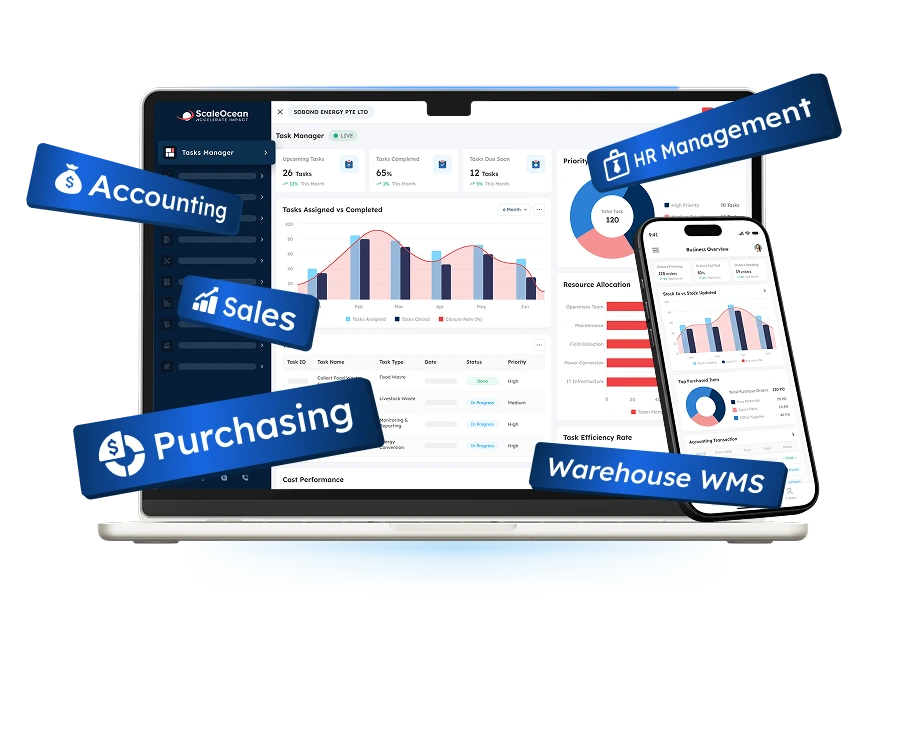
ScaleOcean Atlas ERP did this by consolidating all the business functions, including inventory, accounting, digital attendance, and payroll, into a single and connected system. Data gathered within one workflow could easily be passed on to the subsequent relevant workflow, reducing manual data transferring, or redundant data entry between departments.
For example, the stock could be requested from a branch and approved through the appropriate process. Before making a decision on how to meet the request, the responsible team may be able to ascertain the urgency of the request and quantities required, warehouse locations, and other outstanding requirements.
Once approved, the resulting movement and transaction history in the inventory was linked to the request’s original transaction. The finance teams would then be able to have more uniform records without having to wait for each branch to assemble a separate transaction report.
ScaleOcean’s configurable workflows also allowed Dekkson to align request categories, approval levels, responsible users, branch priorities, and required documents with its actual organizational structure. The company did not need to follow an off-the-shelf workflow that overlooked how its branches and warehouses operated.
Based on data gathered by our team from McKinsey, 79% of surveyed organizations had implemented dashboards for end-to-end supply chain visibility, while 71% expected to revise their planning processes and governance. These findings show that visibility creates greater value when it supports structured planning and operational decisions.
This distinction was important for Dekkson. Seeing available stock was useful, but teams also needed to understand how that stock related to branch urgency, approved requests, warehouse capacity, and distribution priorities.
ScaleOcean offers multi-branch and multi-warehouse visibility so that authorized persons can see where products are and how many products are available when needed. This helps teams to organise their transfers and fulfilment.
The platform also integrated operational and accounting. Financial information can be created by transactions based on the daily workflow, not by individual transactions from the different branches at the end of the reporting period.
This minimized the initial work to be done before reconciling. Financial teams may utilize time instead of compiling frequent transactions by reviewing unusual entries, validating account treatment, and analyzing performance.
ScaleOcean further supported governance through audit trails and role-based access. Activities, approvals, and changes remained traceable, while access could be assigned according to an employee’s role, department, branch, and approval authority.
Its unlimited-user model within the agreed implementation scope was also relevant to Dekkson. Branch employees, warehouse teams, finance personnel, HR staff, and authorized managers could participate directly in the same workflow without depending on a small administrative team to re-enter information for them.
Scalability remained another important consideration because Dekkson needed a system that could support additional products, requests, users, locations, and transactions over time. ScaleOcean’s configurable module structure allowed the company to begin with its most pressing processes and expand the implementation as new requirements emerged.
For Singapore organizations considering a similar transformation, ScaleOcean Atlas ERP can be configured around local financial reporting, GST requirements, PDPA-aligned data practices, and relevant EDG or NTUC CTC Grant transformation plans. These capabilities made ScaleOcean suitable for Dekkson because the company gained a connected operational backbone.
How Dekkson Adopted ScaleOcean Across Its Operations
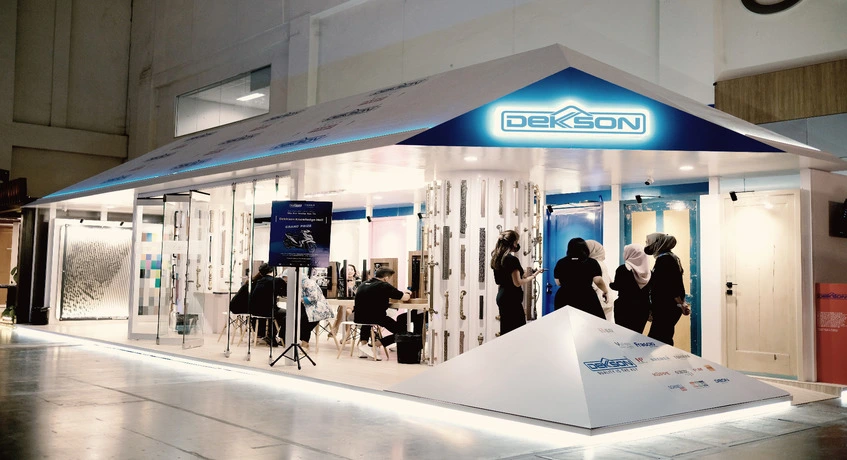
At Dekkson, the deployment of ScaleOcean not only included an ERP app, but a total business process revolution. The project began by creating an overview of how the information moves today through all the departments, warehouses, finance, and HR, and then a detailed analysis of the delays in the unconnected records.
The ScaleOcean team recorded all the essential workflows that Dekkson needs to perform. This included the inventory to be requested, who would approve and sign off on it, how to check at the warehouse, and information that would be required when it was time to go to finance after fulfilment.
The assessment also covered workforce administration. Attendance, leave, overtime, payroll adjustments, benefits, and deductions had to become part of one structured process rather than remain separate administrative activities.
This mapping helped distinguish necessary approval procedures from repetitive steps caused by manual handovers. Dekkson could retain essential reviews while reducing activities that required teams to copy, verify, or reconcile the same data repeatedly.
Forms, user permissions, approval routes, and reporting requirements were then configured around Dekkson’s organizational structure. The system reflected actual responsibilities instead of forcing departments to follow a generic workflow.
Stock requirement approval became one of the first implementation priorities. Branches gained a consistent method for submitting product requests with quantities, locations, urgency details, and relevant supporting information.
Each request was directed to the appropriate authorized users. Reviewers could assess branch demand alongside available inventory, warehouse locations, and pending requirements before deciding how the request should be fulfilled.
Request status and approval history remained visible throughout the workflow. Employees could see whether an item was awaiting review, approved, rejected, allocated, or being processed without relying on repeated messages.
Transaction recording was connected to the same operational flow. When an approved inventory activity created a financial impact, the relevant data could continue into accounting without requiring finance teams to reconstruct it from separate branch reports.
This provided a more consistent basis for reconciliation between branches and headquarters. Finance teams could focus on checking exceptions, validating classifications, and analyzing results instead of compiling routine transactions from several sources.
Businesses facing similar workforce complexity should assess whether the best HR software in Singapore can connect employee records with attendance, leave, schedules, approvals, and payroll through a shared workflow.
At Dekkson, ScaleOcean allowed authorized HR users to record and review working hours, leave, overtime, and attendance adjustments for more than 1,000 employees. Approved information could then support the next process without repeated manual transfer.
This connection was particularly important for payroll. Verified attendance data, overtime, benefits, deductions, and employee details could be processed through one coordinated flow instead of being collected again during each payroll cycle.
ScaleOcean introduced these changes in phases rather than activating every available function at once. Dekkson could prioritize stock approvals, transaction recording, digital attendance, and payroll before expanding the system into other processes.
This phased rollout made adoption more manageable for employees. Each team had time to understand its responsibilities, adjust daily work habits, and become familiar with the new workflow before wider capabilities were introduced.
Companies evaluating the best payroll software should therefore examine more than calculation speed. The system should receive verified HR data directly, preserve calculation histories, and reduce repeated payroll preparation.
Through this structured implementation, Dekkson connected branch requests, inventory activity, financial transactions, attendance, and payroll within one operational flow. Each implemented process strengthened the same business foundation instead of becoming another isolated application.
The Results of Dekkson’s Transformation with ScaleOcean
After implementing ScaleOcean ERP, Dekkson improved the efficiency of its inventory, HR, and accounting processes by 85%. This result came from connecting approval, transaction, attendance, and payroll workflows instead of improving each department separately.
Before implementation, extra verification for stock requests was made between different branches to ensure the request was urgent and the stock was available. Before deciding on the distribution of goods, employees needed to read information from multiple sources.
After implementation, requests could move through a structured workflow supported by current inventory data. Teams could assess branch priorities, review stock availability, and monitor request status within the same process.
Dekkson is now able to accept and process over 150 request orders per day. These requests are sent to the relevant users, have a clear approval history, and are linked to the necessary fulfilment process.
This configuration also provides the company with an improved understanding of demand at each of its branches. The allocation is controlled by the approved priorities, and the allocation process is documented by the best accounting software without the need for each location to keep its own records.
The accounting workflow has transformed as well. In the past, transactions between branches and headquarters were subject to a time-consuming process that may have identified discrepancies and delayed reporting.
Now, ScaleOcean logs relevant transactions in a unified and synchronized workflow. This helps minimize the amount of manual time spent compiling branch information prior to starting reconciliation.
Dekkson can create financial reports automatically in just about 10 seconds. The reports are based on data collected in connected workflows, eliminating the need for finance teams to manually reconcile consolidated data from individual sources.
Therefore, management can get the financial information more quickly. Finance staff can also focus more on reviewing exceptions, analyzing trends, and assisting in decision-making instead of gathering routine transaction data.
The fragmented record-keeping system for attendance was also transferred to a digital workflow. Data for over 1,000 staff members can be captured, monitored, and managed in the same HR system.
Before ScaleOcean, timesheet processing was a manual and prone-to-inaccuracy process that could lead to inaccurate attendance data and administrative delays. The system now has a real-time employee attendance tracking feature and maintains approved changes to the employee’s record.
The connection between attendance and payroll delivered another measurable improvement. Previously, the team had to collect attendance data, calculate overtime, add benefits, apply deductions, and verify salaries through a labor-intensive process.
With ScaleOcean, approved attendance information can directly support payroll calculations. Routine components are processed through the system, while HR focuses on exceptions and necessary adjustments.
Dekkson can now process more than 1,000 pay slips in approximately 10 minutes. This improvement shows how payroll becomes faster when calculations use connected and validated employee data.
The company is also able to complete over 500 HR processes automatically. These include workflows for attendance, employee administration, approval, and preparing payroll.
The rules are followed to maintain the activity history and to automate routine activities. The HR team can quickly track responsibilities and changes, without the need to follow up on all administrative tasks.
Dekkson’s experience after implementation was summarized by Lela Ramadhan, its HRD and GA Manager.
“ScaleOcean ERP really simplified how we manage inventory, HR, and accounting. Real-time updates, integrated attendance and payroll, and more accurate financial records have made operations smoother and easier to manage.”
The statement is a result of the overall influence of ScaleOcean for Dekkson. The value was not just in digitizing inventory, accounting, and HR, but in making information flow from one workflow to another.
Real-time updates reduced the need to contact other teams for the latest status. Integrated attendance and payroll shortened processing time, while consistent transaction records supported more accurate bookkeeping.
The resulting 85% efficiency boost is also representative of a more scalable operating model. Dekkson’s administrative load can not increase in direct proportion to their additional requests, transactions, products, or employees.
This connected foundation gives Dekkson stronger readiness for continued growth. New branches, warehouses, employees, and product requirements can enter structured workflows without creating another separate record-keeping process.
Conclusion
Dekkson’s experience has shown that scalability is not just about increasing the product range, expanding the branch network, or merely increasing the number of people. Companies also require an operational base that continues to provide the business with the right information on requests, approvals, inventory movements, transactions, attendance, and payroll, as the business expands.
Before ScaleOcean, Dekkson had a number of challenges: prioritizing inter-branch stock requests, not knowing what was in and out of stock, long recon periods, and huge HR admin for more than 1000 employees. These challenges came in different departments, but in all had a silo mentality around data flows.
ScaleOcean Atlas ERP integrated these processes into the respective operational information and configured them in workflows. Branch requests could be reviewed alongside stock availability, operational transactions could flow into accounting, and approved attendance data could support payroll calculations without repeated manual transfer.
With more than 200 configurable modules, unlimited users within the agreed scope, role-based access, audit trails, and phased implementation, ScaleOcean Atlas can be adapted to each company’s structure and operational priorities. Schedule a consultation with our team to identify disconnected workflows, map the most urgent improvements, and build a more scalable foundation for connected growth.
FAQ:
1. What business processes did ScaleOcean improve at Dekkson?
ScaleOcean improved Dekkson’s stock request approvals, warehouse visibility, accounting reconciliation, financial reporting, attendance management, HR administration, and payroll calculations. By connecting these activities through shared data, Dekkson achieved an 85% improvement in the efficiency of its inventory, HR, and accounting processes.
2. How did ScaleOcean improve Dekkson’s inventory management?
ScaleOcean introduced a structured workflow for submitting, reviewing, prioritizing, and approving stock requests between branches. Teams can assess branch urgency alongside current warehouse availability, helping Dekkson process more than 150 request orders each day with clearer status and approval histories.
3. How did ScaleOcean simplify accounting reconciliation at Dekkson?
ScaleOcean connected operational transactions with accounting records, allowing branch and headquarters data to remain synchronized. Finance teams no longer need to rebuild transaction histories from separate records, enabling Dekkson to generate financial reports automatically in approximately 10 seconds.
4. Is ScaleOcean suitable for businesses with multiple branches and warehouses?
Yes. ScaleOcean Atlas ERP supports multi-branch workflows, multi-warehouse inventory visibility, configurable approvals, role-based access, audit trails, integrated accounting, and consolidated reporting, making it suitable for growing companies that need to coordinate operations across several locations.




















.png)