











Customer Lifecycle Management (CLM) refers to the management of a customer’s lifecycle, from the moment they first become aware of your business until they become your customers and then stay customers. It allows companies to synchronize their sales, marketing, customer service, and operations processes to target the right buyer, deliver a better customer experience, and establish greater long-term value.
Customer lifecycle management can be challenging in the case of enterprise businesses in Singapore, when customer information is spread across various customer relationship management, sales records, customer service systems, financial information, and operational systems. This breakdown can cause miscommunication and coordination challenges between departments, missed opportunities to respond, reduced visibility into customer behaviour, and increased churn risk.
To address these issues, businesses need a more connected approach. Effective customer lifecycle management depends on centralised customer information, clearer cross-department workflows, more consistent engagement across touchpoints, and better visibility into what customers need at each stage of the relationship.
According to the data our team gathered from ServiceNow’s Customer Experience Singapore research, 52% of Singapore customers would switch brands after poor or slow service, while customer service representatives use more than four systems on average to resolve customer issues. These findings highlight how fragmented customer information and inefficient service processes can weaken customer retention and increase the importance of integrated customer lifecycle management.
This article explains what customer lifecycle management is, the five lifecycle stages, its business benefits, key metrics, common challenges, and practical improvement strategies. It also explores software options, Singapore business use cases, and how integrated systems can support stronger customer relationships from acquisition to retention.
 Key Takeaways
- Customer Lifecycle Management (CLM) is the process of managing customer relationships from initial awareness and acquisition to conversion, retention, loyalty, and advocacy to maximise long-term customer value.
- The five stages of customer lifecycle management include awareness, consideration, conversion, retention, and loyalty and advocacy. Each stage requires targeted engagement strategies to improve customer satisfaction and retention.
- Effective customer lifecycle management helps businesses reduce customer churn, increase customer lifetime value, and improve operational efficiency through centralised customer data, automated workflows, and performance analytics.
- ScaleOcean CRM Software, integrated within ScaleOcean Atlas ERP, connects customer information, sales, service, and operational workflows. Its embedded ScaleMind AI Business Assistant provides data-driven insights to support customer retention and informed business decisions.
What Is Customer Lifecycle Management?
Customer lifecycle management (CLM) refers to managing a customer’s relationship from the moment they first become aware of a solution to the time they become more loyal to it and tell their friends about it. It entails aligning marketing, sales, and customer service efforts with operational functions to ensure a seamless customer engagement experience, enhance customer satisfaction, and optimise the long-term value of the customer.
CLM takes a more customer-centric view than traditional methods of managing customers, which are more focused on sales transactions or one-to-one interactions. An organized customer lifecycle management system enables companies to comprehend consumer behavior, recognize hot spots for interaction, arrange interactions, and react to evolving buyer requirements throughout the customer lifecycle.
For example, a Singapore-based B2B distributor may manage customer enquiries, quotations, purchase orders, deliveries, payment histories, and after-sales support across different departments. Without connected information, sales representatives may struggle to identify outstanding orders or resolve customer issues efficiently. By implementing customer lifecycle management, businesses can connect these activities and maintain greater visibility into each customer’s relationship with the company.
By enabling businesses to identify dormant accounts, predict renewal dates, and tailor their services. It seamlessly connects with other business systems like CRM and ERP, allowing enterprises to oversee customer interactions alongside financial and operational data, which enhances their decision-making process during the customer lifecycle.
 Also Read: What is CRM Software? A Guide and Best 10 CRM Tools 2026
What Are the 5 Stages of Customer Lifecycle Management?
The five steps in customer lifecycle management are awareness, consideration, conversion, retention, and advocacy or loyalty. Every stage has distinct customer goals and calls for various business behaviors, communication strategies, and metrics of success.
Clearly defining these stages is beneficial for businesses since they affect one another. Awareness activities can only lead to conversion when they are viewed by the right audience. Failure to be consistent in the onboarding and support provided after the purchase will also have an impact on retention and advocacy.
Five-Stage Customer Lifecycle Diagram
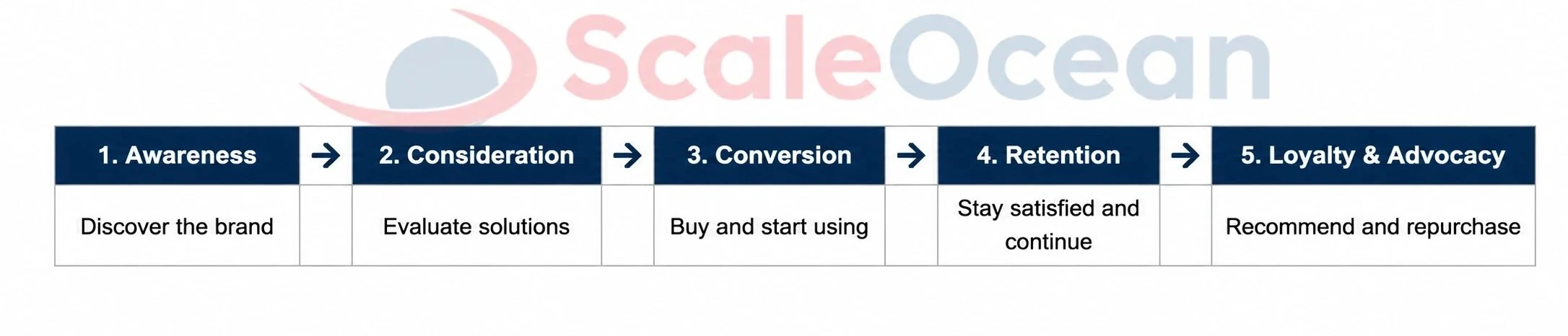 Lifecycle Stage Comparison Table
Each stage of customer lifecycle management requires different business activities and performance indicators. Understanding these differences helps businesses align their engagement strategies with customer needs, monitor progress, and identify opportunities to improve retention. The following table compares the customer goals, business activities, and key performance indicators (KPIs) for each stage.
| Stage | Customer Goal | Business Activities | Primary KPIs |
|---|---|---|---|
| Awareness | Understand the brand or solution | Brand campaigns, content marketing, lead generation, social media outreach | Traffic, reach, impressions, marketing qualified leads |
| Consideration | Compare options and assess fit | Product education, demos, follow-ups, proposal discussions | Lead-to-opportunity rate, engagement rate, demo requests |
| Conversion | Make a purchase or sign a contract | Sales pipeline management, onboarding coordination, quote and order processing | Conversion rate, CAC, sales cycle length |
| Retention | Continue using the product or service successfully | After-sales support, service resolution, renewals, account management | Retention rate, churn rate, CSAT, repeat purchase rate |
| Loyalty & Advocacy | Recommend the brand and stay engaged | Loyalty programmes, referrals, upselling, community engagement | NPS, referral rate, CLV, upsell rate |
1. Awareness
At the awareness stage, prospects come to a company’s attention via digital marketing, referrals, events, search engines, or advertising. At this stage, customers are not ready to purchase. On the contrary, they are seeking to know the business and whether it’s applicable to them.
In this phase, the key objective for businesses is to get their message to the right people in an effective and informative manner. This can involve thought leadership, webinars, paid campaigns, social media, SEO, and content marketing, which help generate initial interest in the brand.
2. Consideration
During the consideration stage, customers start to seriously consider the options that are available. They’ll review the product information, get product demos, do some price comparisons, read some case studies, and talk to the sales teams to see if there is something that will meet their needs.
Businesses’ objective should be to help customers to be confident with their assessment. This means that they will offer education, information, and individual follow-up and education on the product/service that will reduce the uncertainty in the decision-making process.
3. Conversion
The conversion stage is when a prospect becomes a customer; that is, when they order something, sign a contract, or purchase. Often, in this stage, the smoothness of quotes, approvals, onboarding, and handoff between sales and operations is crucial.
A poor conversion experience can damage trust even after a customer decides to buy. That is why businesses should make this stage as efficient as possible by reducing delays, clarifying next steps, and ensuring the customer understands what will happen after the purchase.
4. Retention
Retention begins after the initial transaction and focuses on keeping the customer satisfied and engaged over time. This stage includes onboarding, customer support, service delivery, account management, issue resolution, and regular communication to ensure ongoing value.
Many companies lose customers not because they fail to make the initial sale, but because they fail to maintain consistency after the sale. A strong retention strategy helps businesses reduce churn, improve renewal rates, and strengthen long-term customer relationships.
5. Loyalty and Advocacy
In the loyalty and advocacy stage, customers move beyond satisfaction and become repeat buyers, loyal members, or advocates who recommend the brand to others. They may participate in referral programmes, give testimonials, upgrade services, or contribute to word-of-mouth growth.
This stage becomes more likely when earlier stages are managed well. Businesses can encourage advocacy by rewarding loyalty, recognising customer value, providing excellent service, and maintaining relevant engagement that keeps the relationship active.
Why Is Customer Lifecycle Management Important?
Customer Lifecycle Management (CLM) is important because it shifts a business from chasing random one-off transactions to building a structured, predictable system for growth.
1. Improves Customer Retention and Loyalty
CLM improves customer retention by helping businesses stay engaged after the initial sale. Instead of stopping at conversion, companies can continue supporting customers through onboarding, service, renewals, and loyalty-building activities.
This reduces the risk of customers feeling neglected after purchase. When businesses maintain relevant communication and respond consistently across touchpoints, customers are more likely to stay longer and develop stronger loyalty.
2. Increases Customer Lifetime Value
Customer lifetime value increases when businesses keep customers longer, encourage repeat purchases, and identify upselling or cross-selling opportunities at the right time. CLM helps businesses recognise where these opportunities exist across the lifecycle.
Rather than focusing only on acquiring new customers, companies can improve profitability by expanding the value of existing relationships. This is often more cost-effective than relying only on new lead generation.
3. Enhances Customer Experience Across Touchpoints
Customers interact with businesses through multiple touchpoints, such as websites, sales representatives, service teams, billing channels, and support desks. CLM helps ensure these interactions feel more consistent instead of disconnected.
This matters because customers usually judge a brand by the overall experience, not by a single department. When the business knows the customer’s history and coordinates responses better, the experience becomes smoother and more reliable.
4. Improves Sales and Operational Efficiency
CLM improves efficiency by reducing duplicated work, missed follow-ups, and communication gaps between departments. Marketing can pass leads more clearly, sales can follow opportunities more consistently, and service teams can access better customer context.
This also improves internal coordination. When teams work from connected customer information rather than separate systems, the business can respond faster and make decisions with less manual effort.
5. Supports Data-Driven Business Decisions
Customer lifecycle management gives businesses a clearer view of customer behaviour, lifecycle performance, and revenue opportunities. By tracking engagement, churn risk, and service activity, managers can identify what is working and where improvement is needed.
This helps enterprises make more informed decisions about campaigns, account management, retention strategies, and process improvements. Data becomes more useful when it is connected to lifecycle stages rather than reviewed in isolation.
Key Differences: CLM vs. CRM vs. CEM
Although these three concepts are related, they serve different purposes. Customer lifecycle management (CLM) focuses on managing the entire customer relationship over time, customer relationship management (CRM) focuses on storing and managing customer interactions and sales information, and customer experience management (CEM) focuses on improving the quality of customer experiences across touchpoints.
Understanding the differences helps businesses choose the right systems and avoid treating these terms as if they mean exactly the same thing.
| Aspect | CLM | CRM | CEM |
|---|---|---|---|
| Main Focus | Managing the full customer relationship across stages | Managing customer records, sales pipelines, and interactions | Improving customer experiences and satisfaction across touchpoints |
| Scope | From acquisition to loyalty and advocacy | Usually sales, account, and service relationship data | Experience design, touchpoints, sentiment, and satisfaction |
| Typical Activities | Segmentation, onboarding, engagement, retention, renewals, advocacy | Lead management, contact management, opportunity tracking | Journey design, feedback collection, service quality improvement |
| Key Data Used | Customer stage, behaviour, service history, renewal and engagement data | Contacts, accounts, activities, deals, communication history | CSAT, NPS, feedback, sentiment, service interactions |
| Main Objective | Grow long-term customer value and retention | Organise and manage customer relationships operationally | Make customer interactions smoother and more satisfying |
How Does Customer Lifecycle Management Work?
Customer Lifecycle Management (CLM) is the practice of tracking, analyzing, and guiding a customer through every phase of their relationship with a brand, from first discovering it to long-term loyalty and advocacy.
While a Customer Relationship Management (CRM) system stores static and interactive data (like contact info and purchase history), CLM acts on that data by coordinating cross-functional teams (marketing, sales, product, and customer service) to deliver the right message at the right time.
1. Map the Customer Journey and Identify Key Touchpoints
The first step is to map the customer journey and identify every important touchpoint, from first discovery to after-sales engagement. This includes interactions such as website visits, sales calls, demos, onboarding sessions, support tickets, renewals, and loyalty activities.
Once these touchpoints are mapped, businesses can identify where customers experience friction. This helps them improve the flow between departments and make the customer experience more consistent across the lifecycle.
2. Centralise Customer Data Across Departments
Centralising customer data means bringing together sales records, CRM details, service interactions, account information, contracts, fulfilment status, and related customer data into a more connected environment. This gives teams a more complete view of each customer.
When customer data remains fragmented, departments often make decisions with incomplete information. By contrast, a connected structure helps businesses understand customer history better and respond faster across sales, service, and account management.
ScaleOcean Atlas supports this approach by connecting CRM, sales activities, customer service records, quotations, orders, and related operational data within an integrated ERP environment. This helps enterprise businesses reduce manual data checks and maintain better customer visibility across departments.
3. Segment Customers Based on Lifecycle Stages
Segmentation allows businesses to group customers by lifecycle stage, behaviour, purchase history, product usage, contract status, or churn risk. This makes communication more relevant and helps teams prioritise actions more effectively.
For example, a business may treat new leads, active customers, at-risk customers, and loyal repeat customers differently. Stage-based segmentation helps sales, marketing, and service teams focus on the right actions for each group rather than sending the same approach to everyone.
4. Establish Automated Workflows and Engagement Triggers
Automation helps businesses reduce repetitive tasks and improve response speed throughout the lifecycle. Common workflows include lead assignment, follow-up reminders, onboarding sequences, renewal alerts, service escalations, and inactivity triggers.
When automation is set up properly, the business becomes more consistent without depending fully on manual follow-ups. This is particularly useful for enterprise teams handling large customer volumes or multiple account managers.
5. Coordinate Marketing, Sales, and Customer Service Activities
Customer lifecycle management works best when marketing, sales, and service teams are aligned instead of working independently. Marketing should understand which leads convert best, sales should know the customer context before onboarding, and service teams should be aware of what was promised earlier in the lifecycle.
This coordination improves response quality and reduces handoff problems. Customers are less likely to repeat information when departments share relevant context and follow clearer workflows across the customer relationship.
6. Monitor Performance and Optimise Customer Relationships
The final step is continuous monitoring. Businesses should review lifecycle metrics such as conversion rates, churn, response times, retention, and customer satisfaction to understand which areas need improvement.
This also supports long-term optimisation. By comparing lifecycle stages and performance trends, businesses can refine campaigns, improve account management practices, and identify where resources should be allocated to support better customer outcomes.
Within ScaleOcean Atlas, ScaleMind is an embedded AI Business Assistant that helps users search for information, analyse customer conditions, identify operational issues, and surface relevant insights from connected data. This can support faster lifecycle reviews and more informed decisions without relying solely on disconnected reports or manual analysis.
What Are the Best Customer Lifecycle Management Strategies?

Customer Lifecycle Management (CLM) tracks and guides a customer through every phase of their relationship with a business, from first discovery to brand advocacy.
The best strategies focus on optimizing the core lifecycle stages and leveraging data, automation, and cross-team alignment
1. Personalise Customer Engagement at Every Stage
Personalisation means adjusting communication, offers, and support based on who the customer is and where they are in the lifecycle. New prospects need different information than long-term customers or inactive accounts.
This helps businesses deliver more relevant customer interactions rather than sending generic campaigns to everyone. By working with a loyalty program software vendor, companies can personalise rewards, offers, and engagement activities based on customer preferences, purchasing behaviour, and lifecycle stages.
2. Strengthen Customer Onboarding and After-Sales Support
A customer relationship does not end after the sale. Strong onboarding and after-sales support help customers adopt the product or service more successfully and reduce frustration early in the relationship.
This is especially important for businesses with complex offerings, subscriptions, or ongoing service requirements. A smoother onboarding process often improves both retention and long-term satisfaction.
3. Use Predictive Analytics to Identify Customer Churn Risks
Predictive analytics helps businesses identify customers who may be at risk of churn based on behaviour, inactivity, unresolved issues, or declining engagement. This allows account teams to act earlier instead of responding only after the customer is already leaving.
It also helps businesses prioritise interventions. Rather than treating all accounts the same way, teams can focus their effort on the relationships with the greatest risk or the greatest potential value.
4. Implement Cross-Selling and Upselling Opportunities
Cross-selling and upselling should be based on lifecycle timing and customer relevance, not only on sales pressure. Businesses should identify when a customer is ready for additional services, upgrades, or complementary products.
When these offers are aligned with actual customer needs, they improve revenue without weakening the relationship. This makes lifecycle management more commercially valuable while still supporting customer success.
5. Build Consistent Omnichannel Customer Experiences
Customers often interact with businesses through multiple channels, including websites, phone calls, email, live chat, apps, and in-person support. Omnichannel lifecycle management ensures these channels remain connected, allowing businesses to deliver consistent customer experiences.
Based on data our team obtained from the French Chamber of Commerce in Singapore, FairPrice Group achieved 80% case deflection, over 90% first-call resolution, and a 10% reduction in cost per support ticket through AI-powered customer service and integrated customer engagement technologies. This demonstrates how connected communication channels can improve service efficiency and customer satisfaction.
6. Re-Engage Inactive Customers Through Targeted Campaigns
Inactive customers should not be ignored automatically. Businesses can re-engage them with targeted campaigns based on previous purchases, lifecycle stage, inactivity duration, or known interests.
These campaigns work better when they are relevant and timely. Instead of sending broad reminders, businesses should tailor re-engagement messages to why the customer may have stopped interacting in the first place.
What Are the Key Customer Lifecycle Management Metrics?
Key Customer Lifecycle Management (CLM) metrics track performance, health, and value across every stage of the customer journey, from first awareness to long-term loyalty and advocacy.
1. Customer Acquisition Cost (CAC)
Customer acquisition cost measures how much the business spends to acquire a new customer. It typically includes marketing and sales expenses divided by the number of new customers acquired during a given period.
CAC is relevant as acquisition activities need to be lagged. Should the acquisition cost be historically increasing with the underperforming deal, then it could be viewed as “targeting improvements or increasing efficiencies of the sales”.
2. Customer Retention Rate (CRR)
The indicator represents the number of retained customers over a period of time, which allows you to observe the ability of your team to retain customers.
A good retention rate reflects a good onboarding, servicing, and nurturing process. A bad one can reflect service or other issues, or indeed a particular type of client which is not compatible with your offering, or even bad post-sales service.
3. Customer Churn Rate
Percentage of all users/subscribers that quit or cancel for a specified period of time. The one metric that defines your (potential) relationship drop-off.
But what every company needs to find out is not only the lifetime number of lost customers (churn) but also the type of lost customer and the reason for leaving.
4. Customer Lifetime Value (CLV)
Customer lifetime value estimates the total value a customer contributes throughout the relationship. It helps businesses understand the long-term revenue potential of retaining and expanding each customer relationship.
CLV becomes especially useful when compared with CAC. If the lifetime value of customers is too low relative to acquisition costs, the business may need to improve retention, upselling, or customer targeting.
5. Customer Satisfaction Score (CSAT)
It’s a metric that shows how pleased customers are with a particular experience or type of engagement. This could be a survey or a short feedback form following one interaction.
This indicates how the customer felt after an important contact. Not a general measure of the entire relationship, but does indicate the service and problem resolution.
6. Net Promoter Score (NPS)
NPS measures how likely customers are to recommend the business to others. It is commonly used as an indicator of customer loyalty, advocacy, and overall relationship strength.
A stronger NPS usually suggests that the business is delivering a positive and memorable experience. A weaker score may indicate that customers are staying only out of convenience rather than true loyalty.
What Are the Common Customer Lifecycle Management Challenges?
Managing the customer lifecycle comes with several common obstacles that prevent teams from delivering a smooth experience.
1. Fragmented Customer Data Across Multiple Systems
Customer data resides in numerous places such as CRM tools, billing and ERP systems, customer service applications, emails, spreadsheets, and more, making it impossible to have a single, comprehensive view.
Different data about the customer across the organization leads to a lost opportunity to ‘delight’ them. For instance, sales could be unaware of a still-open service call, the service team unaware of what’s been contracted for, and account teams unaware of lifecycle signals.
ScaleOcean Atlas can help by bringing together all of your customer data, from your CRM, sales, customer service, quoting, orders, inventory, and finance—in one ERP. So you get more customer insight with less duplication of data.
2. Inconsistent Communication Between Departments
When departments do not share the same customer context, communication becomes inconsistent. Marketing may continue pushing acquisition messages to existing customers, sales may promise timelines that operations cannot meet, and support teams may not know what the customer was told earlier.
This inconsistency affects both customer experience and internal efficiency. Clear workflows and better information sharing help departments respond in a more coordinated and professional way.
3. Limited Visibility Into Customer Behaviour and Performance
Most companies have been left in the dark about which customers are truly thriving, which accounts are at risk, and how one-off service interactions may be affecting retention. What this ultimately leads to: reactive lifecycle management instead of proactive.
Better lifecycle visibility helps businesses prioritise key accounts, recognise early signs of churn, and improve customer retention strategies. For membership-based businesses, integrating membership management software in Singapore can also help track member engagement, renewals, and service preferences, giving management clearer insights into customer performance, revenue, and service quality.
4. Inefficient Manual Processes and Follow-Ups
Manual follow-up generates delays, omissions, and chaos. It might be something as simple as hand-offs between sales and service, service reminders, new client onboarding processes, account reviews, and renewal tracking, all handled by email and spreadsheets.
These manual processes may work temporarily for small teams, but they become harder to scale. Businesses improve faster when important lifecycle actions are supported by automated workflows and clearer task ownership.
5. Difficulty Maintaining Data Privacy and Compliance
Customer lifecycle management models global firms to process highly sensitive customer data during each phase and across the system. This increases the level of compliance obligations, privacy, access, and controls.
Customer data needs to be stored, communicated, and utilised appropriately for activities across its lifecycle. Organisations should verify who has access and whether the retention or communication policies remain relevant.
How Can Businesses Improve Customer Lifecycle Management with Software?

Cloud-based apps help businesses to: Build a complete picture of customer data (single source of truth). Automate touchpoints for engaging customers and break down departmental silos throughout the entire lifecycle.
1. Centralised Customer Information Management
If you’re capable of centralising your system, then you can put together a profile of each customer that’ll include every little thing from a service account document, past contact information, previous purchase history, service issues, and lifecycle info. This will allow your folks to gain a full view of the relationship.
Same is true for enterprise company with multiple teams having a better view of the customer relationship. This also saves teams from double data entry and makes sure they stay more nimble and better informed.
2. Automated Sales and Customer Service Workflows
Software can automate tasks such as lead assignment, follow-up reminders, service escalations, onboarding steps, renewal alerts, and ticket routing. This improves consistency while reducing administrative workload.
Automation does not replace the need for good processes, but it helps businesses execute those processes more reliably. It is particularly valuable where customer volumes are high, or response speed is critical.
3. Real-Time Customer Analytics and Reporting
Having the ability to report back on a real-time basis gives the organisation a more complete picture of the customer interaction, and when the customer responds to an organisation’s action. It provides insight into lifecycle, early churn indicators, activity, account, etc.
What this will also mean is that management will also have far more strategic information about how your customers are performing. Rather than having various reports from various areas of your business, management will be able to see a broader view of customers and see where they are going wrong.
4. Integration With ERP and Other Business Systems
Take customer lifecycle management software, for example, which becomes exponentially more useful when integrated with an enterprise resource planning (ERP) system, finance, fulfilment and inventory management, and other operational applications. As a result, the company gets a much clearer view of everything that happens beyond the basics of the daily transactions.
ScaleOcean Atlas is positioned as an integrated, AI-powered ERP for end-to-end customer lifecycle management. It not only manages customer interactions like a conventional CRM, but also connects sales activities, customer service, quotations, order fulfilment, inventory, finance, and other operational information. ScaleMind, as an embedded AI Business Assistant, helps users search for information, analyse customer conditions, recognise operational issues, and surface useful insights through prompt-based interaction.
The Best Customer Lifecycle Management Software in Singapore
All in all, what is the best customer lifecycle management software will be determined by your needs in terms of customer complexity, the needs of your industry, the connected systems you have, and the degree to which you want your lifecycle functions to be integrated with other applications. Certain products are perfect for automation or CRM, but others aim for regulated lifecycle management or even ERP integration.
The following comparison table summarises eight software options often considered by businesses in Singapore.
| Tool | Best For | Core Strengths |
|---|---|---|
| ScaleOcean CLM Software | Medium-to-large enterprises that want ERP-connected lifecycle management | Integrated CRM, sales, service, fulfilment, finance, and embedded AI assistance |
| Salesforce | Large businesses needing advanced CRM and cloud ecosystem support | Extensive CRM features, automation, analytics, large app ecosystem |
| HubSpot | Growing businesses focused on marketing, sales, and service alignment | User-friendly CRM, marketing automation, service tools, content integration |
| Braze | Customer engagement and personalised multi-channel communication | Lifecycle messaging, segmentation, customer engagement journeys, personalisation |
| Fenergo | Financial services and regulated client lifecycle management | KYC, onboarding, compliance, client lifecycle workflows |
| Pipedrive | Sales-focused teams needing lightweight pipeline management | Pipeline visibility, activity management, ease of use |
| S&P Global CLM Pro | Financial institutions and compliance-heavy environments | Client onboarding, due diligence, compliance-oriented lifecycle oversight |
| Lexis Client Lifecycle Management | Legal, risk, and professional services environments | Identity verification, due diligence, compliance workflows, client records |
1. ScaleOcean CLM Software
ScaleOcean is an enterprise ERP software provider that offers ScaleOcean Atlas as its flagship product, equipped with an integrated CRM module to support end-to-end customer lifecycle management. The platform connects CRM, sales, customer service, order fulfilment, inventory, and finance within one system, helping Singapore enterprises coordinate customer relationships across departments and improve operational efficiency.
Additionally, ScaleMind is an AI Business Assistant embedded within ScaleOcean Atlas that allows managers to access customer information, analyse purchasing patterns, review service histories, and identify potential customer churn risks through natural language prompts. These insights support more informed decisions about customer engagement, retention, and account management.
With unlimited users, flexible customisation, and scalable deployment options, ScaleOcean Atlas can accommodate complex customer management requirements as businesses grow. Schedule a consultation with ScaleOcean to explore how its integrated CRM and AI-powered capabilities can strengthen customer lifecycle management across your organisation.
2. Salesforce Client Lifecycle Management Software
Salesforce is widely known for its strong CRM ecosystem and broad range of cloud applications. Businesses often use it for lead management, customer engagement, service, workflow automation, and reporting across large customer teams.
It is generally a strong fit for enterprises that want a scalable cloud platform with many integrations and advanced customer management capabilities. However, the overall setup and ecosystem can also be more complex depending on the business scope.
3. HubSpot Client Lifecycle Management Software
HubSpot is popular among companies that want sales, marketing, and service tools in a relatively user-friendly platform. It is often attractive to businesses that need CRM functions combined with content, marketing, and automation support.
Its strength usually lies in usability and alignment between teams. For companies focused on lifecycle communication, onboarding, and follow-up campaigns, it can provide a practical starting point.
4. Braze Client Lifecycle Management Software
Braze is commonly used for customer engagement and personalised lifecycle communication across channels such as mobile, email, in-app messaging, and push notifications. It is often selected by businesses that want stronger personalisation and campaign orchestration.
Its core strength is journey-based customer engagement. Businesses that rely on ongoing customer communication, especially in digital or consumer-focused environments, often find this useful for retention and re-engagement.
5. Fenergo Client Lifecycle Management Software
Fenergo is generally associated with regulated client lifecycle management, especially in financial services environments. It focuses heavily on areas such as onboarding, KYC, client due diligence, and compliance workflows.
This makes it more specialised than general-purpose CRM tools. Businesses in highly regulated sectors may consider it where lifecycle processes are tightly connected to compliance requirements.
6. Pipedrive Client Lifecycle Management Software
Pipedrive is often used by sales teams that want simpler pipeline visibility and activity tracking. It is more focused on the selling process than on broad enterprise lifecycle orchestration.
For businesses that mainly want to improve follow-up discipline, pipeline management, and sales visibility, it can be a practical option. However, companies with deeper service or cross-department lifecycle needs may require broader capabilities.
7. S&P Global CLM Pro
S&P Global CLM Pro is generally positioned for organisations that need structured client lifecycle management in more compliance-sensitive environments. Its strengths tend to relate to onboarding, due diligence, and controlled lifecycle oversight.
This makes it more suitable for specialised business contexts rather than general customer engagement. It may appeal to companies where risk, governance, and compliance are major parts of the client lifecycle.
8. Lexis Client Lifecycle Management
Lexis Client Lifecycle Management is often associated with identity, legal, and compliance-related lifecycle processes. It is typically relevant for organisations that need strong due diligence and client verification workflows.
For professional services, legal, or regulated customer environments, these capabilities can be helpful. Its emphasis is usually more compliance-driven than broad commercial lifecycle personalisation.
How to Choose the Right Customer Lifecycle Management Software
Choosing the right Customer Lifecycle Management (CLM) software depends on identifying your primary operational bottlenecks, matching features to your business model, and ensuring seamless integration with your existing stack.
1. Evaluate Your Business Processes and Customer Lifecycle Needs
Start by identifying how your customer lifecycle currently works and where the biggest problems occur. This includes acquisition, onboarding, support, renewals, customer visibility, and follow-up consistency.
A software decision becomes easier when the business clearly understands which lifecycle stages need the most support. Otherwise, businesses may adopt tools that look strong on paper but do not solve their real problems.
2. Prioritise CRM, Automation, and Analytics Capabilities
Businesses should determine how important CRM functions, workflow automation, reporting, segmentation, and customer analytics are to their lifecycle strategy. Different tools are stronger in different areas.
For example, some companies may prioritise lead and account management, while others need stronger engagement automation, customer retention capabilities, or cross-department reporting. Identifying these priorities helps businesses select software that supports their customer lifecycle management goals.
3. Assess Integration and Scalability Requirements
Lifecycle software should not work in isolation. Businesses should review how well the software integrates with ERP, finance, fulfilment, customer service, and other systems that affect the customer relationship.
Scalability is equally important. A system that works for a small team today may not support future customer volume, data complexity, or multi-department processes later.
4. Review Security, Data Privacy, and Vendor Support
Because customer lifecycle management involves sensitive customer information, security and privacy should be evaluated carefully. Businesses should review access controls, data handling, compliance practices, and support quality.
Vendor support also matters during implementation and ongoing use. Strong functionality becomes less valuable if the business cannot adopt the system properly or resolve issues efficiently.
5. Compare Total Cost of Ownership and Long-Term Value
The right choice should be evaluated not only by subscription fees but also by implementation effort, training, maintenance, integration work, and expected long-term business value. Lower initial cost does not always mean better lifecycle results.
Businesses should weigh cost against impact. If a platform improves retention, cross-team efficiency, and lifecycle visibility significantly, its long-term value may justify a larger investment.
Customer Lifecycle Management Examples Across Industries
Customer Lifecycle Management (CLM) guides people through awareness, conversion, retention, and loyalty across different industries.
1. Retail and E-Commerce
Retail and e-commerce businesses use customer lifecycle management to guide shoppers from awareness and first purchase to repeat purchases, loyalty programmes, personalised offers, and re-engagement campaigns. Data from sales, support, and loyalty systems often needs to work together.
A practical Singapore example is FairPrice Group, which used connected customer service and personalisation capabilities to improve support and engagement at scale. As Salesforce’s official story notes, its generative AI-powered chatbot achieved 80% case deflection in six months, while AI-supported service replies helped boost first-call resolution to over 90% and reduce support ticket cost by 10%.
2. Manufacturing and Distribution
Manufacturing and distribution companies often manage customer lifecycles through account development, quotations, order coordination, fulfilment, service support, and long-term relationship management. Lifecycle management becomes especially important when customer relationships involve repeat orders and operational follow-through.
In these environments, customer lifecycle management works best when sales activity is connected to fulfilment, inventory, and service. This helps businesses provide more accurate updates, maintain stronger account visibility, and respond more effectively to customer needs.
3. Professional Services
Professional services firms use lifecycle management to handle lead nurturing, proposal conversion, onboarding, project communication, service delivery, renewals, and account growth. Trust and responsiveness are often major factors in retention.
A strong lifecycle approach helps these firms manage customer expectations more clearly. It also improves visibility into account status, communication history, and follow-up actions across service teams.
4. Hospitality and Service Businesses
Hospitality and service businesses use lifecycle management to coordinate bookings, service history, customer preferences, promotions, loyalty programmes, and post-visit engagement. This helps improve both repeat visits and customer satisfaction.
Lifecycle management is particularly important where service quality depends on knowing the customer well. Businesses can use it to personalise offers, recover service issues, encourage repeat business, and strengthen customer loyalty more effectively.
Conclusion
Customer lifecycle management is the process of managing customer relationships from awareness and consideration to conversion, retention, and advocacy. It helps businesses build more structured, connected, and valuable customer relationships over time rather than treating each interaction in isolation.
For enterprise businesses in Singapore, the biggest lifecycle challenges often include fragmented customer data, inconsistent cross-department communication, limited visibility into customer behaviour, and manual follow-up processes. A stronger lifecycle framework, supported by connected data, clearer workflows, and better coordination across teams, helps businesses improve retention, customer experience, and long-term value.
ScaleOcean CRM Software, built within the broader ScaleOcean Atlas ERP environment, helps businesses manage customer lifecycle activities more effectively by connecting CRM, sales, customer service, quotations, order fulfilment, inventory, finance, and operational records. Schedule a consultation with ScaleOcean to explore how integrated customer lifecycle management can support your business in Singapore.
Frequently Asked Questions About Customer Lifecycle Management:
1. What Are the Five Stages of the Customer Lifecycle?
The five stages of the customer lifecycle are awareness, consideration, conversion, retention, and loyalty and advocacy. Together, these stages describe how a customer moves from first discovering a business to becoming a repeat customer and eventually recommending the brand to others.
2. What Is the Difference Between Customer Lifecycle Management and Customer Journey Mapping?
Customer journey mapping focuses on visualising the customer’s experience and touchpoints across a journey. Customer lifecycle management is broader because it includes the processes, workflows, data, and actions used to manage the customer relationship across each stage over time.
3. What Software Is Used for Customer Lifecycle Management?
Businesses use different software depending on their needs, including CRM platforms, customer engagement tools, service systems, and ERP-connected solutions. Common examples include ScaleOcean Atlas, Salesforce, HubSpot, Braze, Fenergo, Pipedrive, S&P Global CLM Pro, and Lexis Client Lifecycle Management.
4. How Can Businesses Improve Customer Retention Through Lifecycle Management?
Businesses can improve retention by strengthening onboarding, personalising engagement, monitoring churn risks, resolving issues faster, and coordinating communication across departments. Retention improves when customers receive consistent support and continue seeing value after the initial sale.