











EWT meaning, short for Expanded Withholding Tax, refers to a tax regulation applied to specific business transactions. Under this system, the buyer deducts a percentage from their payment and remits it directly to the BIR.
The Bureau of Internal Revenue (BIR) requires businesses to withhold taxes on certain income payments under the National Internal Revenue Code and Revenue Regulations No. 2-98, as amended.
Additionally, EWT is important because it encourages buyers and sellers to establish a clear agreement upfront so each party understands its tax obligations. Here are some important aspects that make EWT compliance easier for everyone involved.
 Key Takeaways
- EWT, or Expanded Withholding Tax, is a BIR tax regulation where a buyer or payor deducts a percentage from certain payments and remits it directly to the bureau.
- EWT must be filed by the payor, an individual or organization making the payment that is designated by the BIR as a withholding agent.
- To make your taxes easier to manage, you can use the accounting module of ScaleOcean Atlas to centralize and improve the accuracy of your tax payments.
1. What is Expanded Withholding Tax (EWT)?
Expanded Withholding Tax or EWT, also known as Creditable Withholding tax (CWT) in the Philippines, is an income tax deducted by a withholding agent from certain payments made to another individual or business.
Based on BIR Revenue Regulations No. 2-98, as amended, which implement Section 57(B) of the National Internal Revenue Code, the regulations list the specific income payments subject to EWT and their corresponding rates.
Then who’s paying the EWT? A withholding agent is the person or business who is making the payment. They withhold the tax from the amount due to the payee and pay the tax to the BIR for the payee.
To distinguish the EWT meaning from final withholding tax: final tax settles full liability upfront, whereas EWT acts as an advance tax credit. Payees claim the withheld amount on their income tax return using the BIR Form 2307 issued by the withholding agent.
2. Who Needs to File Expanded Withholding Tax in the Philippines?

Understanding the EWT meaning in practice starts with knowing who bears the responsibility for it. The person or entity obliged to file and remit EWT is not the seller receiving the payment, but the party purchasing the goods or services, known as the Withholding Agent.
The BIR through Revenue Regulations No. 2-98 (as amended by RR No. 11-2018) requires the following entities and individuals to deduct, file and pay EWT on the income payment of covered income:
a. Juridical Persons (Corporations & Partnerships)
One of the parties that has to pay the EWT is all registered corporations, partnerships, cooperatives, associations, and non-profit organizations, whether or not they are tax-exempt, must withhold and file EWT on covered expenses.
b. Individuals Engaged in Trade or Business
The sole proprietors, self-employed professionals, freelancers and individual business owners registered with the BIR are considered to be withholding agents whenever they make any business related payment for which EWT is applicable (such as commercial rent payment).
c. Top Withholding Agents (TWAs)
Medium/large corporations and high earning individual businesses are required to file more broadly (as highlighted further below) in the event that they are formally designated and notified by the BIR as a Top Withholding Agent (TWA) or Large Taxpayer (LT).
d. Government Offices and Agencies
Private suppliers of goods and services must be paid with EWT being deducted and remitted by all national government agencies, local government units (LGUs) and government-owned or controlled corporations (GOCCs). Though the case is different if they are payors.
e. Electronic Marketplace Operators & Digital Financial Services
According to the BIR rules (e.g. RR No. 16-2023), e-commerce platforms and digital payment providers have to withhold and report EWT at 1% of one-half (½) of the gross remittance amount paid to online merchants.
3. Who are Exempt from Expanded Withholding Tax in the Philippines?
On the other hand, there are some entities that are not required to pay the EWT at all in the Philippines. This is primarily due to their status as payees that are not subjected to income tax, and thus rendering EWT inapplicable. Some of them are, amongst others:
- Government Offices and Agencies: Specifically as payees, when a business buys something from a government agency they do not need to file the EWT as a payor since LGUs and other similar bodies are exempt from income tax.
- Barangay Micro Businesses Enterprises (BMBEs): These are businesses with a valid BMBE Certificate of Authority, of which exempts them from income tax.
- Non-Profit Non-Stock Organizations: Some non-profits may not be required to file the EWT in the Philippines provided they are of the specific categories set by the BIR.
4. The Expanded Withholding Tax (EWT) Rates in the Philippines
When applying the EWT meaning to actual transactions, the exact tax amount in the Philippines depends on the type of income payment and the status of the agent. Businesses must identify the correct withholding tax rate for each transaction before deducting EWT from the payment.
In addition, the table below provides a summary of commonly used EWT rates. Unless otherwise provided in a provision of this rate, these rates apply to the appropriate transaction categories whether or not the withholding agent is a TWA.
| Income Payment | EWT Rate | Conditions |
|---|---|---|
| Professional fees paid to individuals | 5% or 10% | Generally 5% if gross income does not exceed ₱3 million and the required sworn declaration is submitted; otherwise, 10%. |
| Professional fees paid to corporations or partnerships | 10% or 15% | Generally 10% if gross income does not exceed ₱720,000 and the required sworn declaration is submitted; otherwise, 15%. |
| Rental payments for real property | 5% | Applies to rental payments covered by the EWT regulations. |
| Payments to contractors | 2% | Applies to income payments to contractors covered by the regulations. |
| Certain commissions paid to agents | 10% or 15% | Depends on the applicable classification and conditions under BIR regulations. |
| Certain income payments to suppliers and service providers | Varies | Depends on the specific transaction and applicable withholding tax category. |
Additional EWT Rates for Top Withholding Agents (TWAs) and TAMP Taxpayers
Businesses classified as TWAs, including taxpayers identified under TAMP, have additional withholding responsibilities when making covered purchases of goods and services, the applicable rates are:
| Transaction | EWT Rate | Conditions |
|---|---|---|
| Purchases of goods | 1% | Applies to covered purchases from local or resident suppliers. |
| Purchases of services | 2% | Applies to covered purchases from local or resident service providers. |
| Purchases of specified goods from manufacturers and direct importers | 0.5% | Applies to qualifying wholesale purchases of motor vehicles and related parts, medicines and pharmaceutical products, and solid or liquid fuels and related products. |
5. When Should You File Expanded Withholding Tax (EWT)?
Beyond knowing the basic EWT meaning, companies need to adhere strictly to the filing and remittance schedules set by the BIR to avoid penalties. The following is a list of forms typically used by withholding agents for regular EWT transactions:
| BIR Form | Purpose | Filing Deadline |
|---|---|---|
| BIR Form 0619-E | Monthly remittance of creditable income tax withheld (expanded) for the first two months of each quarter | On or before the 10th day of the following month for non-eFPS taxpayers, subject to applicable eFPS schedules. |
| BIR Form 1601-EQ | Quarterly remittance return of creditable income taxes withheld (expanded) | On or before the last day of the month following the close of the quarter. |
| BIR Form 2307 | Certificate of Creditable Tax Withheld at Source issued to the payee | Generally within 20 days after the close of the taxable quarter. |
| BIR Form 1604-E | Annual information return of income taxes withheld on expanded withholding taxes | On or before March 1 of the following year, subject to applicable BIR rules. |
6. How To Compute the Philippines Expanded Withholding Tax (EWT)?
To compute Philippine Expanded Withholding Tax (EWT), identify the income-payment type and applicable BIR rate, determine the taxable base (usually the amount before VAT for VAT-registered suppliers), then apply:
EWT= Taxable base × Applicable EWT rate
EWT is a creditable withholding tax: the payor remits it to the BIR and issues the payee a BIR Form 2307, which the payee can use as a credit against income tax. Here are the steps to compute Philippines EWT:
- Confirm the payment is subject to EWT and identify the correct Alphanumeric Tax Code (ATC) and rate based on the nature of the payment and payee type.
- Determine the tax base, for a VAT-registered supplier, EWT is generally computed on the VAT-exclusive amount; if the invoice is VAT-inclusive, divide it by 1.12. For a non-VAT supplier, the full billing is normally the base.
- Multiply the base by the EWT rate.
- Deduct EWT from the total invoice to determine the cash payable to the supplier.
- Remit and report the withheld tax, typically through BIR Form 0619-E for the monthly remittance and BIR Form 1601-EQ for the quarterly return, and issue Form 2307 to the payee.
Example of How to Compute EWT
Suppose a Philippine company hires a professional consultant who qualifies for the 5% EWT rate. The consultant issues an invoice worth ₱50,000, exclusive of VAT. The calculation would be:
| Description | Amount |
|---|---|
| Professional fee (excluding VAT) | ₱50,000 |
| Applicable EWT rate | 5% |
| EWT deduction | ₱2,500 |
| Amount payable before VAT | ₱47,500 |
EWT computation: ₱50,000 × 5% = ₱2,500
The company deducts ₱2,500 from the consultant’s professional fee and remits this amount to the BIR. The consultant receives ₱47,500 before any applicable VAT adjustment.
7. Automatically Generate Every BIR Form with ScaleOcean Atlas
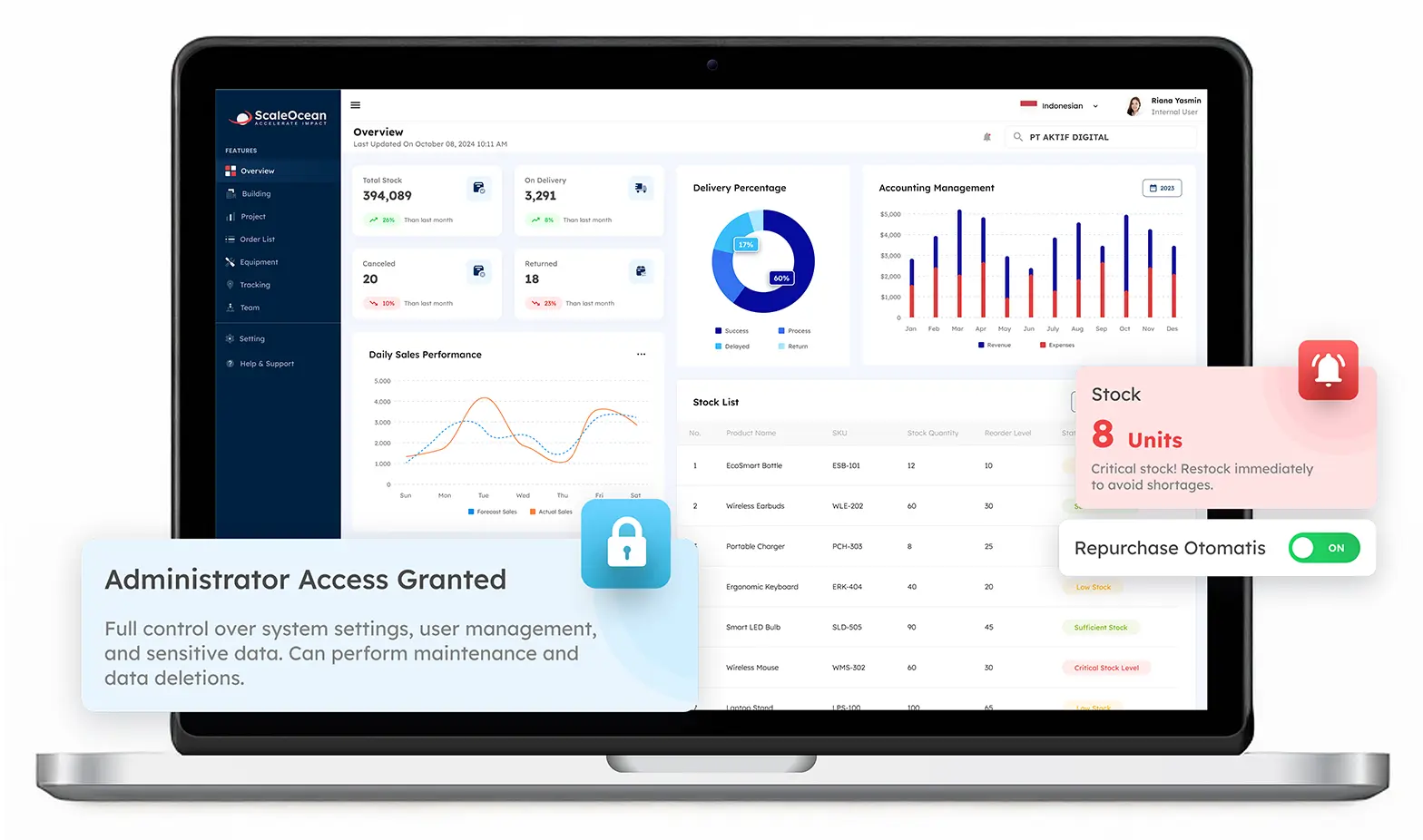
As businesses handle larger volumes of supplier invoices and financial transactions, applying the EWT accurately in daily operations becomes far more challenging. Manual record-keeping can easily result in mis-entered taxes, mismatched payments, and disorganized records.
This is where ScaleOcean Atlas’s accounting module can help by integrating accounting, tax, and financial reporting for Philippine business in a single platform. In addition, it can help increase the accuracy and visibility of its accounting operations with the use of AI-assisted.
Besides, you can learn more about ScaleOcean Atlas by scheduling a consultation with our team to optimize your financial business processes, or learn about its features here:
- Automated BIR Form Generation & AI Deadline Reminders: Automatically populates and generates required EWT forms, including BIR Form 0619-E, 1601-EQ, and 2307, while sending AI-powered reminders ahead of BIR filing deadlines to prevent late penalties.
- Unlimited Users: Additional users require no additional fees and each can be given role-based access, making it easy for internal finance departments and external accounting agencies to collaborate without per-user licensing bottlenecks.
- Multilocation Integration: Consolidates accounting, supplier invoices, and withholding tax data across multiple branches or business locations in real time, giving finance teams a single, unified view.
- AI-Assisted Ledger Posting: Automatically matches transactions with associated accounts and enables proper journal posting, minimizing manual encoding errors and ensuring accurate financial records.
- Tax Invoice Management: Tracks tax invoices, taxable values, EWT amounts, filing periods, and validation issues to streamline BIR tax preparation and reporting.
- Automated Financial Statements & Centralized Cash Flow: Generates real-time balance sheets, income statements, and cash flow reports with variance tracking, giving businesses clearer visibility into payment obligations and cash positions.
In Conclusion
It is not impossible for a business to handle accounting, tax payments, and invoicing at the same time, but the workload can be overwhelming for the finance teams. This is why companies are switching to digital accounting solutions for assistance.
One of those solutions is ScaleOcean Atlas. It optimizes financial processes and ensures the reliability of each transaction. Also, it centralizes your business processes in the cloud which minimizes manual work and makes remote document handling effortless.
Best of all, your files remain protected with strong encryption so your team can access critical data with peace of mind. Ready to simplify your accounting workflows? Schedule a consultation with ScaleOcean Atlas today.
FAQ:
1. What is EWT tax in the Philippines?
Expanded Withholding Tax or EWT is a credit of income tax for the payee that is being deducted by the payor from the payment of certain income and remitted to BIR.
2. Is form 2307 an EWT or CWT?
The certificate covering Creditable Withholding Tax (CWT) is popularly called Expanded Withholding Tax (EWT) and is issued through BIR Form 2307.
3. How to calculate EWT?
The computation of EWT is a simple process where the tax base (amount not billed with VAT) is multiplied by the appropriate BIR withholding tax rate for the income.
4. Is EWT mandatory for all businesses in the Philippines?
For all business purchases, not all transactions are eligible for EWT. But, income payments subject to BIR regulations are subject to tax withholding, whether or not the business is classified as a TWA.