ERP or Enterprise Resource Planning is a system to manage and integrate the essential process of business operations. This system connects different business functions through a shared platform that helps companies coordinate operations more efficiently with accurate data.
Additionally, ERP addresses a major challenge for many businesses, handling large volumes of documents and financial records. In this article, we will explain what ERP is and its benefits for the growth of Philippine businesses.
Key Takeaways
ERP software integrates accounting, inventory, sales, purchasing, manufacturing, and HR into one centralized system, helping Philippine businesses manage operations more efficiently.
The main benefits of ERP include lower operational costs, improved data accuracy, better team collaboration, faster reporting, and centralized business information.
Successful ERP implementation requires careful budgeting, employee training, change management, and accurate data migration to minimize disruptions.
ScaleOcean Atlas connects business operations across inventory, finance, procurement, manufacturing, and other functions, with ScaleMind AI supporting data analysis.
Enterprise Resource Planning (ERP) is a type of business management software that combines various functions into one single system. Typically, these functions are accounting, inventory and stock management, purchasing, sales, manufacturing, payroll and reporting.
Think of ERP as the operational backbone of a business. It links employees, procedures and data that allows departments to work together without the distraction of jumping between stand-alone applications.
ERP trends increasingly focus on online, automated, real-time data access and sharing. For example, a Philippine distributor can use ERP software to process orders from Cebu, check stock levels in a Manila warehouse, and track supplier deliveries, helping teams coordinate operations efficiently.
2. How Does an ERP System Work?
An ERP system works by connecting business functions through a shared database and coordinated workflows. The data for each business function is either entered or retrieved by that part of the business, here is a very simplified illustration of the process:
Data Entry: Employees input data about the business such as purchase orders, customer orders, inventory and financial transactions.
Data Processing: The ERP software manipulates the data based on standard business rules & work flows.
Centralized Database: The system stores business information in a shared database that authorized departments can access.
Module Integration: Different modules, such as finance, sales, inventory, and human resources, exchange relevant information.
Process Automation: The system automates tasks such as invoice generation, purchase order creation, and inventory updates when configured to do so.
Reporting and Analysis: ERP creates reports and dashboards to present managers with information for decision-making and tracking how the business is running.
Example of How an ERP System Works
After understanding how an ERP system works, it’s helpful to walk through its step-by-step process so you can better understand how it manages business operations. To illustrate, imagine a manufacturing company receiving an order from a customer:
Step 1 (Sales): The sales department enters a customer order into the ERP system.
Step 2 (Inventory): The system verifies the availability of the essential products in store.
Step 3 (Production): If stock is insufficient, the production department plans to manufacture the remaining products.
Step 4 (Purchasing): If raw materials are insufficient, the purchasing department orders additional materials from suppliers.
Step 5 (Warehouse): Once the products are ready, the warehouse team prepares and ships the order.
Step 6 (Finance): The finance department records the relevant transactions and processes the customer invoice.
Step 7 (Reporting): Management makes a report on sales, inventory, manufacturing costs, and financial measures.
3. Why is ERP Important?
ERP is especially beneficial when information is decentralized across many applications, departments or sites. Without integration, employees spend time entering the same information twice instead of focusing on tasks that help the business grow.
This is crucial in the Philippines, where small businesses dominate the economy. PSA 2021 data shows micro-businesses comprise 90.5% (977,670) of 1.08 million total operating businesses. Here is why implementing an ERP system is vital for sustainable business growth:
a. Long-Term Cost Savings
ERP eliminates duplicate data entry and automates repetitive tasks. For example, businesses can spot overstocking and transfer inventory before reordering. Total savings ultimately depend on implementation costs and how effectively the system is used.
b. Increased Efficiency and Accuracy
ERP reduces repetitive data entry by connecting transactions and automating routine tasks. When sales, purchase orders, or inventory movements are recorded, related information can be updated automatically and help businesses maintain more accurate records.
c. Streamlines Collaboration
ERP connects sales, finance, purchase and warehouse operation through the general business data. Employees can check stock availability, monitor transactions, and review purchasing needs without waiting for separate reports. This improves coordination, especially for Philippine businesses managing multiple branches or regional suppliers.
d. Faster and Better Automatic Reports
ERP creates reports based on the data of the business you connect it to, so you spend less time gathering spreadsheets and verifying the accuracy of your figures. Managers can monitor sales, spending, inventory turnover and production levels through dashboards. This helps them identify trends and make better-informed reports.
e. Centralized Data and Information
ERP consolidates customer records, product details, supplier information, and transaction histories in one system. Authorized employees can access consistent, up-to-date information, reducing outdated records and improving traceability.
f. Scales with Your Business
ERP allows business expansion with new branches, warehouses, sales channels and workflows. Philippine companies can expand operations while maintaining consistent processes. Additionally, choosing a scalable system with suitable modules helps businesses meet changing needs without paying for unnecessary features.
4. The Benefits of ERP
ERP can also enhance a company’s resources planning, customer service, and business growth. The greatest advantages are achieved when the software solves operational problems rather than just creating an electronic version of paperwork. Some of the key advantages are:
a. Better Inventory Control
ERP helps track stock movements, current balances, and replenishment requirements across warehouses or branches in real time. Having centralized visibility prevents stockouts, reduces holding costs, and optimizes reorder points, ensuring products are always available when needed.
b. More Coordinated Purchasing
Secondly, having ERP in place streamlines the supplier ordering process and brings them in direct relation to the actual inventory requirements, production schedules, and demand forecasts. Automated requests and vendor tracking help procurement teams avoid over-purchasing, shorten lead times, and secure better terms.
c. Improved Financial Visibility
Another benefit is, ERP can connect sales, purchasing, expenses, and accounting records into a single ledger. Unifying these functions gives leaders clear insights into cash flow and profitability while streamlining audits, compliance, and period-end financial closings.
d. Smoother Customer Service
Give customer-facing teams immediate access to live order statuses, stock availability, and transaction histories. Equipping support staff with accurate, centralized data enables them to answer inquiries quickly, resolve issues, and deliver a reliable customer experience.
e. Stronger Production Planning
ERP enables manufacturers to track raw materials, bill of materials, production orders and finished goods. Increased visibility into production cycles enables plant managers to avoid downtime, improve labour capacity and retain quality for on-time delivery.
f. More Informed Decisions
In addition, ERP utilizes consolidated reports, business analytics, and interactive dashboards to spot operational bottlenecks and trends.Having one single version of the truth gives executives the ability to make confident decisions based on data, rather than waiting until the spreadsheet report arrives.
g. More Consistent Workflows
Moreover, ERP also standardizes recurring activities and operational procedures across all departments and branch locations. Uniform work processes reduce the risk of human errors, adhere to all the regulations, and foster efficient team collaboration.
5. Types of ERP Software
There are several types of ERP software based on the way they are hosted, accessed, maintained, and licensed. Following are the four common types of ERP software that are mostly used for business:
1. On-Premise ERP
The first type is on-premise Enterprise Resource Planning, which is installed on a company’s own servers. With On-Premise ERP, the organization’s internal or external IT team handles all security, maintenance and update requirements.
This configuration provides the most control of the infrastructure, and can be used for a variety of technical or security requirements. It does, however, come with a high initial investment of servers, licenses and regular hardware upgrades.
Best for: Organizations with dedicated IT resources that require full control over their own infrastructure.
2. Cloud ERP
Hosted online and accessed via the web, Cloud Enterprise Resource Planning offloads server maintenance, security, and updates to the vendor. It reduces initial investments in hardware and provides hassle-free access at any location or for remote teams.
However, businesses need to consider the reliability of the internet, subscription fees, vendor support and data privacy policies. Also, ensure that there is backup offline workflows as well for uninterrupted operations.
Best for: Growing businesses wanting multi-location access with low infrastructure maintenance.
3. Hybrid ERP
Hybrid ERP blends local servers with cloud services. Companies can keep core systems on-premise while adopting cloud applications for reporting, sales, or collaboration, allowing for a gradual digital transition.
However, the biggest problem is the complexity of the systems. It’s because integrations, access control, and data synchronization need to be managed, as there is a risk of inconsistencies between local and cloud environments.
Best for: Businesses modernizing operations in phases while preserving critical legacy systems.
4. Open Source ERP
The fourth type is open source ERP, it grants access to its underlying source code, allowing internal technical teams to freely inspect, modify, and customize the system to match unique business workflows.
While software licenses may be free, operations are not. For example, hosting, custom development, security, and ongoing updates still require significant investment and skilled developers.
Best for: Tech-savvy organizations looking for high customizability and prepared to deal with continuous coding upkeep.
6. ERP Implementation Challenges
Enterprise Resource Planning can benefit business operations but it isn’t just about buying software and setting up user accounts. It is important to be aware of the typical challenges in the early stages to minimize disruption and maximize the rollout’s success.
a. High Upfront Costs
ERP implementation involves software licenses, configuration, data migration, training, and ongoing support, alongside hardware costs for on-premise setups. The total ERP cost should also include the possibility of currency exchange exposure and unanticipated fees for custom features among other considerations by Philippine companies.
How to address it: The total ERP cost should also include the possibility of currency exchange exposure and unanticipated fees for custom features among other considerations by Philippine companies.
b. Employee Training
After all, employees need to be familiar with the ERP system and their new roles in the changed workflow. If staff are not trained, they could enter incorrect information, forget to follow standard procedures or switch back to manual spreadsheets, resulting in delays in the process between departments.
How to address it: Real-life business tasks for role-based training, such as tasks in a warehouse or finance reporting. Assign internal department champions to help team members, answer common questions and help with a smooth system rollout post launch.
c. Resistance to Change
Staff tend to engage in routine behaviors and practices, many of which are repetitive and ineffective. When implementing standardized ERP workflows, there is a possibility of higher workloads or reduced flexibility that may result in interdepartmental conflicts during the implementation process.
How to address it: Communicate the primary value of the change to each department. Engage team members in testing, provide regular and accurate communications and implement staged rollouts for staff to adapt to.
d. Traditional Data Conversion Issues
Migrating data from spreadsheets or legacy software often uncovers duplicate records, missing entries, outdated customer files, and messy item codes. Transferring unverified data directly weakens new system accuracy, causing reporting errors across operations.
How to address it: Clean and standardize all records before migration by reconciling financial balances, updating contact lists, and testing sample transactions. Philippine multi-branch companies must also align item codes and measurement units across all regional sites.
7. When Should You Consider an ERP?
Not all businesses require an entire ERP software straight away. When disjointed systems start to hinder visibility, coordination, or expansion, the necessity of ERP becomes more evident. If you notice your business is facing any of the following, consider looking into ERP:
Information is scattered: There are various spreadsheets or applications used by employees which increases the chances of the wrong figures being used.
Inventory discrepancies occur frequently: There are various spreadsheets or applications used by employees which increases the chances of the wrong figures being used.
Reporting takes too long: Managers spend hours gathering data and reconciling reports before being able to make decisions.
Manual work is increasing: Orders, invoices, supplies or stock movements are frequently entered into different systems over and over.
Operations span multiple locations: There is a need for more standardized information and/or processes on branches, warehouses, or production sites.
Growth is becoming harder to manage: Increased transaction volumes, new products or new sales channels lead to operational bottlenecks.
Compliance records need better control: The business needs more reliable transaction histories, document retention, and accounting processes.
8. Implement ScaleOcean Atlas – The Best ERP in the Philippines
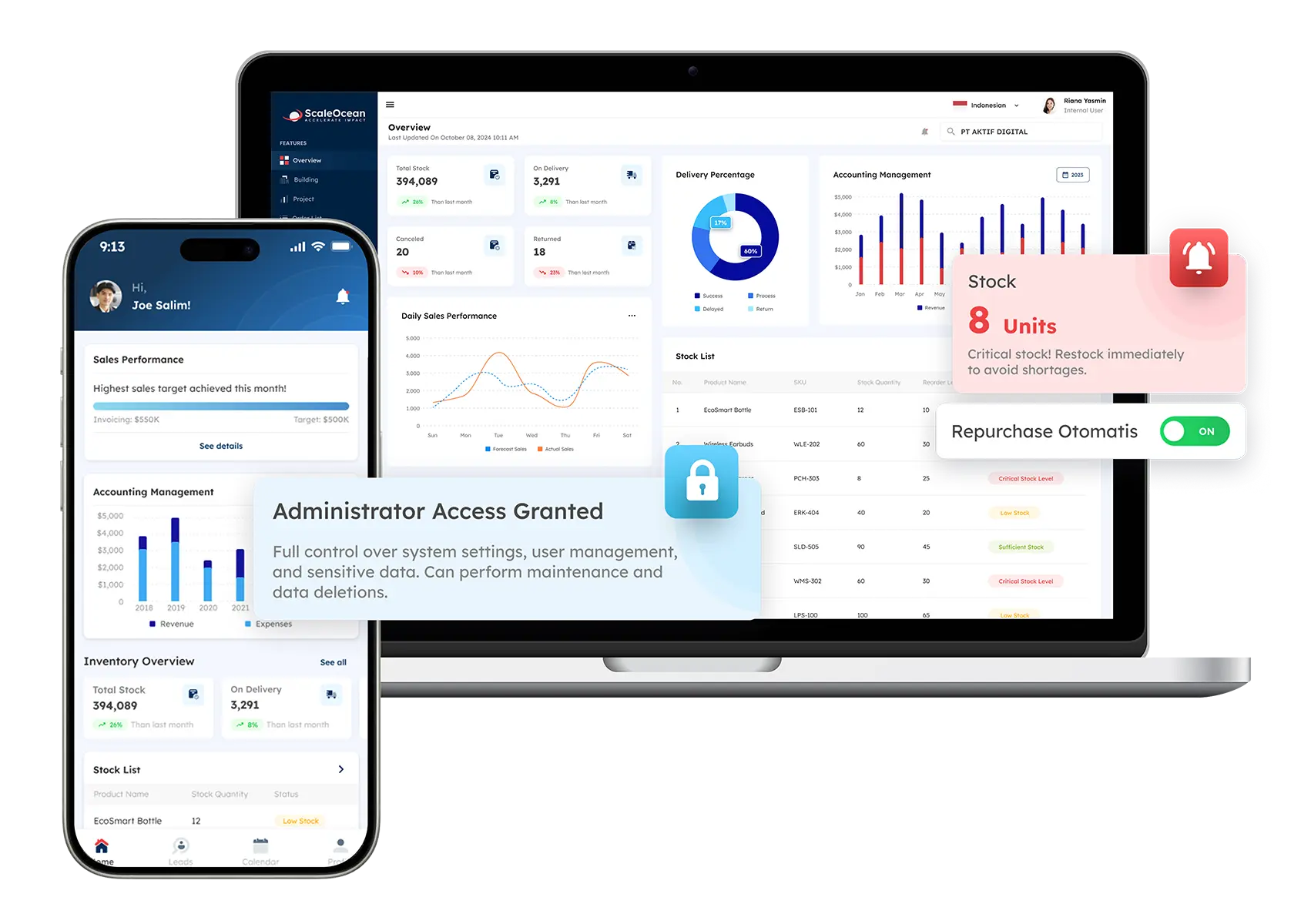
For businesses seeking to streamline operations and improve cross-department collaboration, ScaleOcean Atlas offers a comprehensive ERP platform that unites your core business processes in a single system.
Rather than treating every company as if it operates the same way, ERP selection should begin with the actual workflows that need improvement. ScaleOcean Atlas adapts to your business, supporting operations across finance, inventory, procurement, sales, manufacturing, logistics, HR, and project management.
Additionally, ScaleOcean Atlas is powered by ScaleMind AI, an advanced tool designed to enhance data analysis and automate operational workflows. ScaleMind AI helps your team unlock actionable insights and make faster, smarter decisions.
Schedule a consultation with the ScaleOcean team today to optimize your business workflows. To learn more, explore our key features below:
Connected operations: Bring relevant business functions together so authorized teams can work with shared information.
Inventory and warehouse visibility: Monitor stock movements and inventory records to support replenishment and order fulfillment.
Industry-specific workflows: Evaluate modules designed for sectors such as manufacturing, distribution, retail, construction, and logistics.
Reporting and decision support: Use business reports and dashboards to review operational performance and identify areas requiring attention.
Adaptability: Assess whether the available configuration, integrations, and modules can accommodate your company’s processes as requirements change.
9. In Conclusion
An ERP platform allows companies to have all manual processes and various systems replaced by one integrated system. With the consolidation of accounting, inventory, procurement, manufacturing and HR, teams have their one source of truth and real-time visibility for smarter decision making.
In the end, there’s no one-size-fits-all solution for ERP; it’s about what a business needs for its workflows, reporting requirements, and growth. Planning around costs, data migration and team training are key components to a successful transition.
ScaleOcean Atlas provides a flexible solution that can be customized to fit your needs, making it an ideal choice for businesses in the Philippines that want to connect their operations. Look at its core modules, match them with your business objectives and get a consultation today to see how it can propel you forward in your next phase of growth.
FAQ:
1. What is Enterprise Resource Planning?
ERP or Enterprise Resource Planning is a single software platform that allows businesses to coordinate, streamline and automate their critical business processes throughout the organization.
2. What are the 5 components of ERP?
The five main ERP components are financial management, human resource management, supply chain management, customer relationship management (CRM), and business intelligence.
3. What are the main benefits of ERP?
The benefits of an ERP are to unify company data, streamline collaboration, improve inventory control, automate routine processes, and provide real-time insights for better decision-making.
4. Is ERP the same as CRM?
No, ERP manages internal business operations like finance and inventory, whereas CRM focuses specifically on managing customer interactions, sales pipelines, and support.
5. What are the steps of ERP implementation?
ERP implementation typically involves project planning, workflow analysis, system design and configuration, data migration, thorough employee training, system testing, and go-live deployment followed by ongoing support.













 Key Takeaways